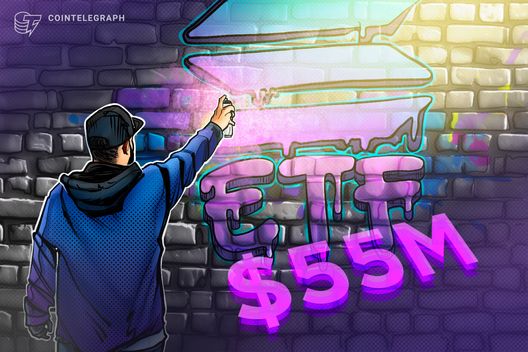
Bitwise Solana Staking ETF notches $55M trading volume on debut
Bitwise’s Solana staking ETF saw $55.4 million on its first day, the highest of all crypto ETFs this year, alongside the launch of Hedera and Litecoin ETFs from Canary Capital.
Litecoin
Global Crypto Adoption Report 2025
The post Global Crypto Adoption Report 2025 appeared first on Coinpedia Fintech News Cryptocurrency adoption has surged in 2025, driven by both institutional and grassroots participation across diverse economies. While high-income countries focus on regulatory frameworks and investment products, lower- and middle-income nations lead in […]
Research report
SEC silent on Canary Litecoin ETF amid US government shutdown
The US SEC has seemingly missed its decision deadline for the Canary Litecoin ETF, adding to uncertainty amid a government shutdown and new generic listing standards.
Litecoin
How to buy food with Bitcoin?
Key takeaways In 2025, you can have your digital wallet ready to pay with Bitcoin directly at 15,000 merchants and restaurants worldwide. Whether you’re using your own Bitcoin wallet to pay directly at accepting merchants or pay with cards, you’ll find plenty of options to […]
Analysis
Key takeaways
- In 2025, you can have your digital wallet ready to pay with Bitcoin directly at 15,000 merchants and restaurants worldwide.
- Whether you’re using your own Bitcoin wallet to pay directly at accepting merchants or pay with cards, you’ll find plenty of options to buy food with Bitcoin.
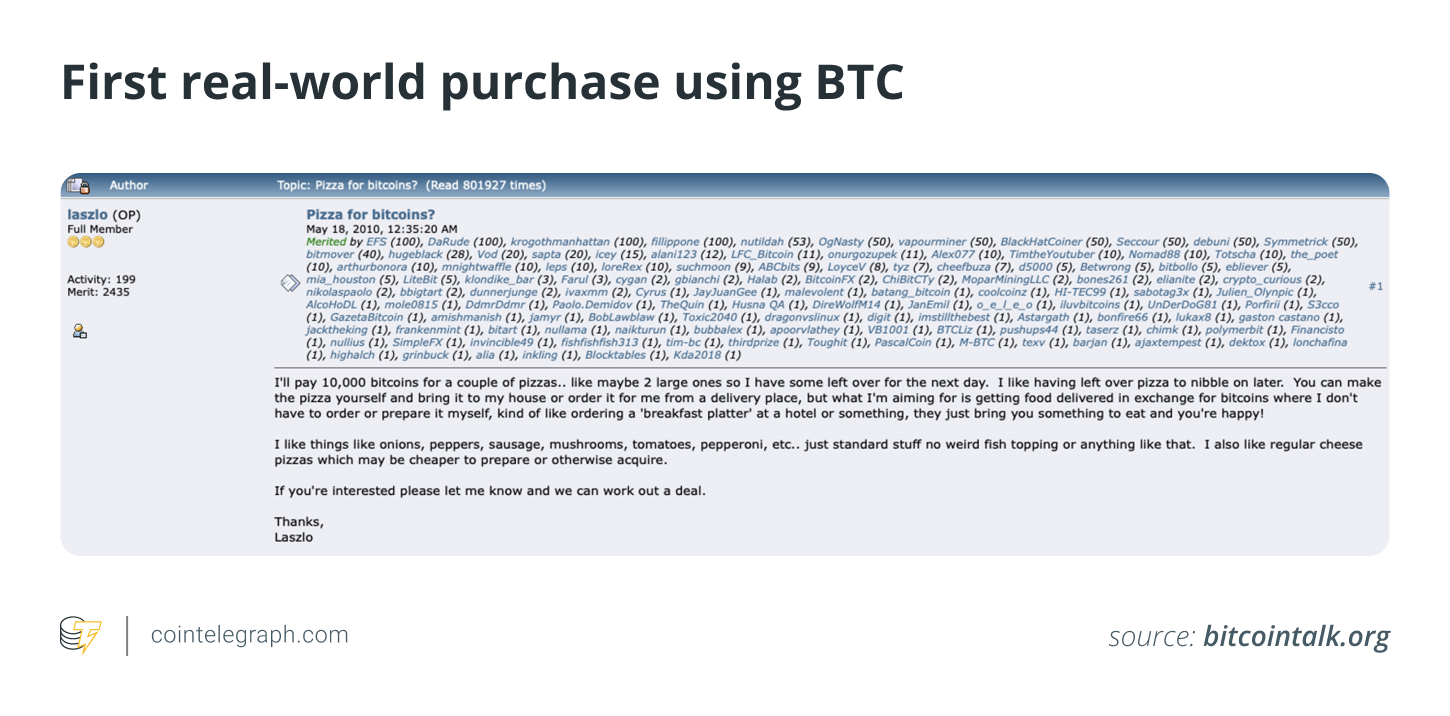
- Bitcoin has evolved since Laszlo Hanyecz’s first purchase of food. A new whole payment structure has formed around Bitcoin, with innovative creative ways to use it to pay for food.
- Bitcoin payment processors, such as Bitrefill and BitPay, are now known globally. They handle thousands of transactions each month.
As Bitcoin becomes more accepted worldwide, many retailers, restaurants and food delivery services are embracing it. They now allow customers to pay for food with Bitcoin (BTC).
You can still buy food with Bitcoin, even if merchants don’t accept it directly. Use methods like crypto cards or crypto gift cards to make your purchase.
Bitcoin has long been recognized as a strong store of value, but its potential goes beyond that. As the world moves toward greater decentralization, Bitcoin is increasingly positioned to challenge traditional payment systems that rely on third-party approval. The primary purpose of Bitcoin is to bypass banks and financial institutions and enable direct payments with no censorship or confiscation.
Bitcoin’s creator, Satoshi Nakamoto, created a peer-to-peer electronic cash system to make people more independent from financial intermediaries, so you may as well start using the cryptocurrency as intended.
This article will show you how to pay for food with Bitcoin. You’ll learn different methods for grocery stores, restaurants and food retailers, both in-store and online.
Did you know? The first Bitcoin transaction to buy food was executed by Laszlo Hanyecz on May 22, 2010, which later became the famous Bitcoin Pizza Day. He paid 10,000 BTC for two pizzas, worth $40 at the time.
Can you buy food with Bitcoin?
The short answer is yes, definitely. Depending on the country you’re in, there may be different options presented to you.
The benefit of using a Bitcoin payment for food directly is to avoid the intermediary and higher costs while performing a pure Bitcoin transaction as Satoshi had intended.
Although most merchants do not accept BTC as payment yet, Bitcoin cards, gift cards and food delivery portals that accept Bitcoin, even indirectly, are pretty much available everywhere.
All you need to do is refill the card with some cryptocurrency, and the payment processor will directly exchange Bitcoin for local currency.
1. Pay for your food via direct Bitcoin payments
Although the number of merchants accepting Bitcoin is increasing globally, very few are still fully embracing the cryptocurrency as a payment method. When Bitcoin is accepted, normally, a Lightning wallet is used for fast payments and very low fees.
You can visit https://btcmap.org/ to find Bitcoin-friendly food companies around the world. Just choose a nearby area to see where you can use the digital currency.

Depending on the jurisdiction, fast food companies that accept Bitcoin include groups like Burger King and Subway. McDonald’s fully accepts BTC as a direct payment in El Salvador and as a pilot program in Lugano, Switzerland.
You can also pay with Bitcoin at specific restaurants such as Mastro’s (at selected US locations) and Tahini’s, a Canadian-Middle Eastern chain with some US presence. This crypto-friendly restaurant even holds Bitcoin as a reserve asset.
Accepting Bitcoin directly for online orders is less common unless the merchants partner with a delivery service that supports crypto. It’s possible to pay with Bitcoin for food delivery at companies like Manufy in the US that also accept Bitcoin directly.
You can also buy groceries with crypto directly at many Bitcoin-friendly grocery stores. Whole Foods in the UK, US and Canada accepts BTC via the Flexa network’s Spedn app at specific locations. One of South Africa’s largest grocery retailers, Pick n Pay, is a supermarket accepting Bitcoin payments. It rolled out Bitcoin payments across many of its stores following a successful pilot.
El Salvador is deservedly known as a Bitcoin country, and in most cases, restaurants, grocery stores and online retailers allow their customers to pay with Bitcoin directly.
Many small municipalities are adopting Bitcoin as a widely used currency. Other than El Salvador, in places like Lugano, Switzerland and Mossel Bay, South Africa, many merchants, mostly small retailers, accept Bitcoin as a legitimate method of payment.
How to pay with Bitcoin directly
- You can download a custodial or non-custodial Lightning wallet directly on your mobile.
- Transfer some Bitcoin there to pay for everyday expenses.
- Position your wallet to scan merchant QR codes.
- Your purchase finalizes in just a few seconds.
Did you know? Subway was the first major food chain to accept Bitcoin. The first Bitcoin purchase at a Subway occurred in 2013 in Moscow, Russia.
2. Bitcoin cards, an alternative way to pay for your food
Many services offer Bitcoin-funded debit cards that convert Bitcoin to fiat at the point of sale. BitPay, Wirex and Binance are well-known companies. They support Bitcoin and crypto payments at grocery stores like Walmart. They can also convert cryptocurrency into various currencies.
The benefit of Bitcoin cards is that the conversion into fiat is instant, without the need for the store to accept Bitcoin directly. The crypto card provider partners with companies like Visa and Mastercard to make sure that your card is accepted by the vast majority of vendors and merchants.
How to pay with Bitcoin cards
- Sign up with one of the crypto card services available.
- Link your Bitcoin wallet.
- Add funds.
- Use the card at selected merchants by swiping it at checkout like a normal card.
- Connect the card to your Apple or Google Pay to pay directly with your mobile.
How to use Bitcoin gift cards to pay for food
Bitcoin gift cards are Bitcoin vouchers that you can buy to purchase food from popular delivery platforms like Uber Eats, DoorDash or Grubhub. Services like BitPay, CoinGate and Bitrefill let you order food online with Bitcoin.
Bitcoin gift cards are also widely used for grocery shopping at Walmart, Whole Foods, Safeway and Lidl. The gift cards can be used for shopping in-store or online services, or pick-up or delivery.
How to pay with Bitcoin cards
- Buy the card with Bitcoin at selected stores or platforms.
- Receive the digital gift card.
- Choose the merchant you want to pay with the gift card.
- Pay at the checkout with the gift card.
Paying with Bitcoin gift cards is one of the most widely available methods, particularly helpful when the chosen restaurant or merchant doesn’t accept crypto directly yet.
Precautions when paying with Bitcoin for food
While Bitcoin offers a convenient and decentralized payment method, it’s essential to take certain precautions to ensure a safe and smooth transaction:
- Security of wallet: Always use a trusted and secure Bitcoin wallet, whether custodial or non-custodial, to store your cryptocurrency. Ensure your wallet’s private keys are kept safe and inaccessible to unauthorized users.
- Transaction fees: While Bitcoin payments are designed to be cheaper than traditional payment methods, transaction fees may still apply, especially when using the Lightning Network for fast payments. Be aware of the fees associated with each payment method.
- Merchant reliability: Ensure that the merchant or restaurant you’re purchasing from is legitimate and accepts Bitcoin through trusted payment processors. Avoid using random or unverified third-party services.
- Bitcoin volatility: Bitcoin’s price can fluctuate rapidly, so be prepared for potential price changes between when you make your payment and when the merchant processes it. This is especially true when converting Bitcoin to local fiat currencies.
- Regulations and acceptance: Depending on your location, some regions may have different regulations surrounding Bitcoin payments. Make sure you are aware of local cryptocurrency laws and whether merchants in your area are legally allowed to accept Bitcoin.
Remember, the security of your funds is just as important as how you use them. Taking precautions now will ensure your assets remain safe while enjoying the convenience of paying with Bitcoin.

XRP, ADA, SOL go parabolic after Trump US crypto reserve post: Will other altcoins follow?
Bitcoin (BTC) witnessed solid buying over the weekend as US President Donald Trump announced that Bitcoin, Ether (ETH), XRP (XRP), Solana (SOL) and Cardano (ADA) would be included in a crypto strategic reserve. The announcement massively pumped the chosen coins, which made it risky for […]
Litecoin
Bitcoin (BTC) witnessed solid buying over the weekend as US President Donald Trump announced that Bitcoin, Ether (ETH), XRP (XRP), Solana (SOL) and Cardano (ADA) would be included in a crypto strategic reserve. The announcement massively pumped the chosen coins, which made it risky for a fresh entry after the rally. The coins in this article have been selected for their technical setups rather than the Trump-based pump.
Apart from the crypto strategic reserve, in a sign that could create new demand for Bitcoin, BlackRock added the iShares Bitcoin ETF Trust (IBIT) to its $150 billion model portfolio, according to a Bloomberg report. The global investment firm is adding 1% to 2% allocation to portfolios that allow for alternative assets. This move opens the doors for a potential new demand for the Bitcoin ETF.
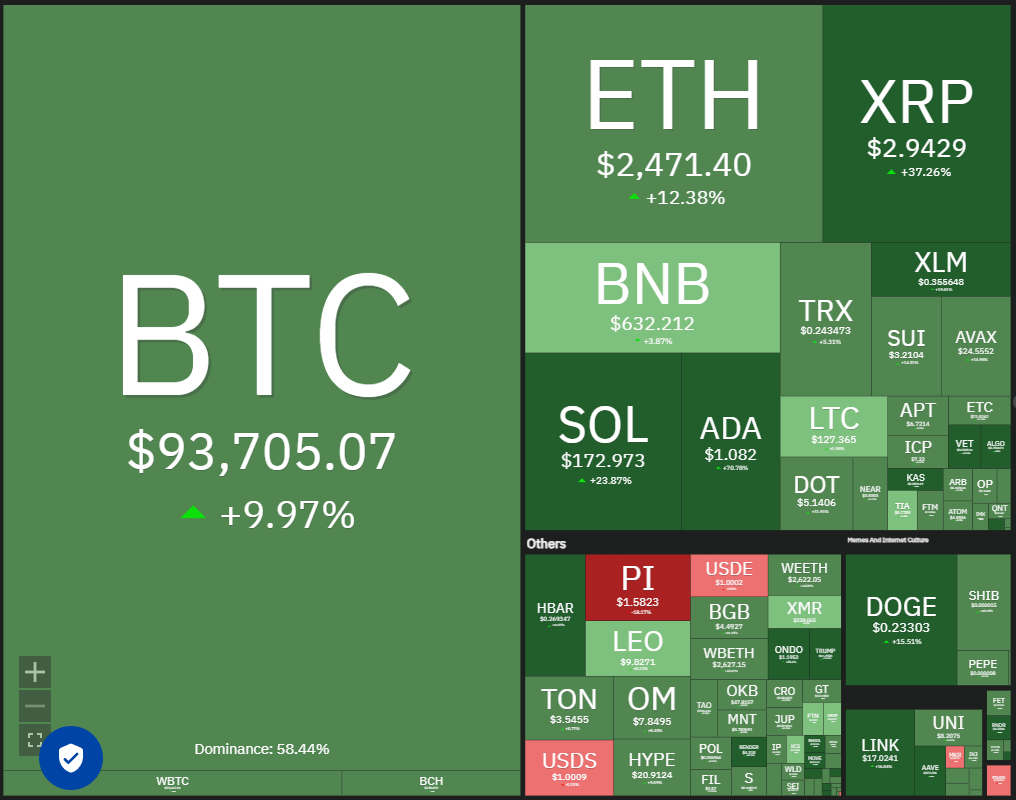
Crypto market data daily view. Source: Coin360
However, some analysts believe that Bitcoin could witness some more pain in the near term. They anticipate Bitcoin to drop near $70,000 before starting the next leg of the bull move. Nexo dispatch analyst Iliya Kalchev told Cointelegraph that Bitcoin could “establish firm support in the $72,000 to $80,000 range.”
Could Bitcoin manage to hold above $90,000? If that happens, select altcoins apart from the ones chosen for the crypto strategic reserve may find buyers. Let’s look at the top cryptocurrencies that look strong on the charts.
Bitcoin price analysis
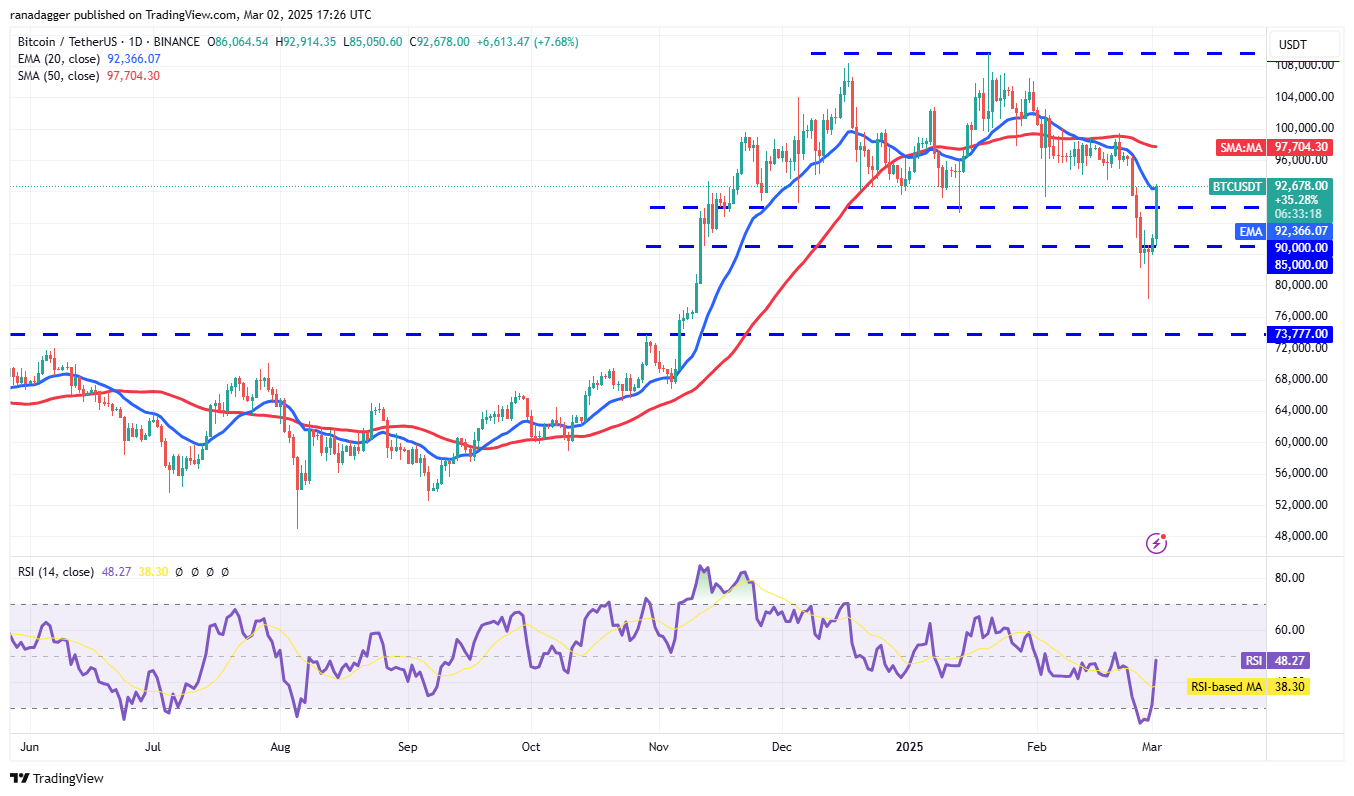
Bitcoin has reached the 20-day exponential moving average ($92,366), indicating aggressive buying at lower levels.
BTC/USDT daily chart. Source: Cointelegraph/TradingView
Sellers will try to stall the relief rally at the 20-day EMA. If the price turns down from the 20-day EMA, the BTC/USDT pair could drop to $85,000, which is a crucial support to watch out for.
If the price rebounds off $85,000, the pair could rise above the 20-day EMA. The pair may then rally to the 50-day simple moving average ($97,704). Such a move will signal that the pair may have bottomed out in the near term.
If bears want to retain the advantage, they will have to swiftly pull the price below $83,000. If they manage to do that, the pair could retest the critical $78,258 support.
BTC/USDT 4-hour chart. Source: Cointelegraph/TradingView
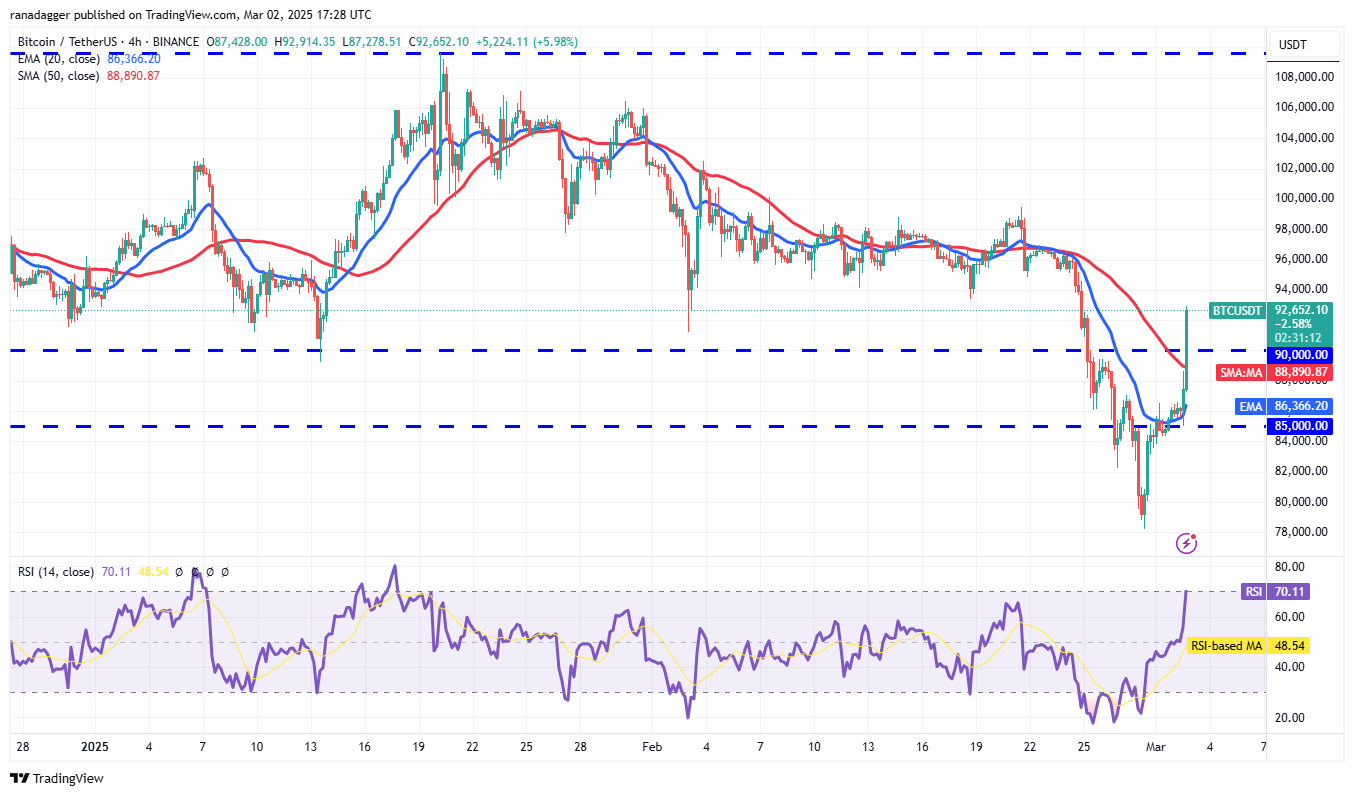
The 20-EMA has started to turn up on the four-hour chart, and the relative strength index (RSI) has jumped into the overbought zone, indicating that the bulls are on a comeback. If the price remains above $90,000, the pair could climb to $96,000 and then $100,000.
The first sign of weakness will be a break below the 50-simple moving average. That could sink the pair to the 20-EMA, which is likely to attract buyers. The bears will be back in the driver’s seat if they pull the pair below $83,000.
Hedera price analysis
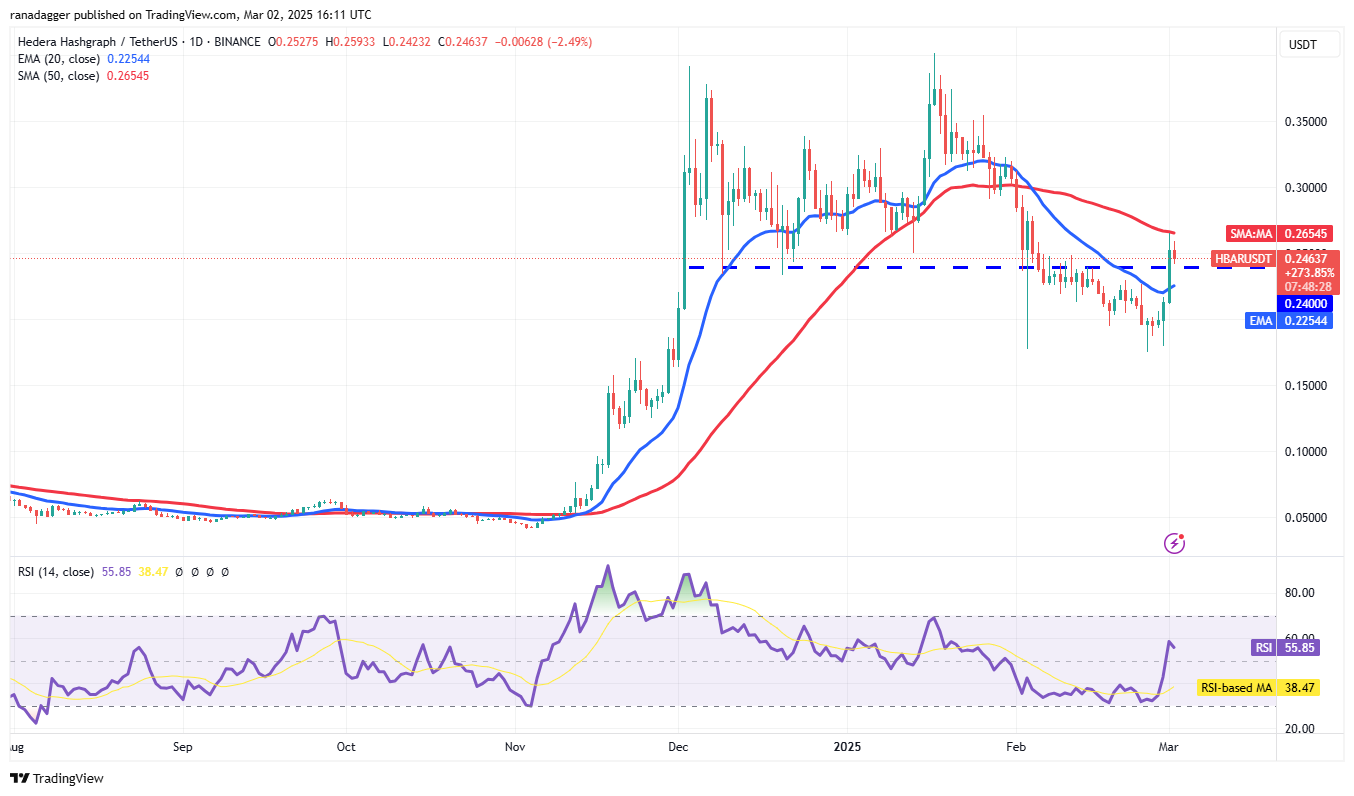
Hedera (HBAR) rose above the 20-day EMA ($0.22) and reached the 50-day SMA ($0.26) on March 1.
HBAR/USDT daily chart. Source: Cointelegraph/TradingView
The 20-day EMA is the critical support to watch out for on the downside. If the price rebounds off the 20-day EMA, it will signal a change in sentiment from selling on rallies to buying on dips. The bulls will again try to propel the HBAR/USDT pair above the 50-day SMA. If they can pull it off, the pair may rise to $0.32.
Contrarily, a break and close below the 20-day EMA suggests that the bears remain sellers on rallies. The pair may slump to $0.18, where the bulls will try to arrest the decline.
HBAR/USDT 4-hour chart. Source: Cointelegraph/TradingView
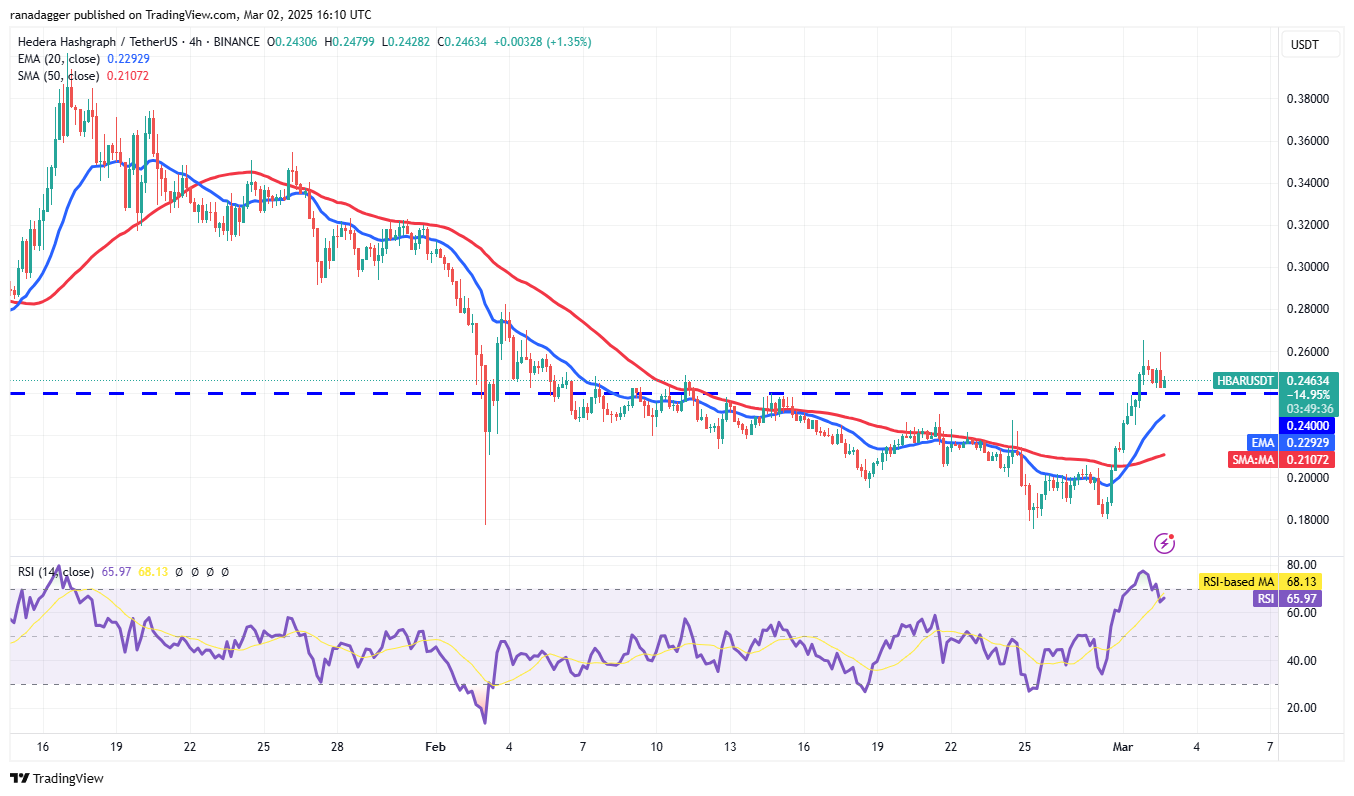
The pair turned down from $0.26 but is likely to find support at the 20-EMA on the four-hour chart. If the price rebounds off the 20-EMA with force, it will signal buying on dips. That improves the prospects of a rally to $0.28.
Instead, if the price continues lower and breaks below the 20-EMA, it will suggest that the bulls are losing their grip. The pair may tumble to the 50-SMA, which is likely to act as strong support.
Litecoin price analysis
Litecoin (LTC) has been trading inside a symmetrical triangle pattern, indicating indecision between the buyers and sellers.
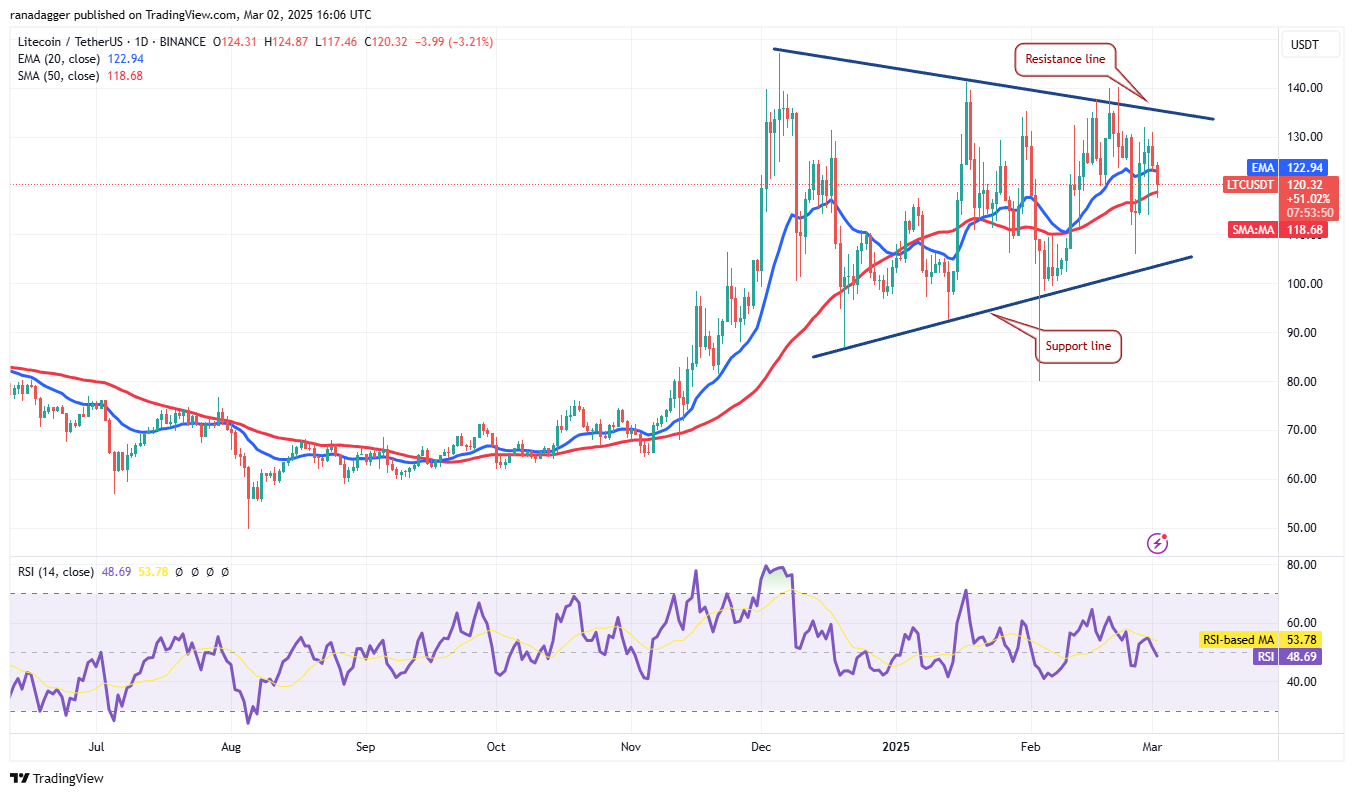
LTC/USDT daily chart. Source: Cointelegraph/TradingView
The flattish 20-day EMA ($122) and the RSI near the midpoint do not give a clear advantage either to the bulls or the bears. If the price rises and sustains above the 20-day EMA, the bulls will try to push the LTC/USDT pair above the resistance line. If they succeed, the pair may rise to $147.
Contrarily, a close below the moving averages suggests that the short-term advantage has tilted in favor of the bears. The pair may skid to the support line, which is a crucial level for the bulls to defend because a break below it may sink the pair to $86.
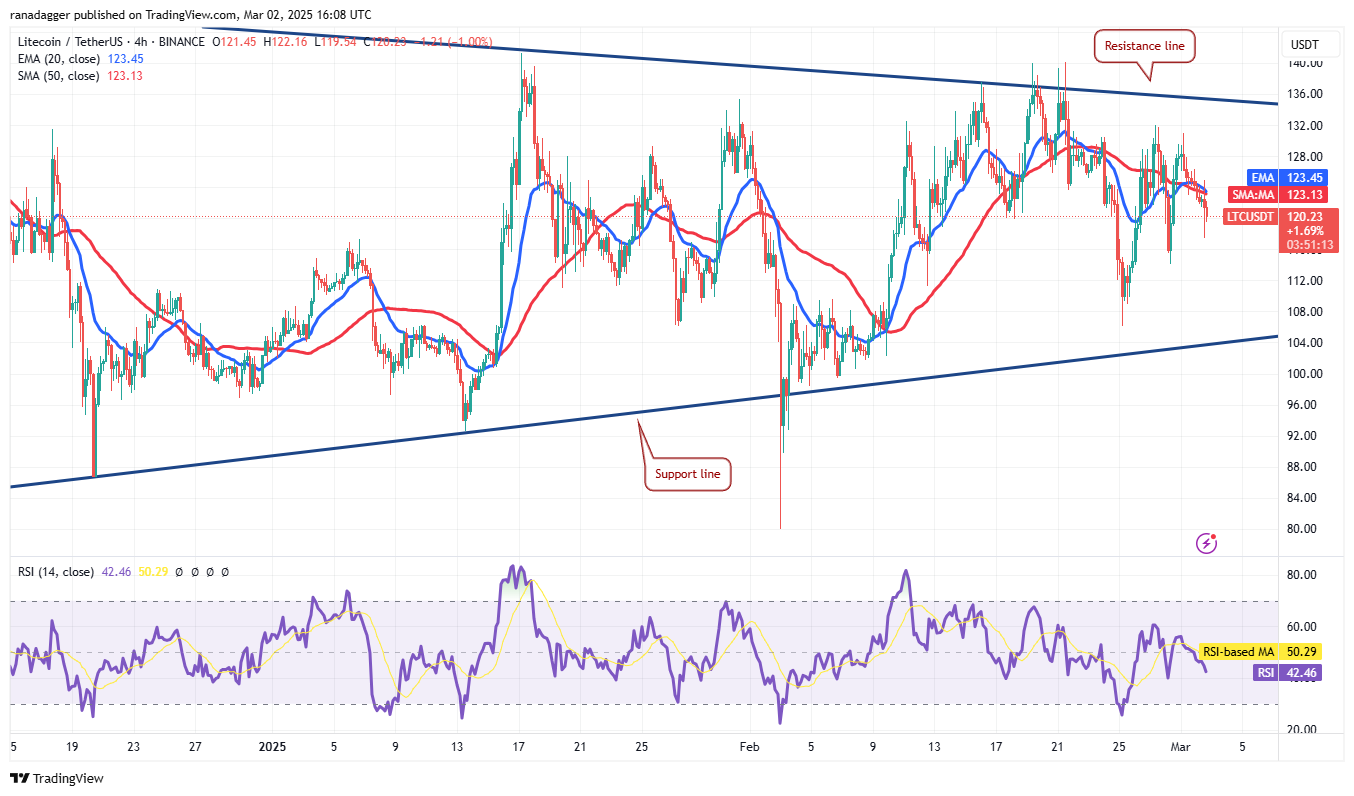
LTC/USDT 4-hour chart. Source: Cointelegraph/TradingView
The pair has dipped below the moving averages on the four-hour chart, indicating that the bears are trying to take charge. If the price sustains below the moving averages, the pair could descend to $114 and then to the support line.
Buyers will have to push and maintain the price above the moving averages to open the doors for a rise to $132 and later to the resistance line. The up move could pick up momentum after the price closes above the resistance line.
Related: Here’s what happened in crypto today
Monero price analysis
Monero (XMR) bounced off the $205 level and rose above the moving averages, signaling solid buying on dips.
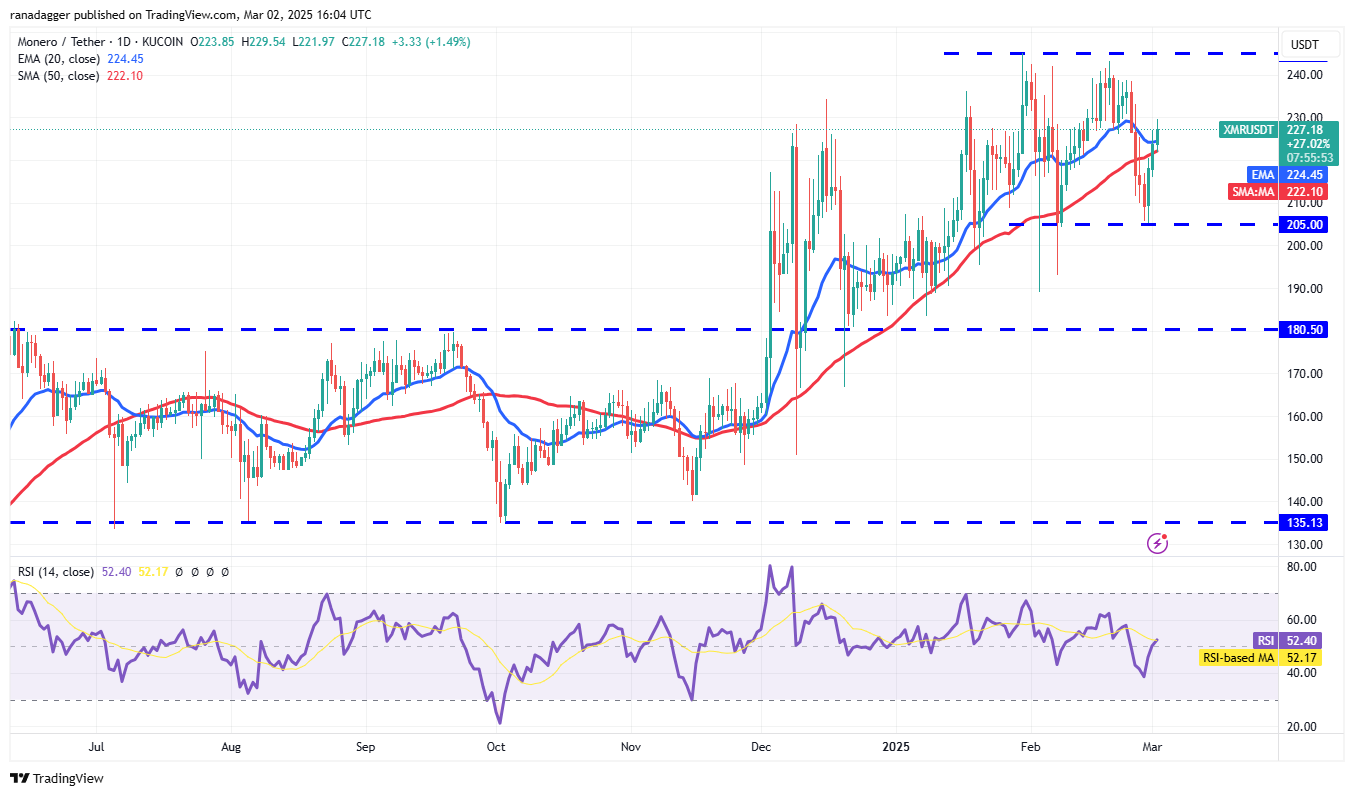
XMR/USDT daily chart. Source: Cointelegraph/TradingView
The flattish 20-day EMA ($224) and the RSI near the midpoint suggest that the XMR/USDT pair may swing between $205 and $245 for a few days. If the price stays above the 20-day EMA, the pair could retest the $245 resistance.
On the contrary, if buyers fail to maintain the price above the moving averages, it will suggest a lack of demand at higher levels. The bears will then try to pull the price down to the support of the range at $205.
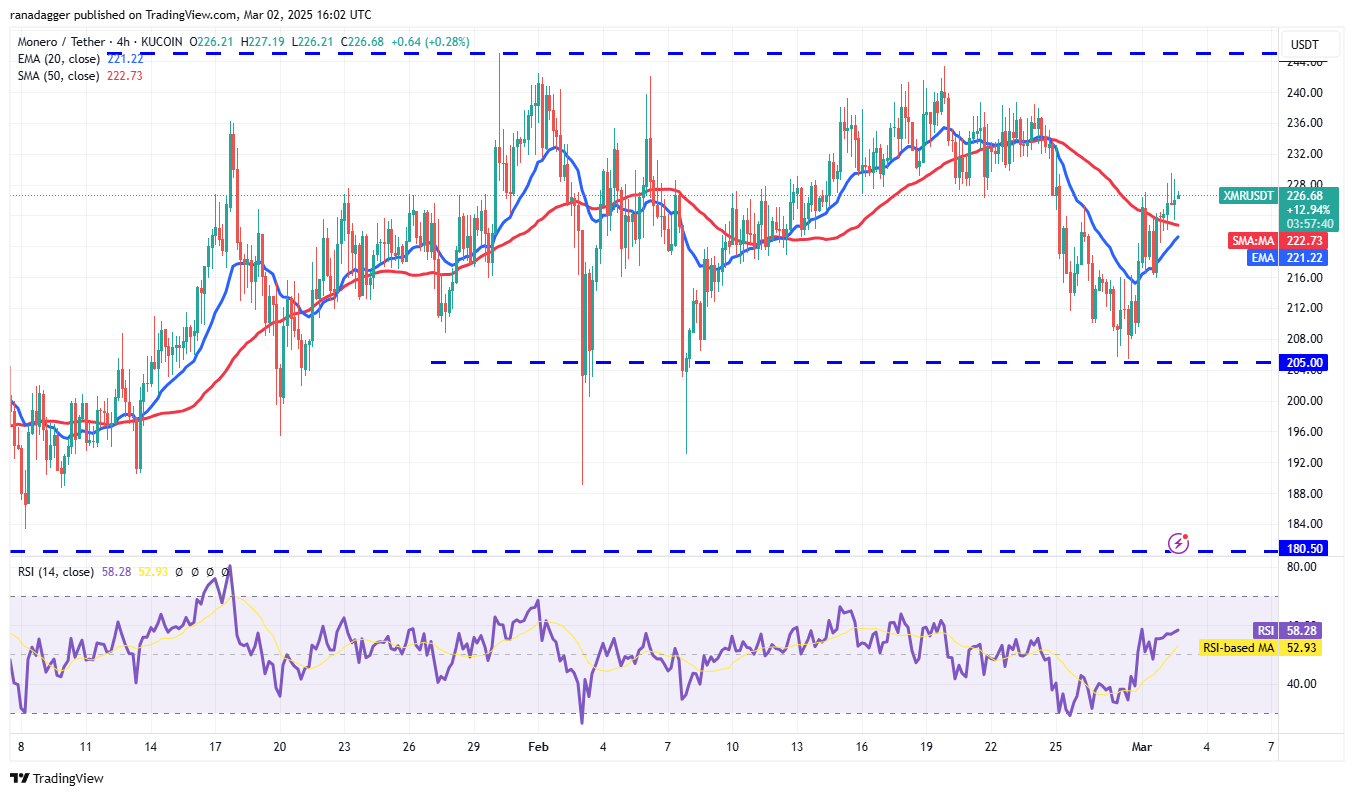
XMR/USDT 4-hour chart. Source: Cointelegraph/TradingView
The 20-EMA has started to turn up on the four-hour chart, and the RSI is in the positive zone, indicating an advantage to buyers. The pair could rise to $238, where the bears are expected to step in.
On the downside, a break and close below the 20-EMA suggests that the bears are back in the game. The pair may slide to $216, and if this level cracks, the next stop could be the solid support at $205.
Celestia price analysis
Celestia (TIA) has risen above the moving averages, and the bulls are trying to sustain the price above the breakdown level of $4.14.
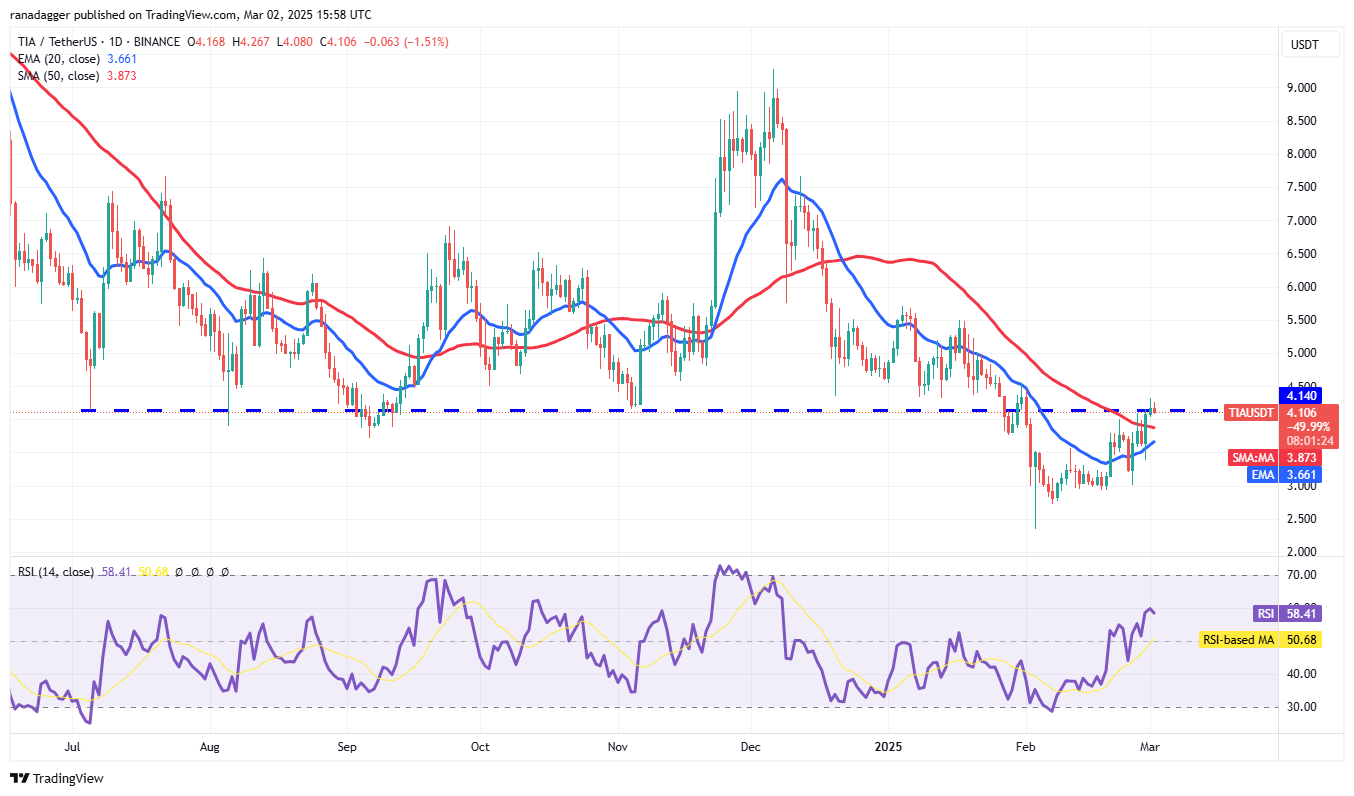
TIA/USDT daily chart. Source: Cointelegraph/TradingView
If they manage to do that, it will signal that the markets have rejected the breakdown. There is minor resistance at $4.50, but if the level is crossed, the TIA/USDT pair could climb to $5.50. Sellers are expected to defend the $5.50 level aggressively.
This positive view will be invalidated in the near term if the price turns down and breaks below the 20-day EMA ($3.66). That could sink the pair to $3 and subsequently to $2.72. Such a move will suggest that the bears have flipped the $4.14 level into resistance.
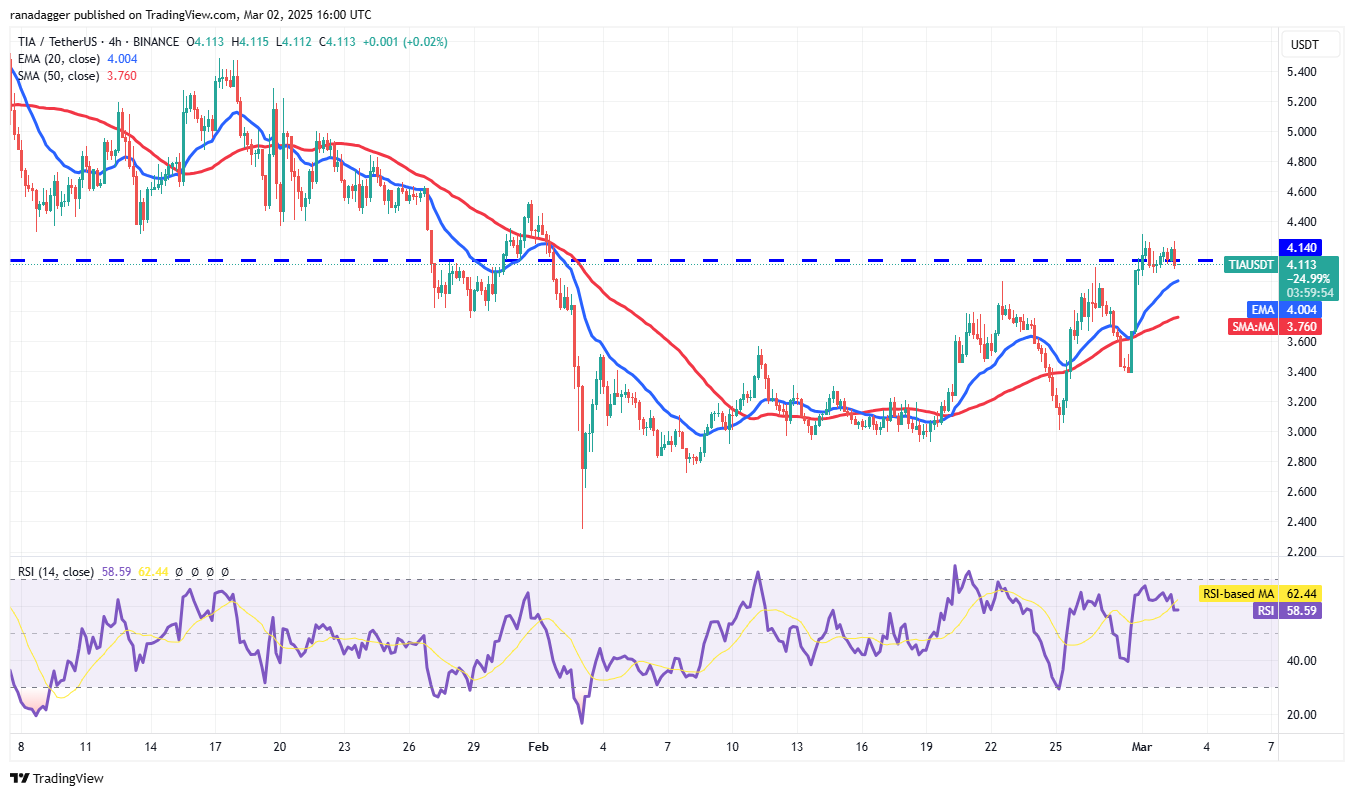
TIA/USDT 4-hour chart. Source: Cointelegraph/TradingView
Both moving averages have started to turn up, and the RSI is in positive territory on the four-hour chart, indicating an advantage to buyers. The first sign of weakness will be a break and close below the moving averages. If that happens, the pair could drop to $3.40 and later to $3.
If buyers want to retain the advantage, they will have to defend the 20-EMA and quickly push the price above $4.31. The $4.50 level may prove to be a stiff resistance, but if the buyers overcome it, the pair could jump to $5.
This article does not contain investment advice or recommendations. Every investment and trading move involves risk, and readers should conduct their own research when making a decision.

Price analysis 2/28: BTC, ETH, XRP, BNB, SOL, DOGE, ADA, LTC, LINK, AVAX
Bitcoin (BTC) dropped close to $78,000 on Feb. 28, but lower levels attracted solid buying by the bulls. CryptoQuant founder and CEO Ki Young Ju said in a post on X that selling after a 30% correction could be a “noob” mistake as Bitcoin rose […]
Litecoin
Bitcoin (BTC) dropped close to $78,000 on Feb. 28, but lower levels attracted solid buying by the bulls. CryptoQuant founder and CEO Ki Young Ju said in a post on X that selling after a 30% correction could be a “noob” mistake as Bitcoin rose to a new all-time high after falling 53% in 2021.
Select whales seem to be building a position during the dip. A Bitcoin whale, known as “Spoofy,” bought 4,000 Bitcoin worth roughly $344 million when the price was between $82,000 and $85,000. Crypto analyst Saint Pump said on X that Spoofy builds his position “extremely slowly” and may buy more if the markets fall further.
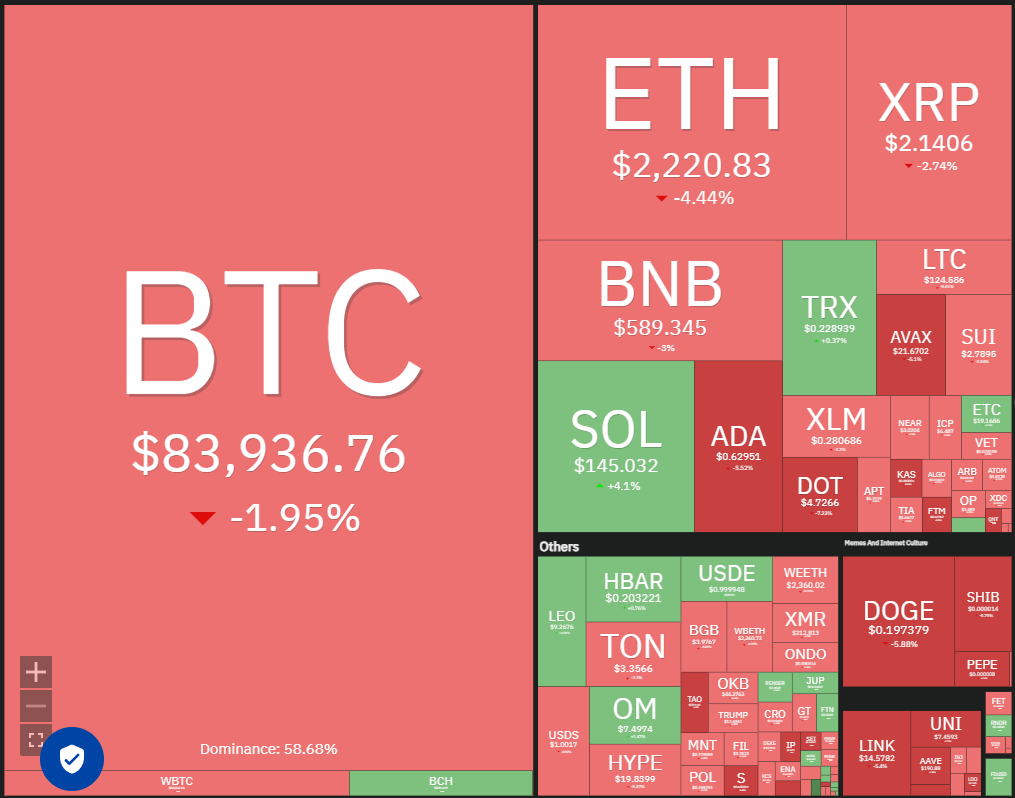
Crypto market data daily view. Source: Coin360
The current correction has not deterred Standard Chartered’s long-term view. In a CNBC interview, Standard Chartered head of digital assets research Geoffrey Kendrick said that Bitcoin could recover to $200,000 this year and surge to $500,000 before President Trump finishes his second term.
Could Bitcoin start a recovery, pulling altcoins higher? Let’s analyze the charts of the top 10 cryptocurrencies to find out.
Bitcoin price analysis
Bitcoin closed below the $85,000 support on Feb. 26, and the bears successfully defended the level on Feb. 27.
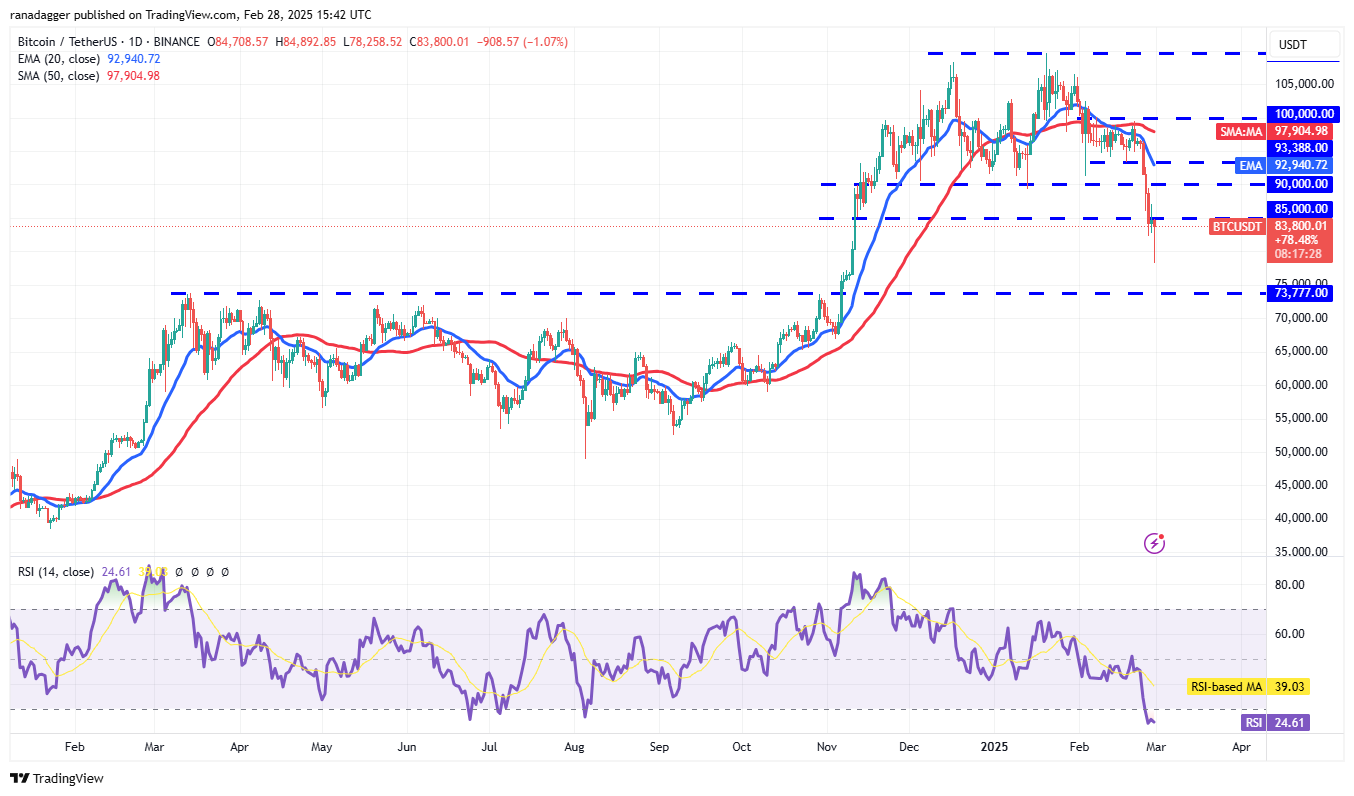
BTC/USDT daily chart. Source: Cointelegraph/TradingView
Sellers tried to sink the BTC/USDT pair to $73,777, but the bulls purchased the dip to $78,258 on Feb. 28. Buyers will try to push the price back above the $85,000 to $90,000 resistance zone. If they manage to do that, it will suggest that a short-term bottom may be in place.
Conversely, if the price turns down sharply from the overhead resistance zone, it indicates selling on every minor rally. The pair could then descend to the vital support at $73,777, where buyers are expected to step in.
Ether price analysis
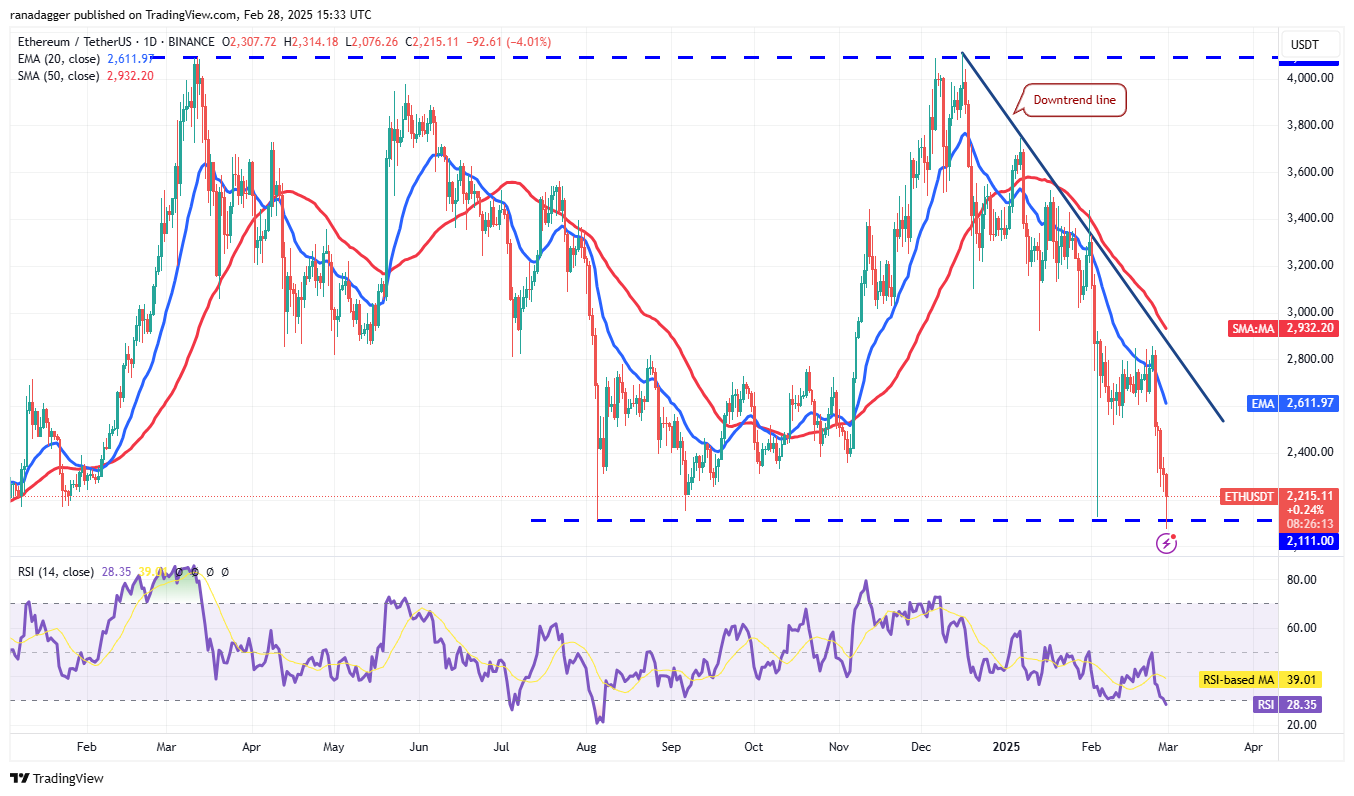
Ether (ETH) rebounded off the $2,111 support, indicating that the bulls are trying to keep the price inside the large range.
ETH/USDT daily chart. Source: Cointelegraph/TradingView
The bulls will attempt to stretch the recovery to the 20-day EMA ($2,611) and then to the downtrend line. Sellers are expected to aggressively defend the downtrend line. If the price turns down from the overhead resistance, the ETH/USDT pair could retest the $2,111 level. If this support cracks, the pair may sink to $2,000 and later to $1,900.
Contrary to this assumption, a break and close above the downtrend line suggests that the bears are losing their grip. The pair could rise to the 50-day SMA ($2,932).
XRP price analysis
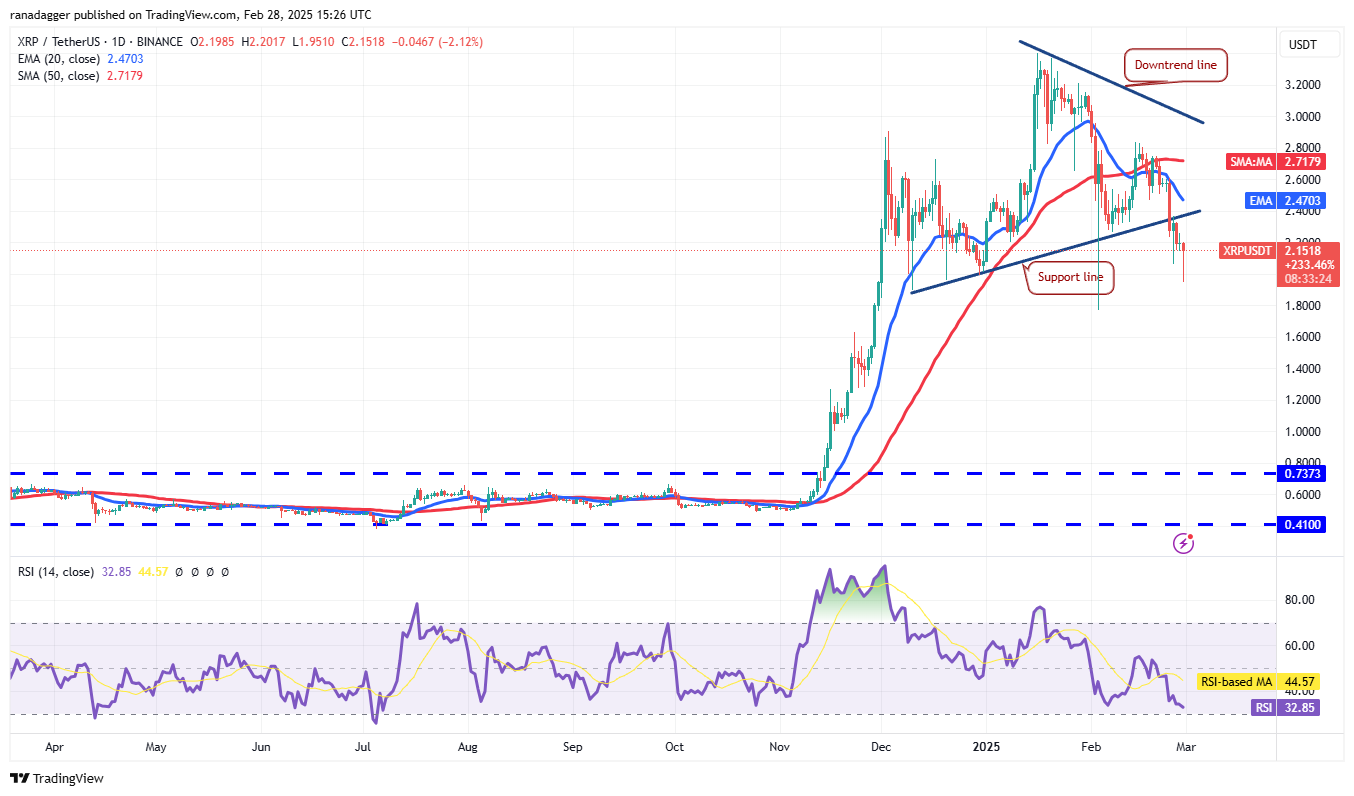
XRP (XRP) turned down from the support line of the symmetrical triangle pattern on Feb. 26, suggesting that the bears have flipped the level into resistance.
XRP/USDT daily chart. Source: Cointelegraph/TradingView
The XRP/USDT pair dipped below the $2.06 support on Feb. 28, but the bears could not sustain the lower levels. Buyers will attempt to push the price above the 20-day EMA. If they can pull it off, it will signal that the bulls are back in the game.
Contrarily, if the price turns down from the 20-day EMA, it will suggest that the bears remain active at higher levels. That increases the possibility of a drop to the crucial support at $1.77.
BNB price analysis
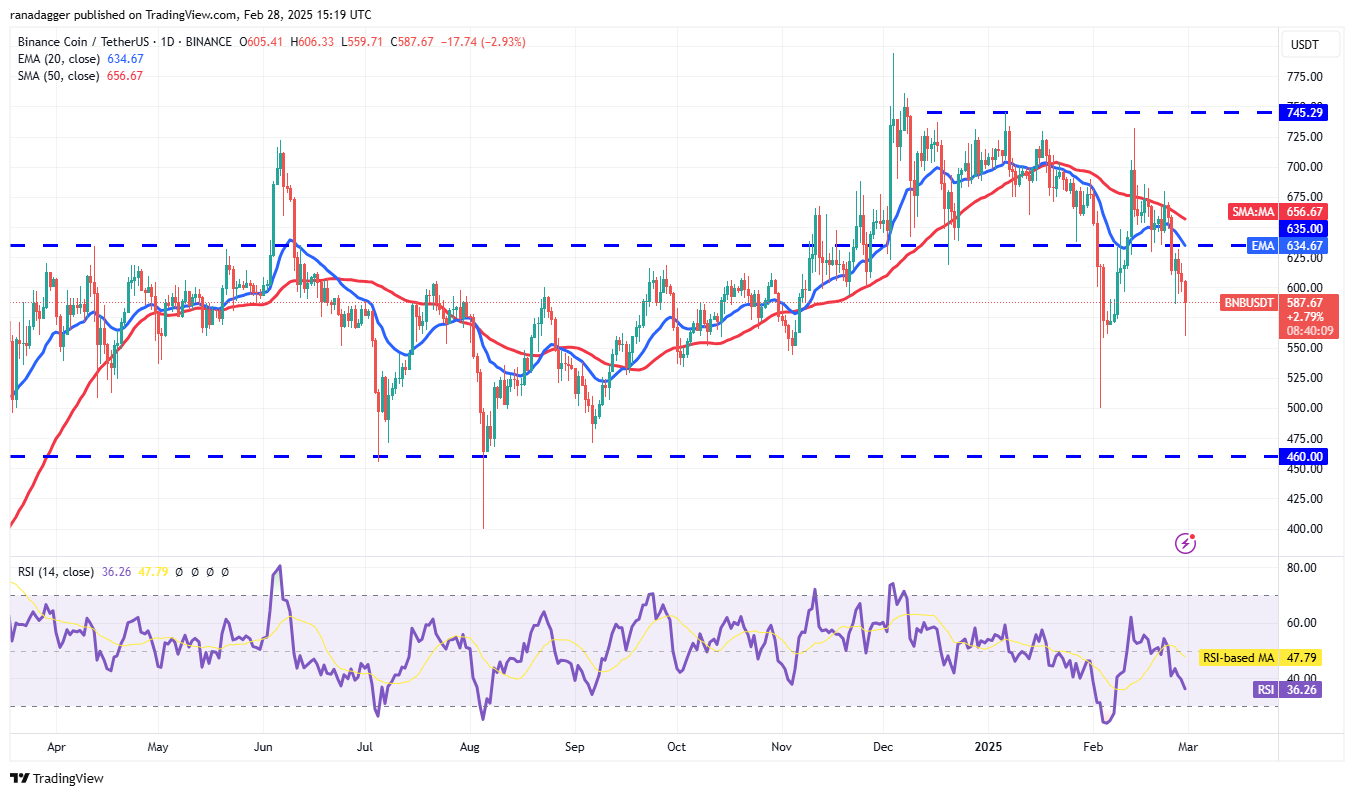
BNB (BNB) rebounded off the support near $557, indicating that the bulls are trying to defend the level.
BNB/USDT daily chart. Source: Cointelegraph/TradingView
The BNB/USDT pair will attempt a relief rally, which is expected to face strong selling at the 20-day EMA ($634). If the price turns down sharply from the 20-day EMA, it increases the likelihood of a break below $557. If that happens, the pair could collapse to $500. Buyers are expected to fiercely defend the zone between $460 and $500.
On the upside, a break and close above the 20-day EMA suggests the selling pressure is reducing. The pair could then reach the 50-day SMA ($656).
Solana price analysis
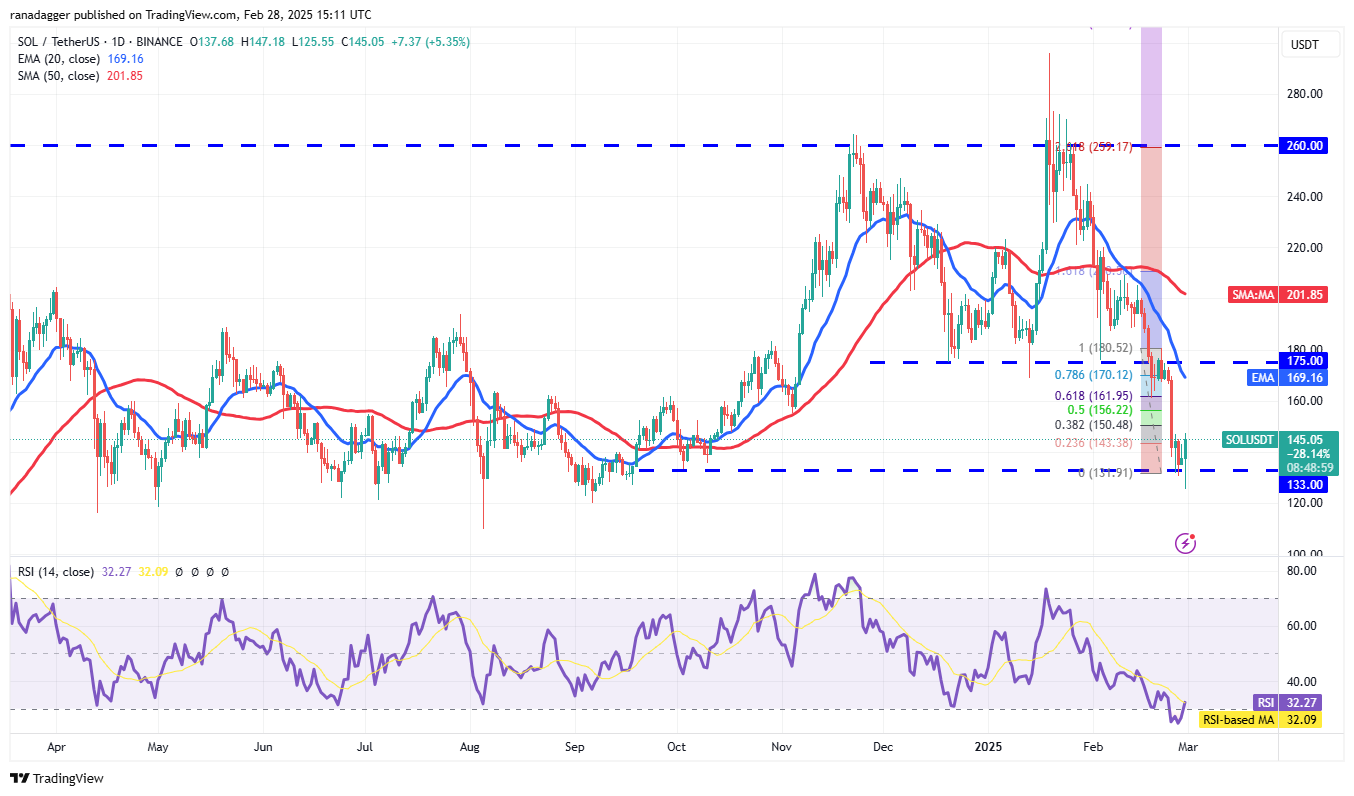
Solana (SOL) slipped below the $133 support on Feb. 28, but the long tail on the candlestick shows solid buying at lower levels.
SOL/USDT daily chart. Source: Cointelegraph/TradingView
There is minor resistance at $147, but it is likely to be crossed. If the price holds above $147, the SOL/USDT pair could reach the 20-day EMA ($169). Sellers are expected to pose a strong challenge at the 20-day EMA, but if the bulls prevail, the pair could extend its recovery to the 50-day SMA ($201).
This optimistic view will be negated if the price turns down and breaks below $125. The pair could then plummet to $110.
Dogecoin price analysis
Buyers failed to push Dogecoin (DOGE) back above the support line, suggesting that the bears have flipped the level into resistance.
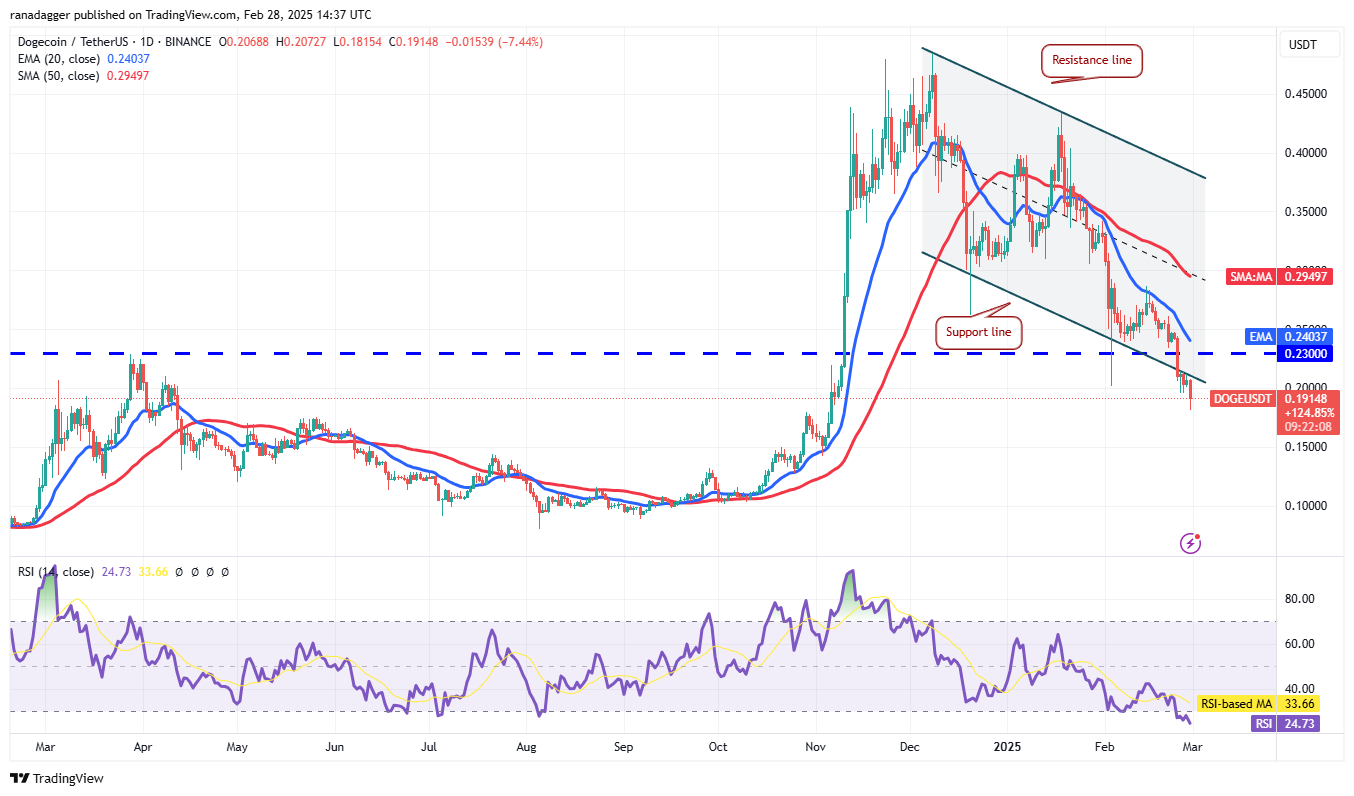
DOGE/USDT daily chart. Source: Cointelegraph/TradingView
The selling resumed on Feb. 28, and the bears will try to sink the price to $0.15. However, the RSI has slipped into the oversold zone, suggesting that a relief rally could be around the corner. Buyers will have to push and maintain the DOGE/USDT pair above the 20-day EMA ($0.24) to start a sustained recovery.
The failure to push the price back above the 20-day EMA increases the risk of a drop to $0.13 and then to $0.10.
Cardano price analysis
Cardano (ADA) is witnessing a tough battle between the bulls and the bears at the support line of the descending channel pattern.
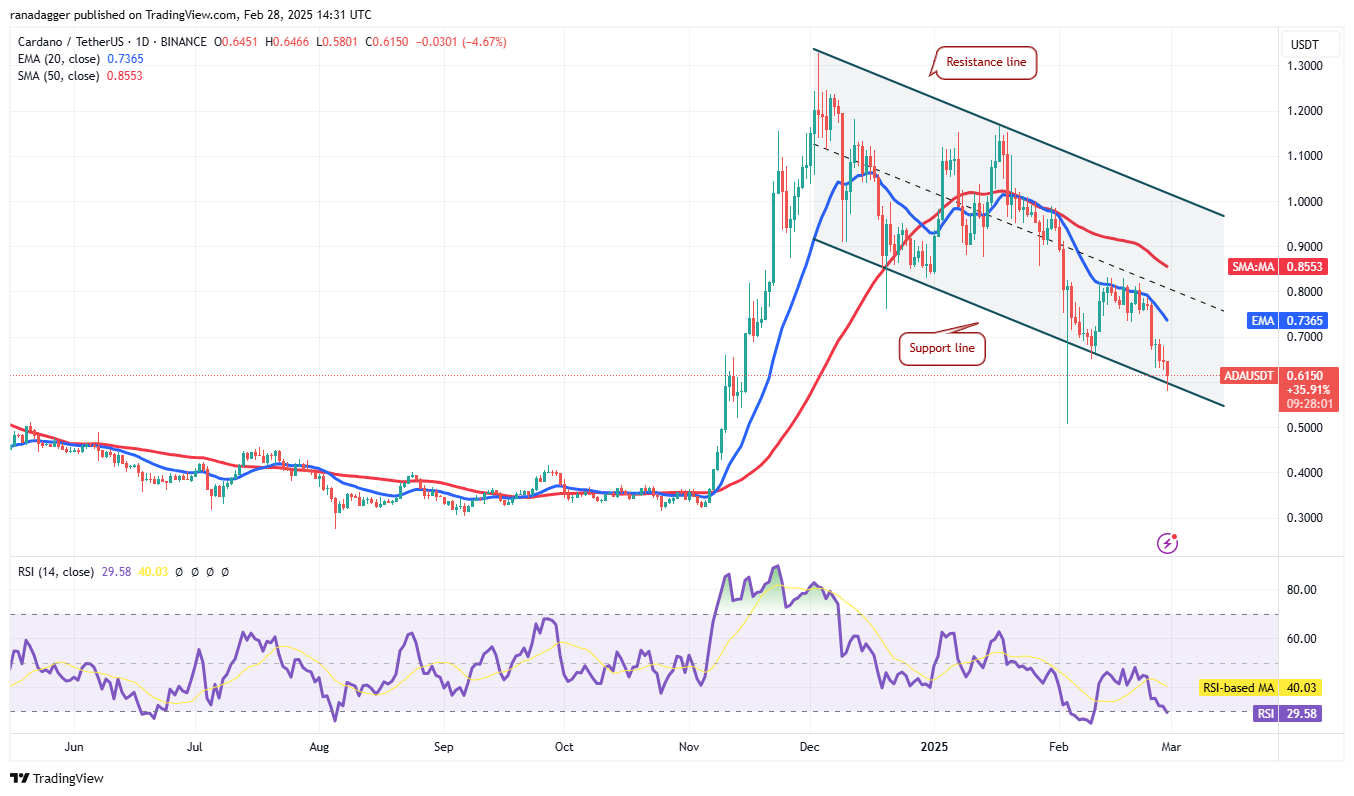
ADA/USDT daily chart. Source: Cointelegraph/TradingView
If the price sustains below the support line, the selling could pick up, and the ADA/USDT pair may drop to $0.50. Buyers are expected to defend the $0.50 level with all their might because a close below it could sink the pair to $0.33.
If the price turns up from the support line, the pair could reach the 20-day EMA (0.73). This is a vital overhead resistance to watch out for because a break above it suggests that the pair may remain inside the channel for some more time.
Related: Bitcoin price metric hits ‘optimal DCA’ zone not seen since BTC traded in $50K to $70K range
Litecoin price analysis
Litecoin (LTC) has been oscillating inside a symmetrical triangle pattern, indicating indecision between the bulls and the bears.
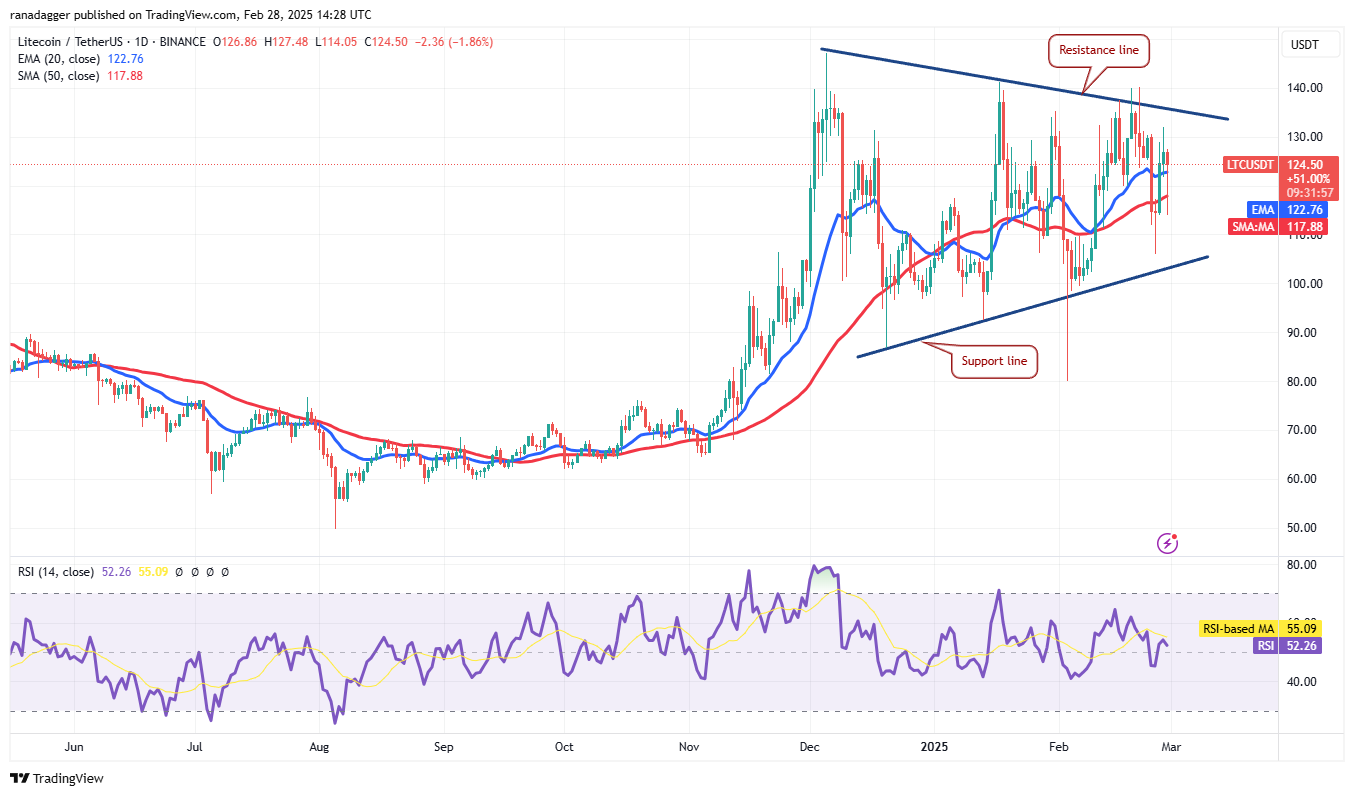
LTC/USDT daily chart. Source: Cointelegraph/TradingView
The 20-day EMA ($122) is flattish, and the RSI is just above the midpoint, indicating a balance between supply and demand. If the price sustains above the 20-day EMA, the bulls will try to push the LTC/USDT pair above the resistance line. If they succeed, the pair could rally to $147.
Conversely, a break below the 50-day SMA ($117) opens the gates for a drop to the support line. If this level gives way, the pair could plunge to $80.
Chainlink price analysis
The failure of the bulls to start a strong recovery from the support line triggered another round of selling by the bears in Chainlink (LINK).
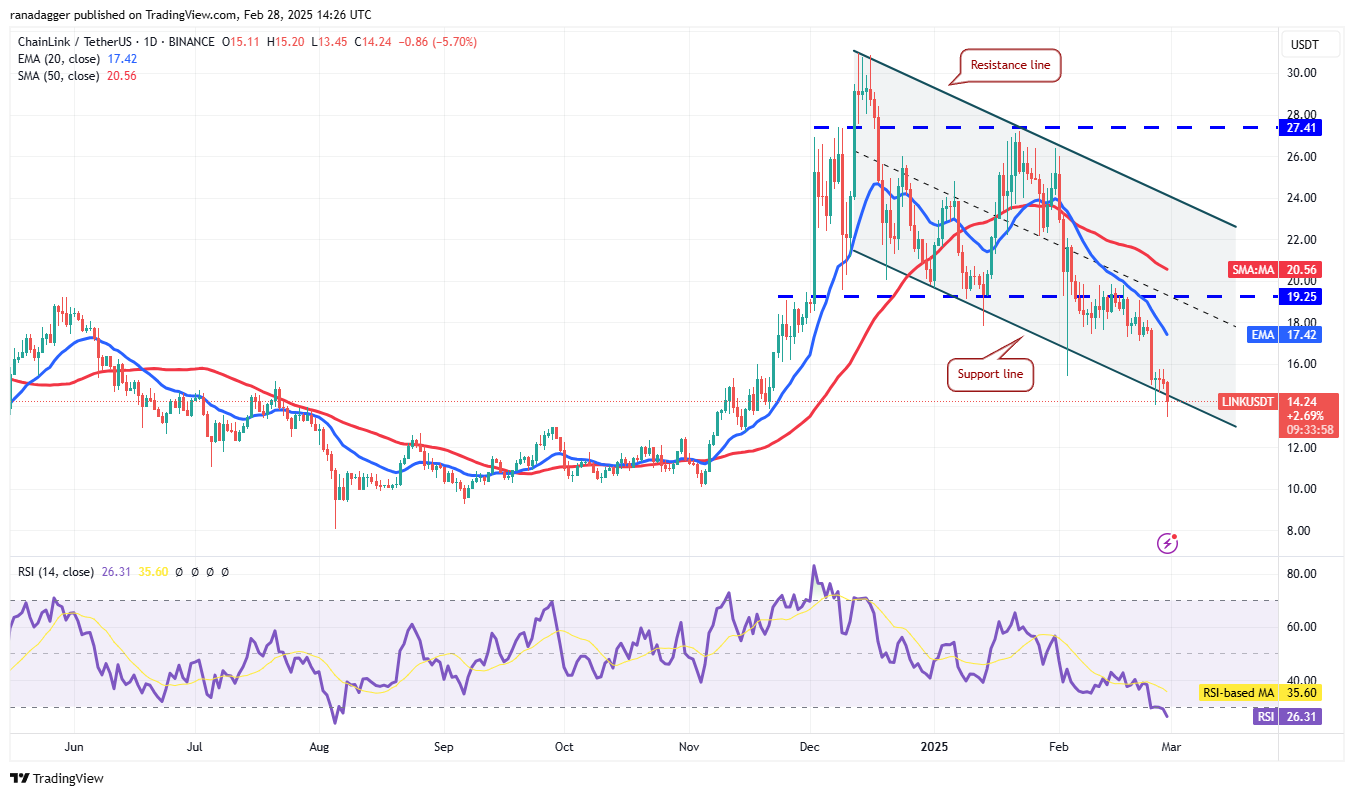
LINK/USDT daily chart. Source: Cointelegraph/TradingView
If the price sustains below the support line, the selling could accelerate, and the LINK/USDT pair could drop to $12.71 and, subsequently, to $10.
If buyers want to prevent the downside, they will have to swiftly push the price back above $16. The pair could then rise to the 20-day EMA ($17.42), which is likely to act as a stiff resistance. Buyers will have to push the price above the 20-day EMA to suggest that the break below the support line may have been a bear trap.
Avalanche price analysis
Avalanche (AVAX) tried to rise above the breakdown level of $22.35 on Feb. 27, but the bears held their ground.
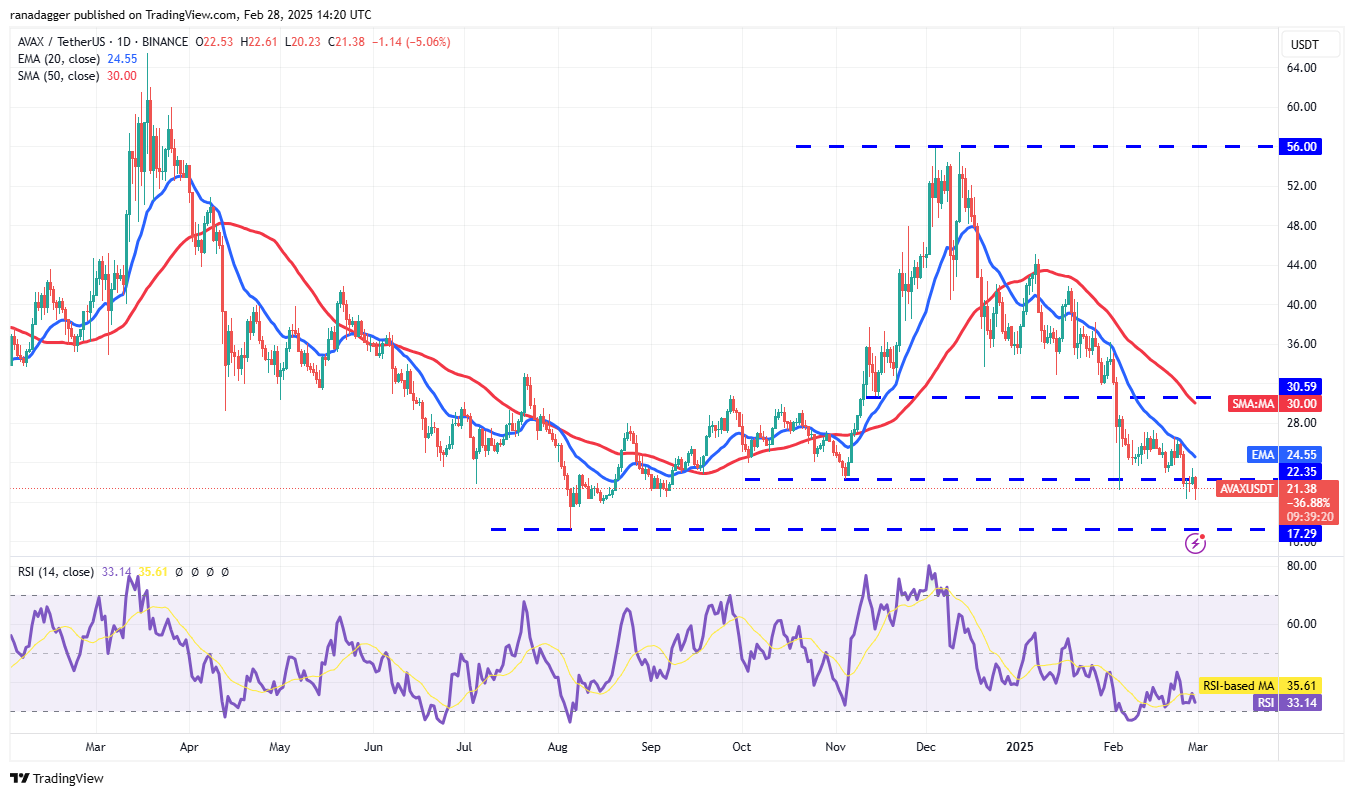
AVAX/USDT daily chart. Source: Cointelegraph/TradingView
The bears resumed selling on Feb. 28. If the price breaks and maintains below $20, the AVAX/USDT pair could retest the solid support at $17.29. This is an important level to watch out for because a break below it may sink the pair to $15.
Time is running out for the bulls. They will have to push and maintain the price above the 20-day EMA ($24.55) to start a recovery. The pair may rise to $27.50, which is again expected to act as a resistance.
This article does not contain investment advice or recommendations. Every investment and trading move involves risk, and readers should conduct their own research when making a decision.

Why is Litecoin (LTC) price up today?
Litecoin (LTC) has outperformed the broader crypto market vastly in the last 24 hours, rising over 9% to reach $127.85 on Feb. 27. LTC/USD four-hour price chart. Source: TradingView In contrast, the crypto market’s combined valuation has dropped by 3% amid a sour risk-on mood […]
Litecoin
Litecoin (LTC) has outperformed the broader crypto market vastly in the last 24 hours, rising over 9% to reach $127.85 on Feb. 27.
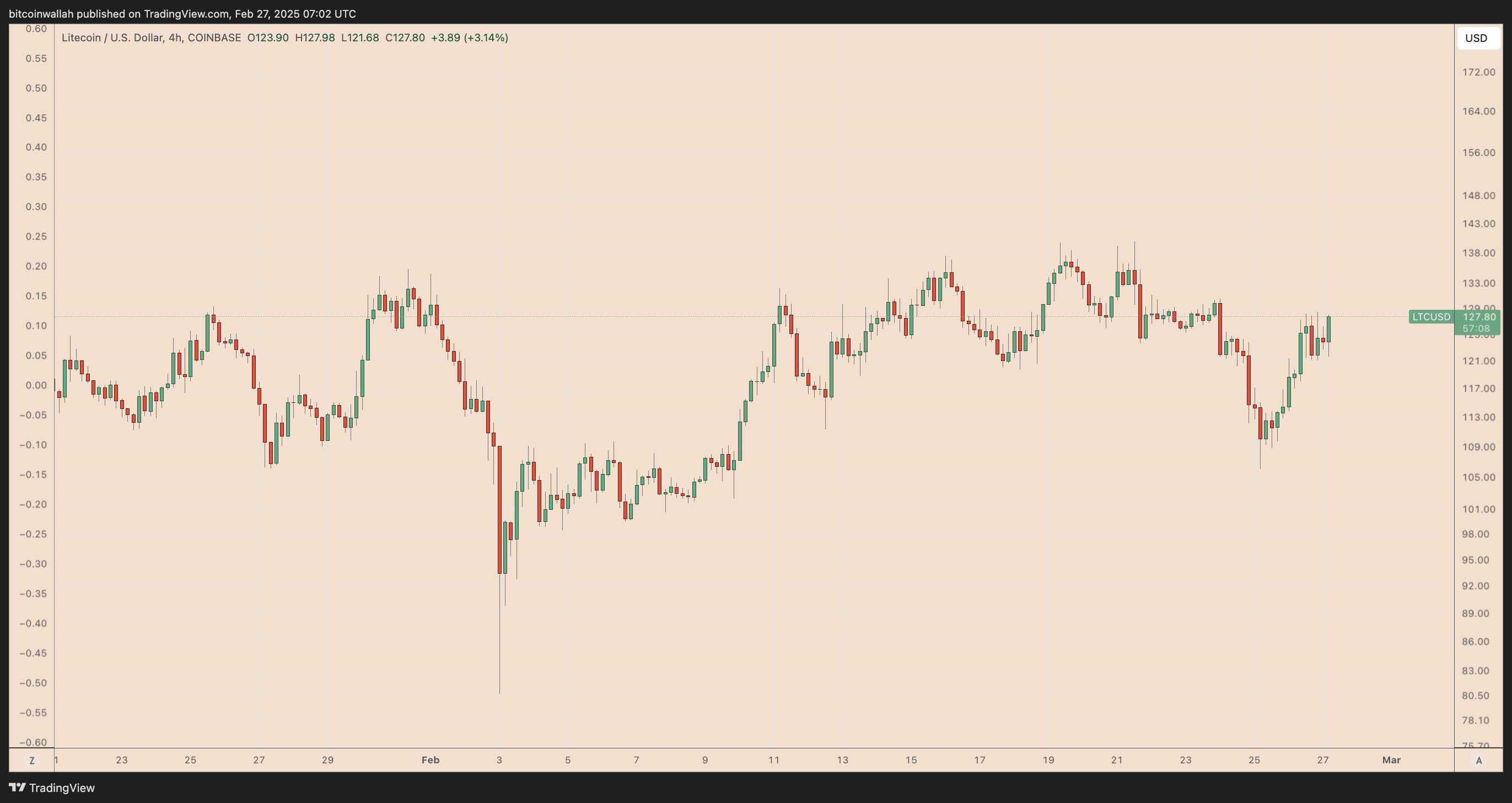
LTC/USD four-hour price chart. Source: TradingView
In contrast, the crypto market’s combined valuation has dropped by 3% amid a sour risk-on mood led by underwhelming Nvidia earnings and US President Donald Trump’s latest tariff announcements.
Key drivers behind Litecoin’s gains include:
-
Announcement of Litecoin’s own domain, “.ltc“
-
LTC’s rising strength against Bitcoin (BTC).
-
Strengthening chart technicals.
Litecoin announces official domain extension “.ltc“
Litecoin’s price gains today appear after the cryptocurrency’s official X handle announced the launch of its own domain extension.
What to know:
-
On Feb. 25, 2025, Litecoin announced the launch of its official domain extension, “.ltc,” in collaboration with Unstoppable Domains.
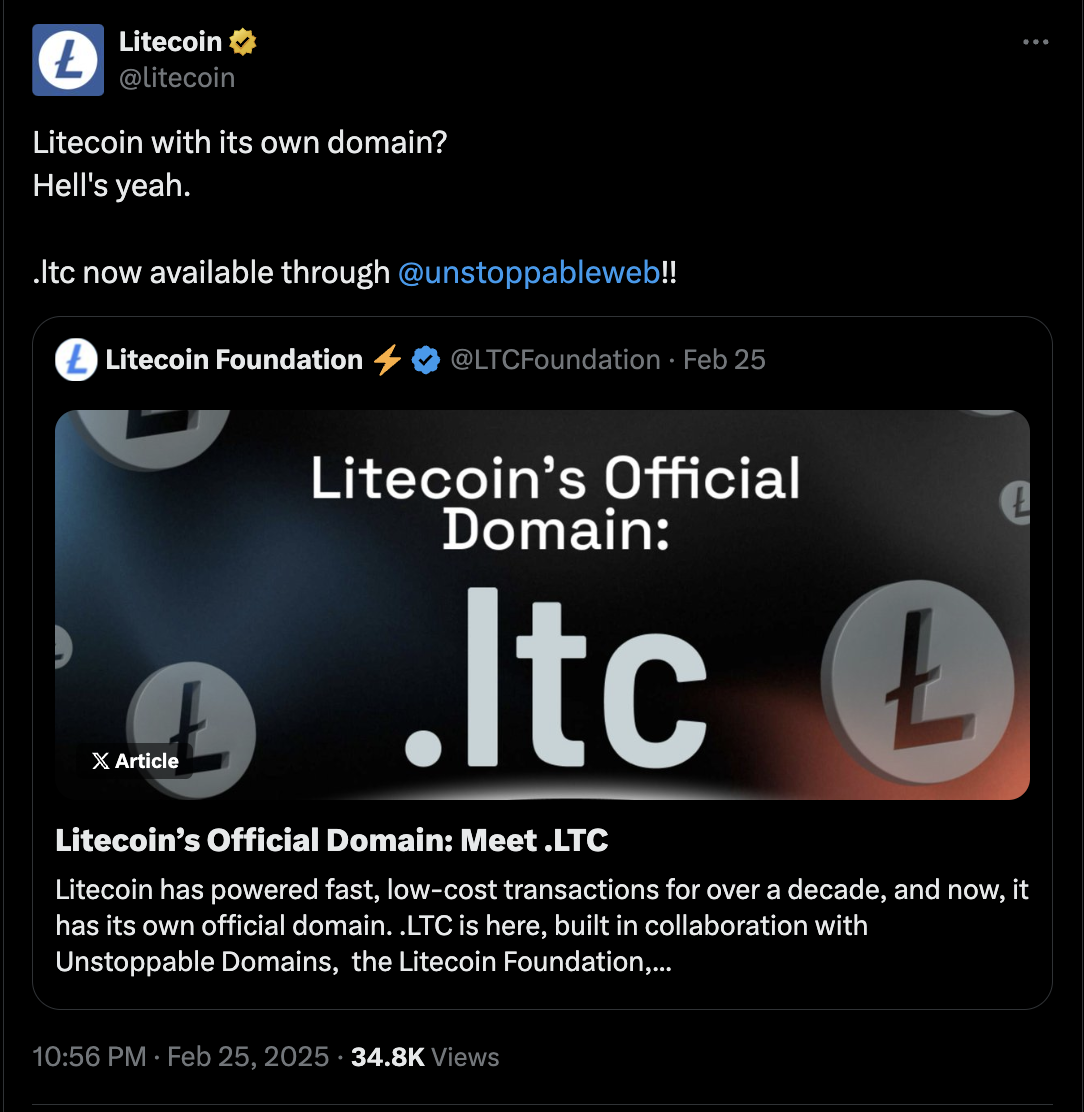
Source: Litecoin Official X Handle
-
Litecoin’s move mirrors Ethereum’s .eth domains, which have gained popularity as an essential part of Web3 identity solutions.
-
With .ltc domains, users can register personalized blockchain-based addresses instead of relying on long alphanumeric wallet addresses.
-
Domain extension should ideally make sending and receiving LTC payments seamless by reducing the chances of errors in transactions.
-
LTC’s price has risen by approximately 22% since the domain extension announcement.
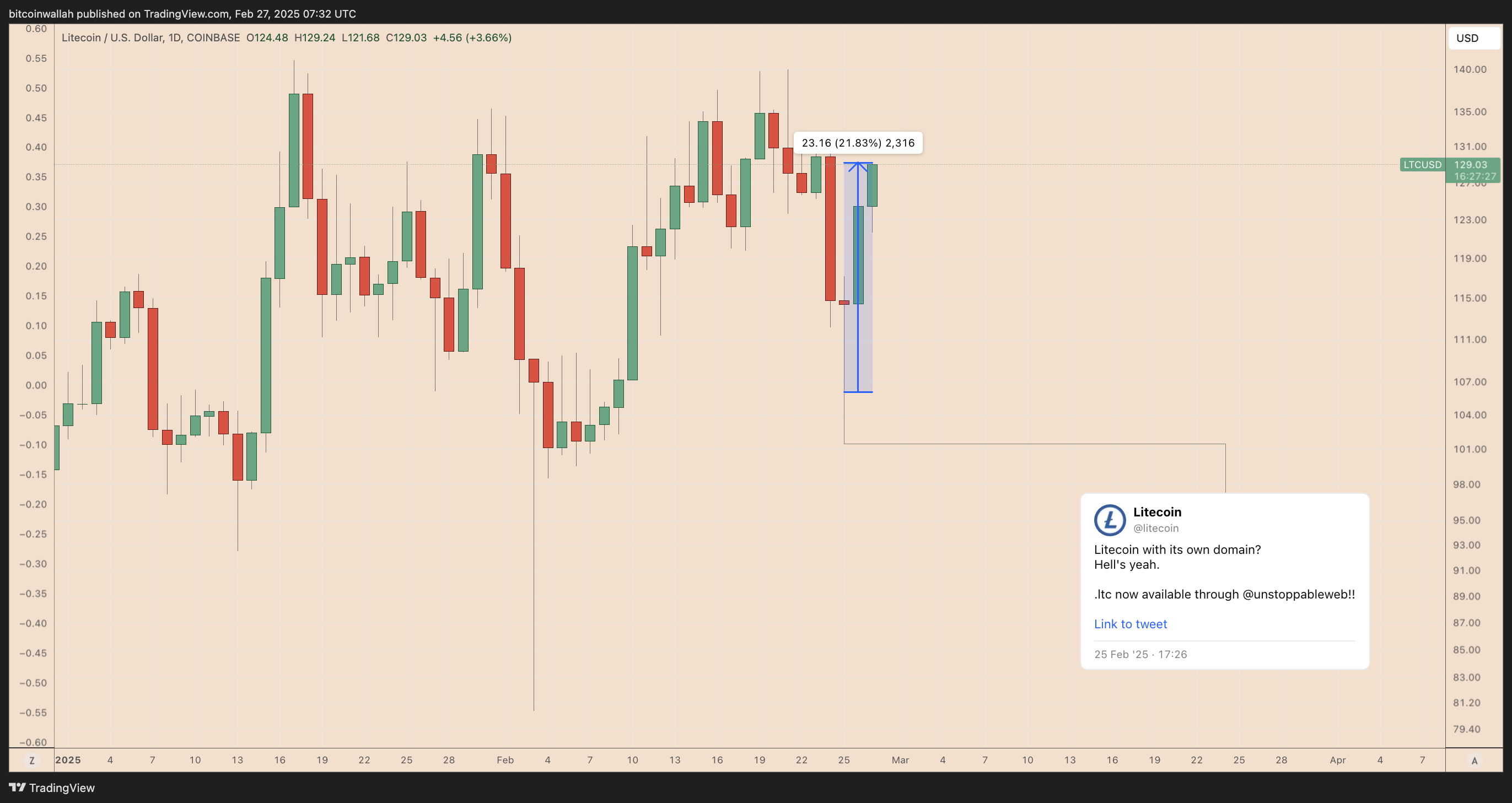
LTC/USD daily price chart. Source: TradingView
LTC’s strength against Bitcoin is improving
Litecoin’s gains today are also due to its consistently strong performance against Bitcoin, which controls about 60% of the entire crypto market valuation.
Key points:
-
The LTC/BTC pair has climbed approximately 40% year-to-date.
-
In comparison, Ether (ETH) and Solana (SOL) have plunged by over 24.45% and 20.50% against Bitcoin, respectively.
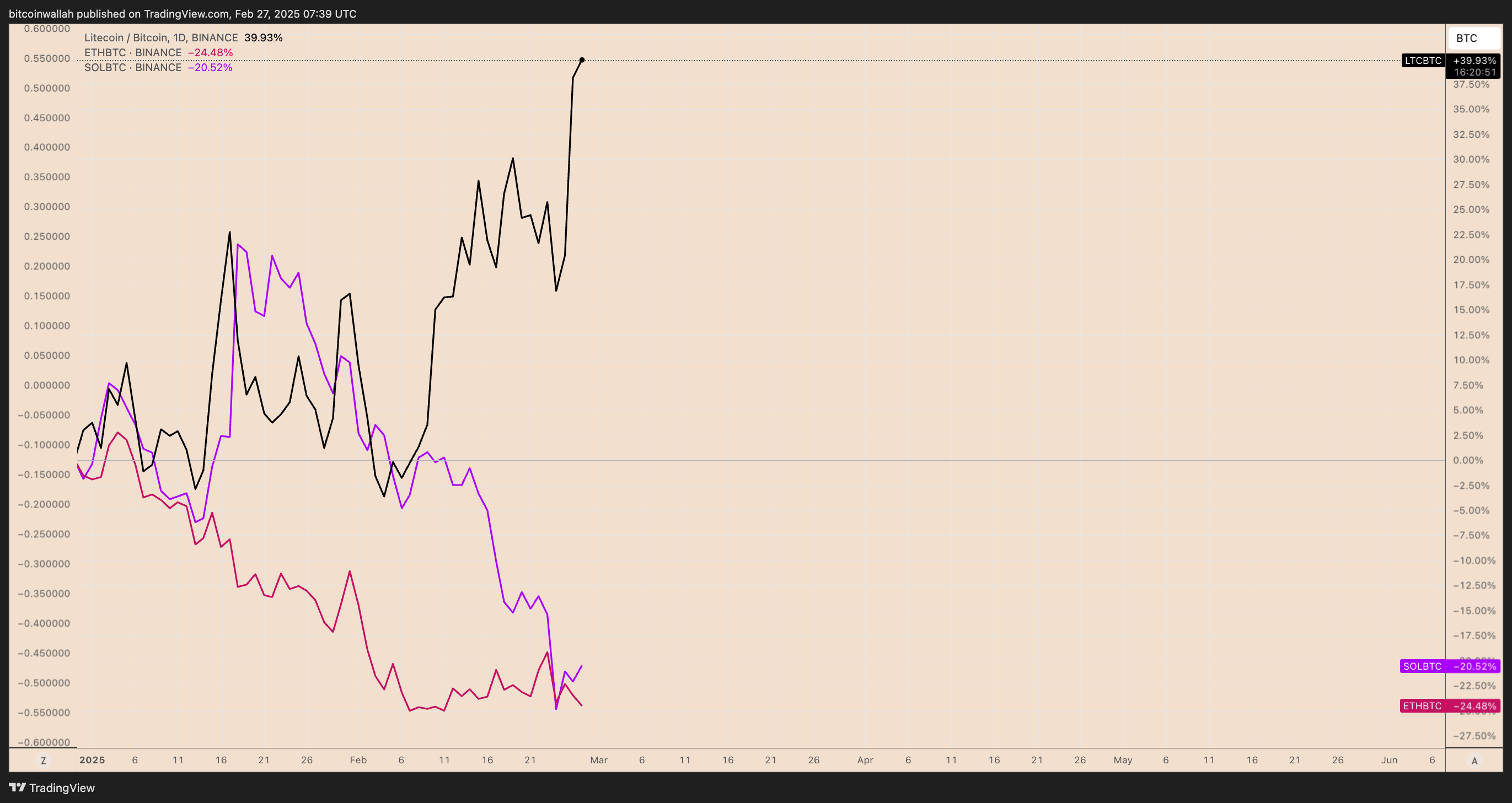
LTC/BTC vs. ETH/BTC and SOL/BTC year-to-date performance chart. Source: TradingView
-
Litecoin’s crypto market dominance has improved due to the ongoing exchange-traded fund (ETF) buzz.
-
Ether and Bitcoin saw similar uptrends ahead of their spot ETF approvals in 2024.
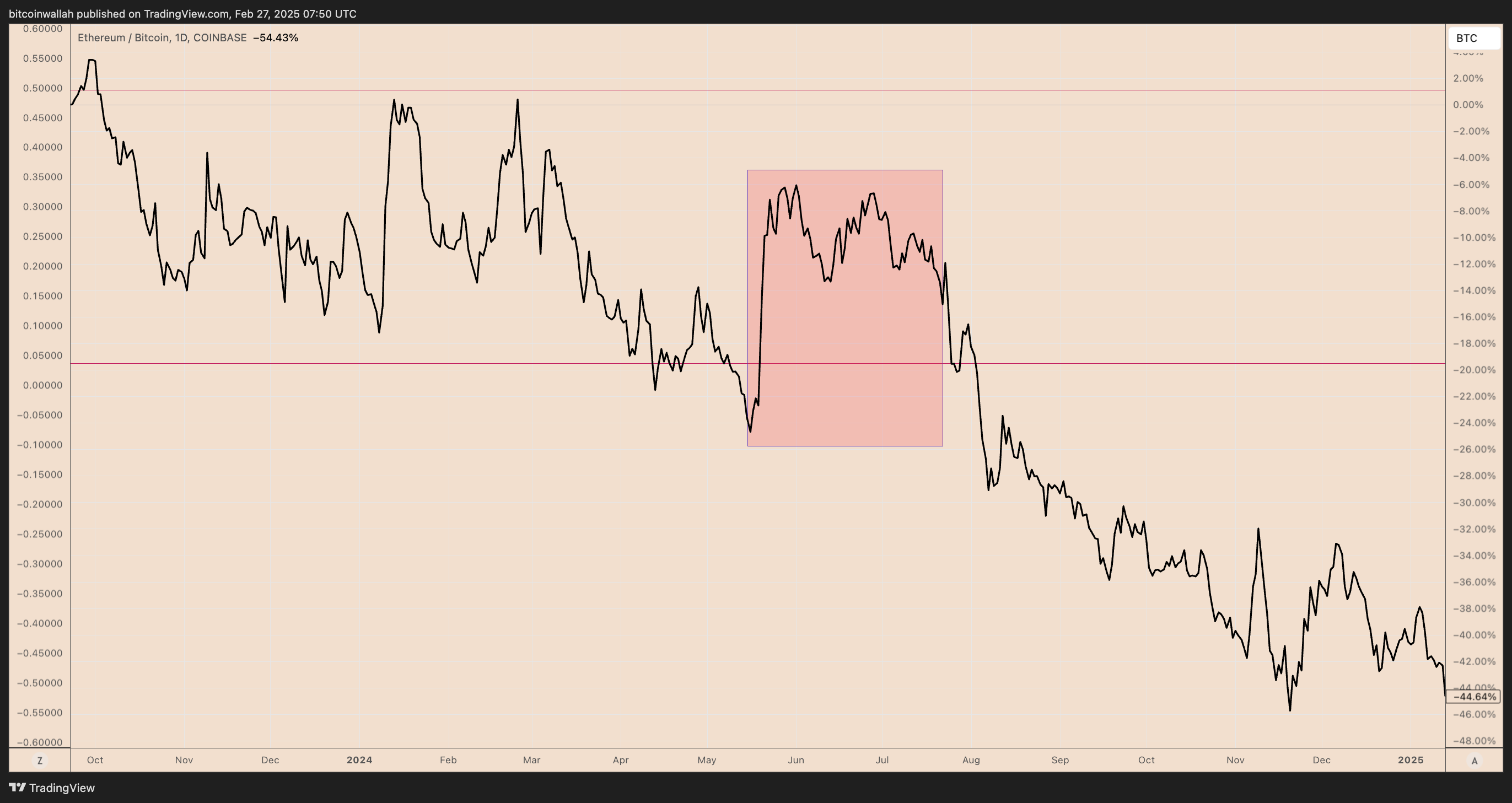
ETH/BTC daily chart ft. uptrend before Ether ETF’s approval in July 2024. Source: TradingView
-
Earlier in February, Eric Balchunas, Bloomberg’s senior ETF analyst, noted that there is a 90% likelihood of a Litecoin ETF being approved in 2025.
-
On the Polymarket betting platform, the odds for a spot Litecoin ETF approval by 2025’s end was 75% as of Feb. 27.
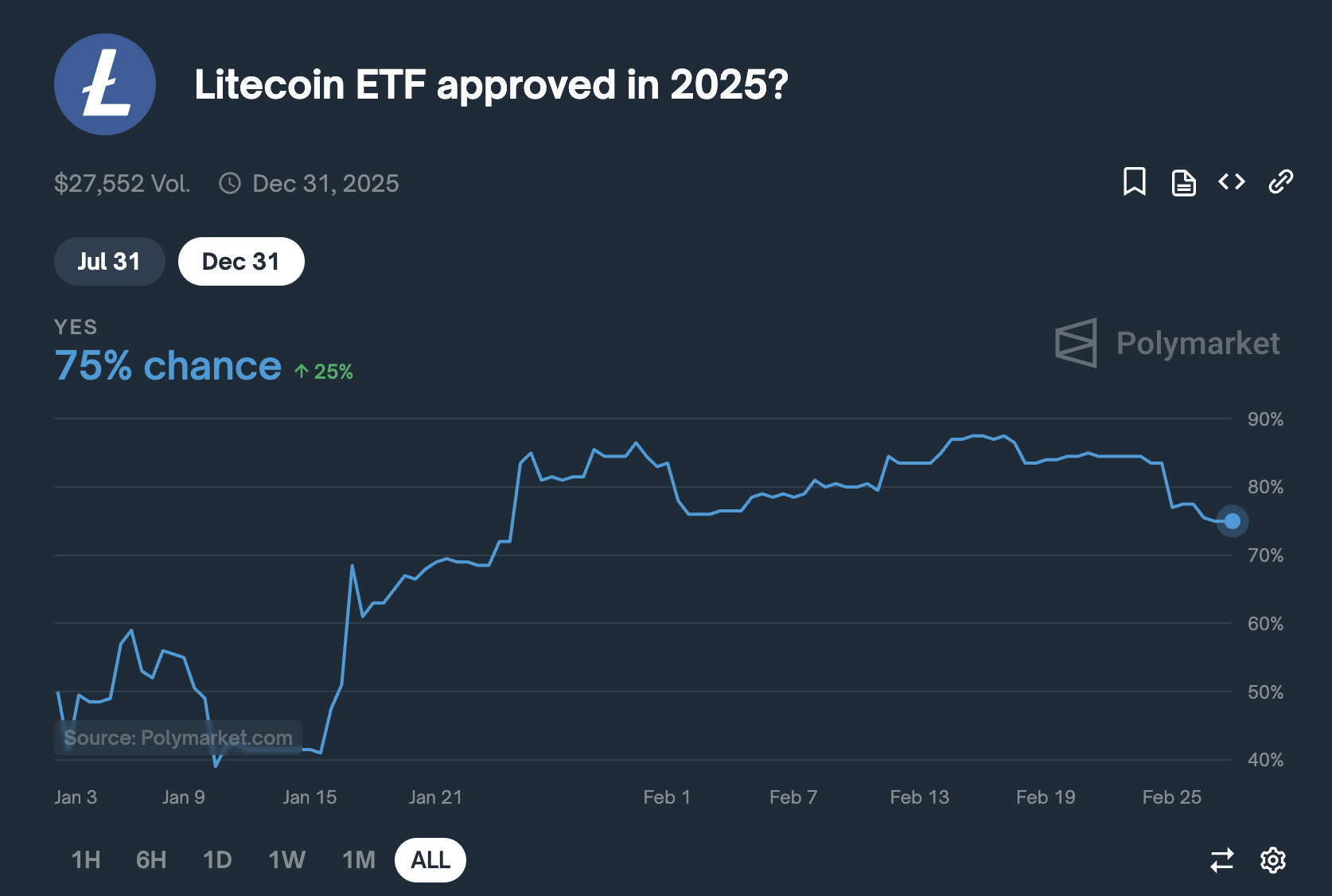
Litecoin ETF approval odds by 2025. Source: Polymarket
-
On Feb. 19, the US Securities and Exchange Commission acknowledged CoinShares spot Litecoin filings ETF.
Litecoin hashrate is rising
Litecoin is bucking the market downtrend as network fundamentals strengthen, with miners accumulating and hashrate reaching new highs.
Notably:
-
Litecoin’s hashrate has hit an all-time high of 2.25 PH/s, signaling increased network security and miner confidence.
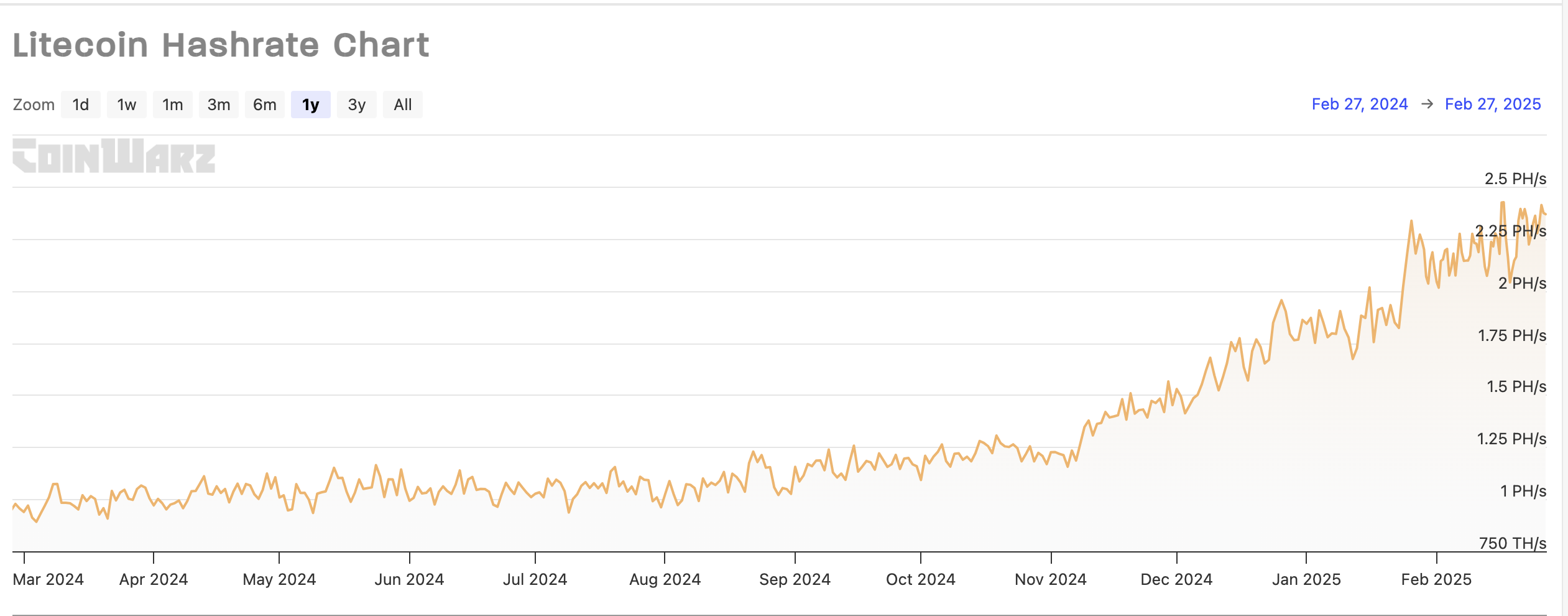
Litecoin hashrate chart. Source: CoinWarz
-
Onchain data shows miners reducing selling pressure and increasing reserves, creating a potential supply squeeze.
Related: Litecoin txs surge 243% in 5 months amid ETF hype: Santiment
-
The miner reserve chart further exhibits a rounding bottom pattern, indicating a shift from long-term selling to accumulation.
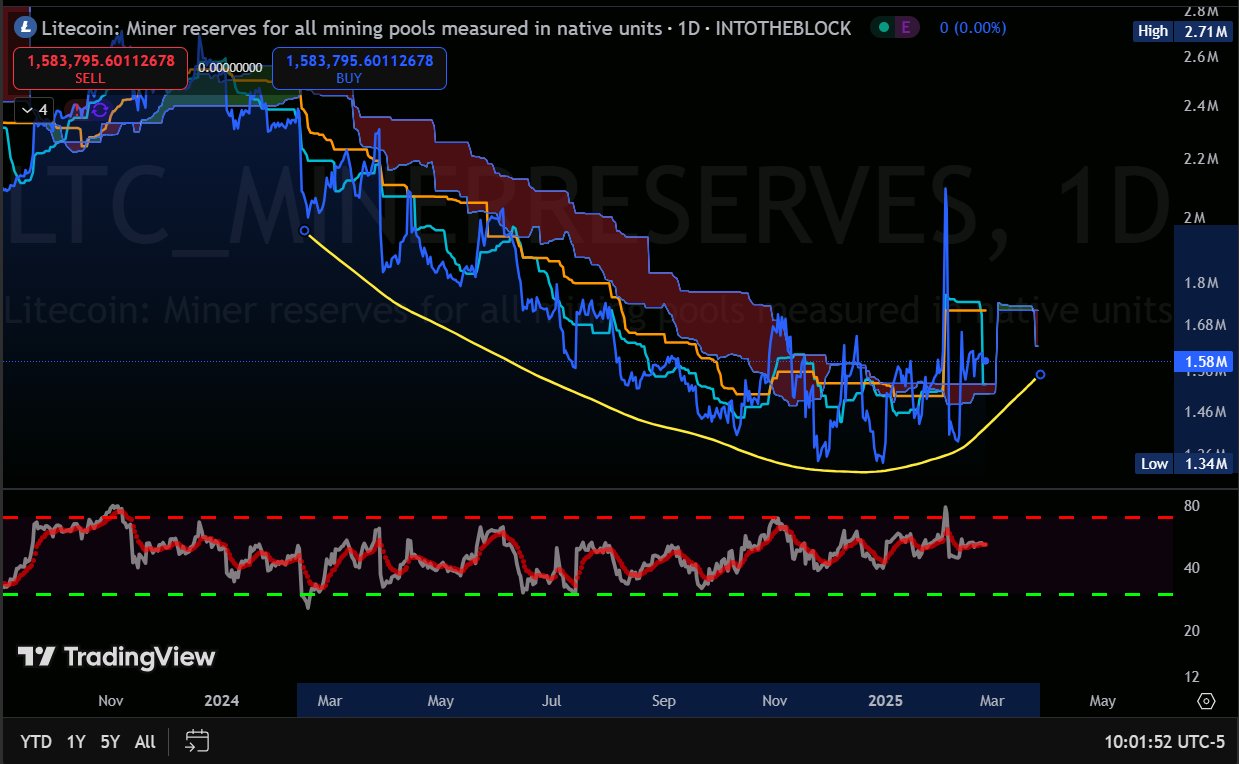
Litecoin miner reserve chart. Source: TradingView/recontour
-
Reduced miner selling, rising network strength, and sustained demand position LTC for further upside potential.
LTC is eyeing $360 next
Litecoin’s gains today are part of its prevailing inverse head and shoulders (IH&S) pattern, a classic bullish reversal setup signaling a potential breakout.
Key takeaways:
-
An IH&S is a technical pattern that forms after a downtrend and consists of three key troughs: a left shoulder, a lower head, and a right shoulder, forming underneath a neckline resistance.
-
The pattern resolves when the price decisively breaks above the neckline and rises by as much as the maximum distance between the head’s trough and neckline.
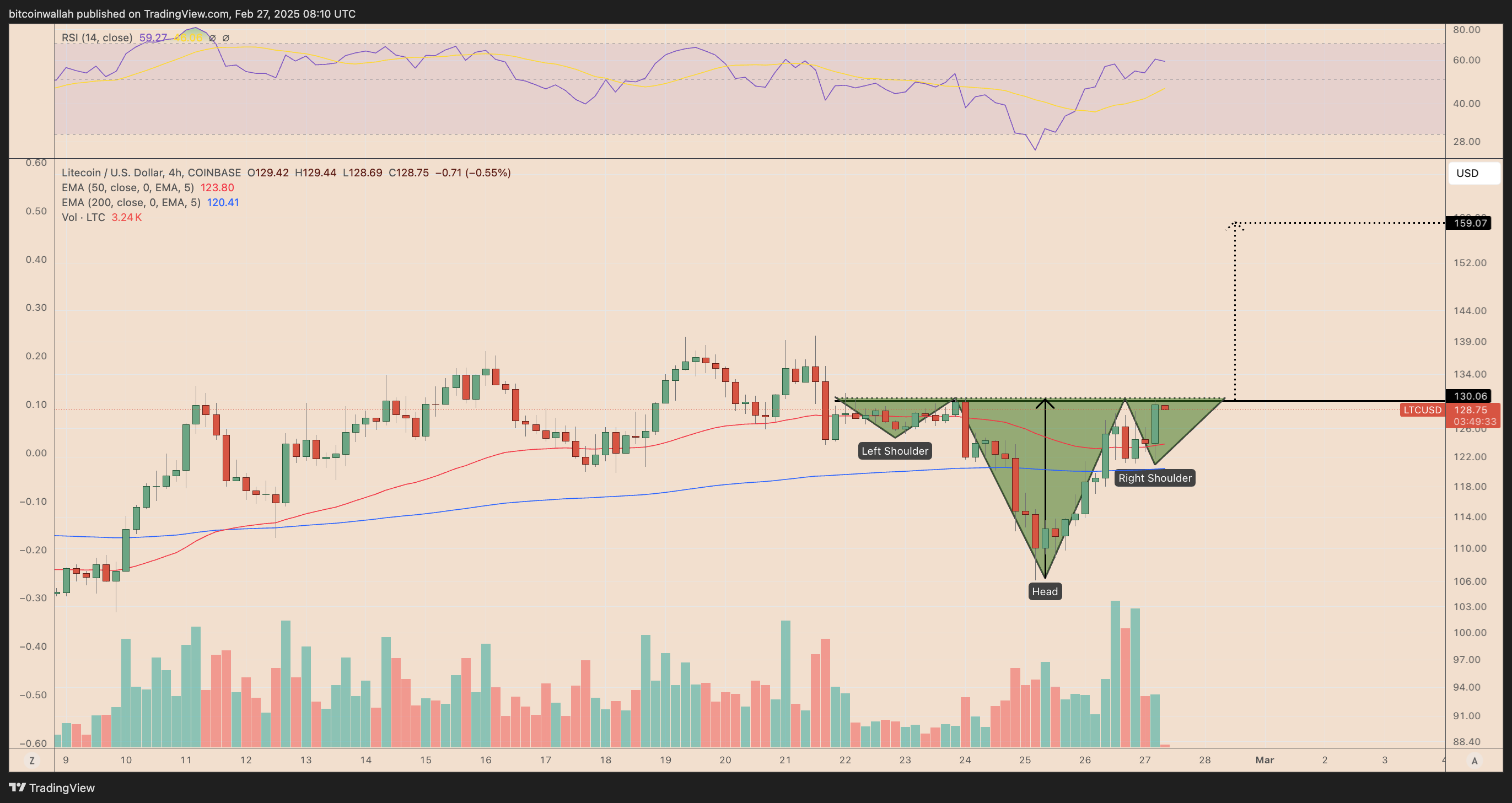
LTC/USD four-hour price chart. Source: TradingView
-
As of Feb. 27, Litecoin was forming the pattern’s right shoulder while eyeing the breakout above its neckline resistance of around $130.
-
The resulting target is around $160, suggesting a potential rally by March if the breakout sustains.
-
Failure to hold above $130 could lead to a retest of lower support levels near the 50-4H EMA ($123.80) and approaching the 200-4H EMA ($120.41).
This article does not contain investment advice or recommendations. Every investment and trading move involves risk, and readers should conduct their own research when making a decision.

Litecoin (LTC) price rallies while Bitcoin and the wider crypto market crash
Litecoin (LTC) demonstrated a V-shaped recovery of 20% after dropping to $106 on Feb. 25. After a brief decline below the 50-day and 100-day exponential moving averages (EMAs), the altcoin has regained a bullish position and is currently outperforming a majority of assets within the […]
Litecoin
Litecoin (LTC) demonstrated a V-shaped recovery of 20% after dropping to $106 on Feb. 25. After a brief decline below the 50-day and 100-day exponential moving averages (EMAs), the altcoin has regained a bullish position and is currently outperforming a majority of assets within the crypto market.
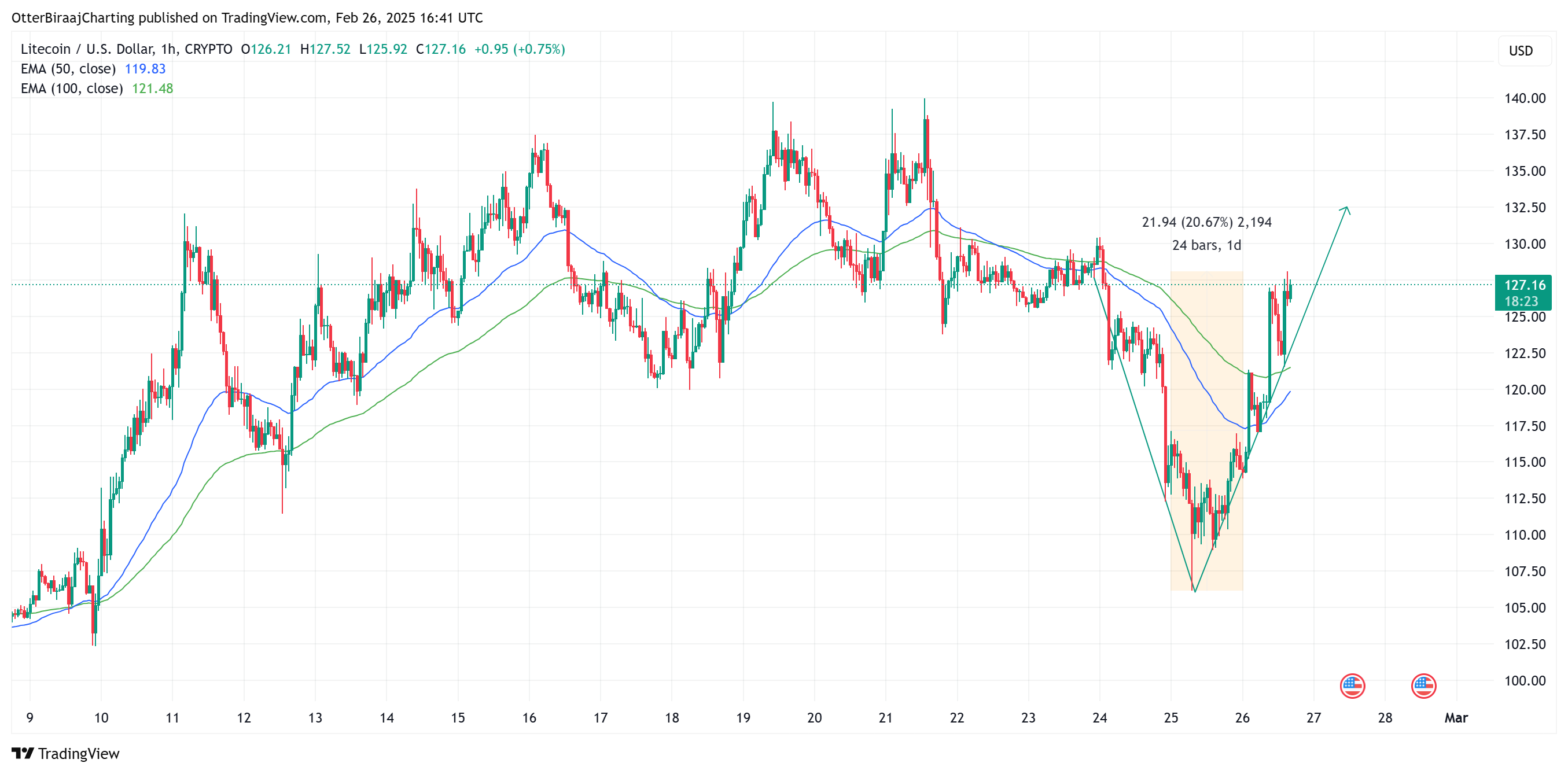
Litecoin 1-hour chart. Source: Cointelegraph/TradingView
Litecoin has “one of the best charts in crypto”
Litecoin’s current performance implies it is on an asymmetric rally versus the wider crypto market, and most LTC futures traders maintain a clear directional bias. Data highlights a clear trend where LTC’s open interest has consistently peaked at $140.
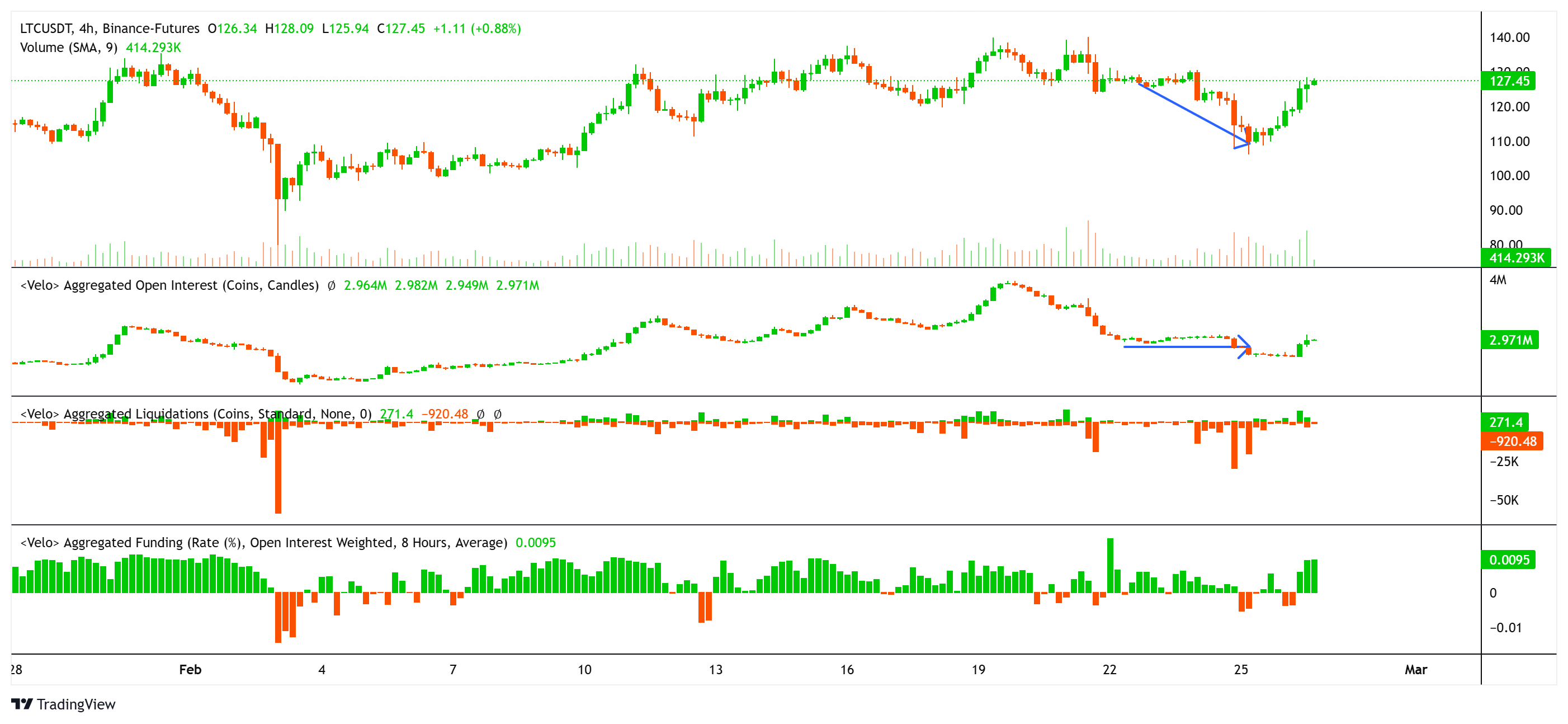
Litecoin open interest, funding rate and liquidation chart. Source: Velo.data
During LTC’s recent correction, its open interest dropped from $885 million to $525 million, which is a 40% drop between Feb. 20 and Feb. 26. However, a majority of the OI declined within the first three days. It remained flat during LTC’s drawdown in the past two days.
In the past 24 hours, a flash OI spike of 10% was observed alongside a price rise, which might imply fresh long positions from traders. The rise in the funding rate further confirmed that more longs were currently active than shorts.
In light of that, Tyler, an anonymous crypto trader, said that the altcoin presented “one of the best charts in crypto.”
The sentiment was followed up by Poseidon, a crypto analyst who predicted that Litecoin is targeting a new all-time high at $300.
However, a technical analyst, Mihir, believed the long-term target could be even higher.
The analyst said,
“LTC hit $350 USD during 2017 — a 310x move. It retested the 2017 high during the 2020 bull run but failed to make a new ATH. In the current (2023-2025) bull run, it hasn’t moved much yet, but it is indicating an upside move this year. If it breaks above $250 USD, then $1,000 is feasible.”
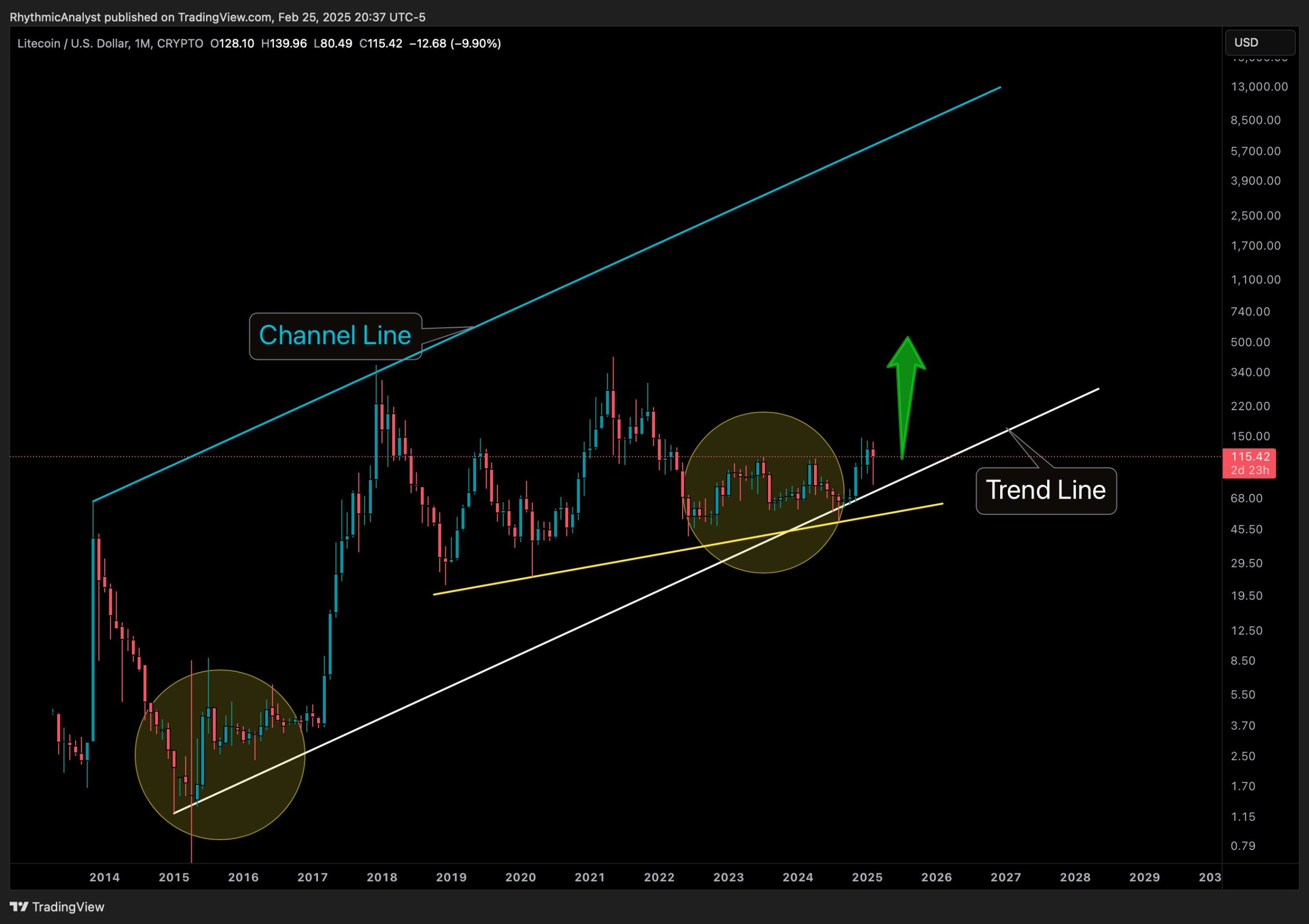
Litecoin 1-month analysis by Mihir. Source: X.com
Related: M2 money supply could trigger a ‘parabolic’ Bitcoin rally — Analyst
Overhead resistance hangs at $140
As illustrated in the chart below, Litecoin’s weekly price action is exhibiting strength, and a candle close above $133 will mark its highest level since January 2022. However, the altcoin has failed to break above its overhead resistance at $140 over the past three months.
With supply-side liquidity (yellow box) available on the upside, LTC needs a weekly close above $133 to invalidate its resistance range.
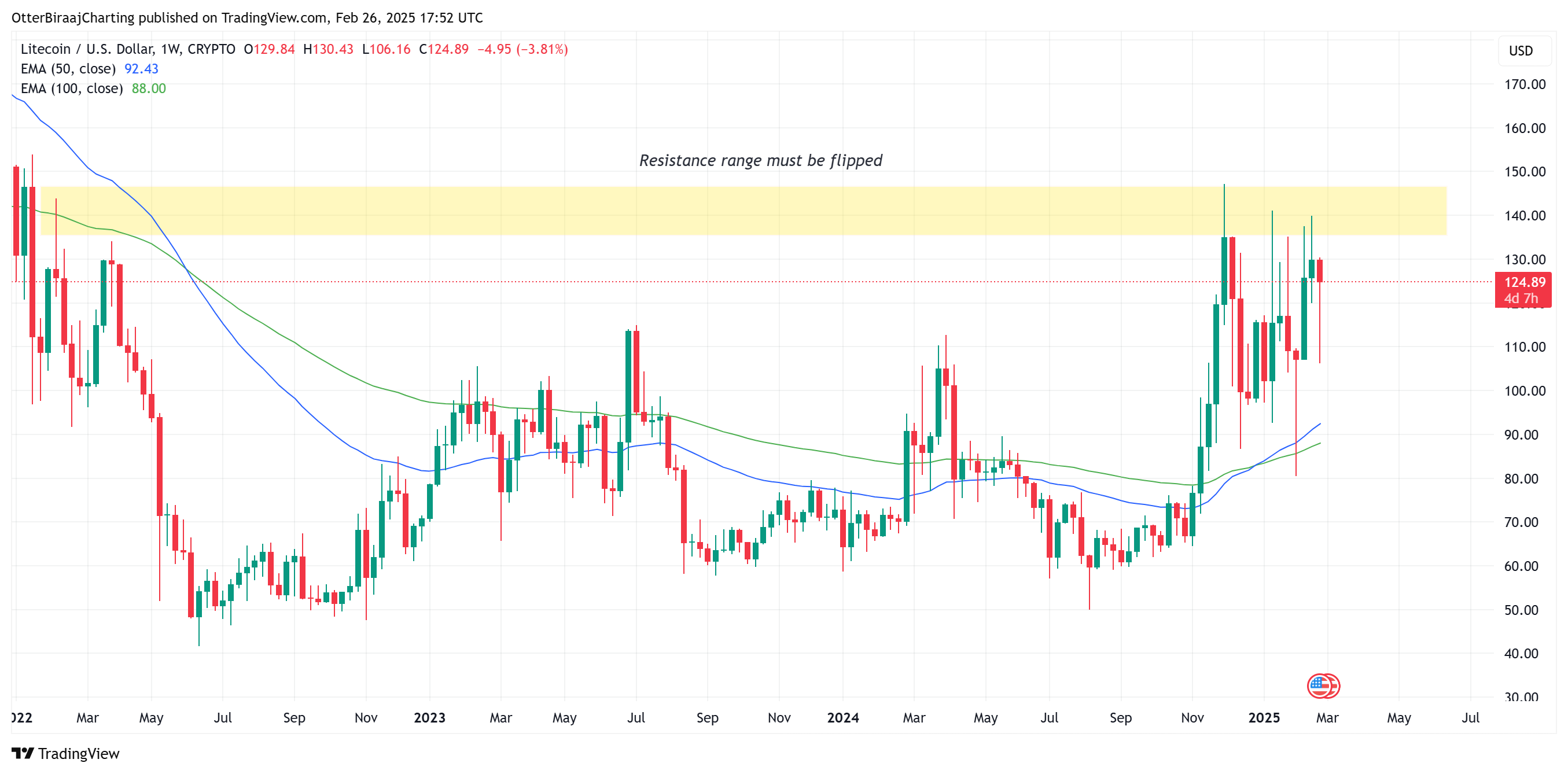
Litecoin 1-week chart. Source: Cointelegraph/TradingView
Related: Bitcoin sets new 3-month low as analyst eyes $93.5K reclaim ‘this week’
This article does not contain investment advice or recommendations. Every investment and trading move involves risk, and readers should conduct their own research when making a decision.

Nasdaq files to list Grayscale Polkadot ETF
US securities exchange Nasdaq has requested to list a Grayscale exchange-traded fund (ETF) holding the Polkadot network’s native token, DOT (DOT), filings showed. If approved, the Grayscale Polkadot Trust would add to the asset manager’s expanding suite of publicly traded crypto funds. The filing adds to […]
Litecoin
US securities exchange Nasdaq has requested to list a Grayscale exchange-traded fund (ETF) holding the Polkadot network’s native token, DOT (DOT), filings showed. If approved, the Grayscale Polkadot Trust would add to the asset manager’s expanding suite of publicly traded crypto funds.
The filing adds to the litany of applications with the US Securities and Exchange Commission by exchanges and asset managers seeking to list ETFs tied to alternative cryptocurrencies, or altcoins.
The SEC must review and approve the filings before trading can commence.
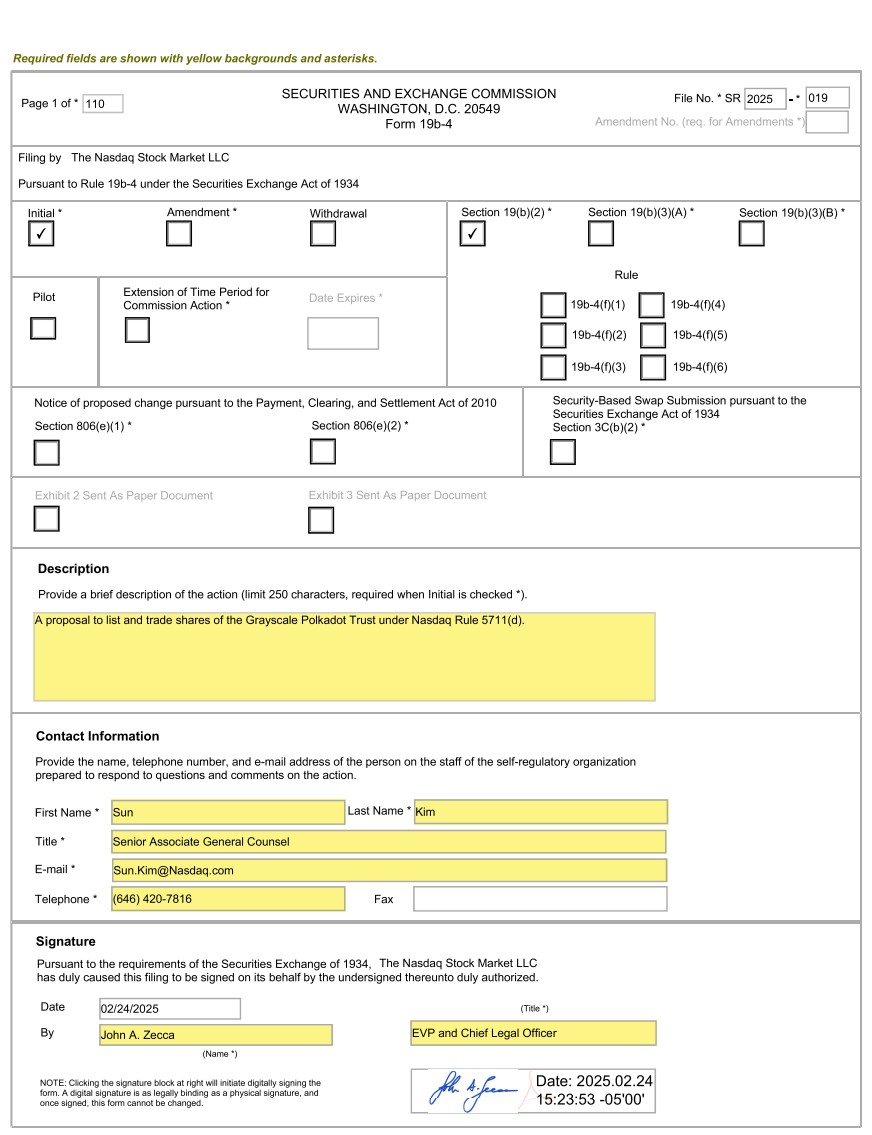
Nasdaq proposal to list and trade Grayscale’s Polkadot Trust. Source: Nasdaq
Related: Grayscale launches Pyth investment fund
Grayscale’s ETF expansion
Grayscale already lists two spot Bitcoin (BTC) ETFs and a spot Ether (ETH) ETF. It is also seeking to list ETFs holding Solana (SOL), Litecoin (LTC), XRP (XRP), Dogecoin (DOGE) and Cardano (ADA).
Additionally, the asset manager is seeking permission to list an ETF holding a diversified basket of cryptocurrencies, including several altcoins.
Grayscale operates dozens of single-asset crypto funds that are not traded on public exchanges.
In February, the company launched an investment fund for the Pyth Network’s native token. In January, it launched a non-listed investment fund for Dogecoin, the most popular memecoin by market capitalization.
In December, Grayscale launched two new investment funds for Lido and Optimism’s governance tokens — LDO (LDO) and OP (OP), respectively.
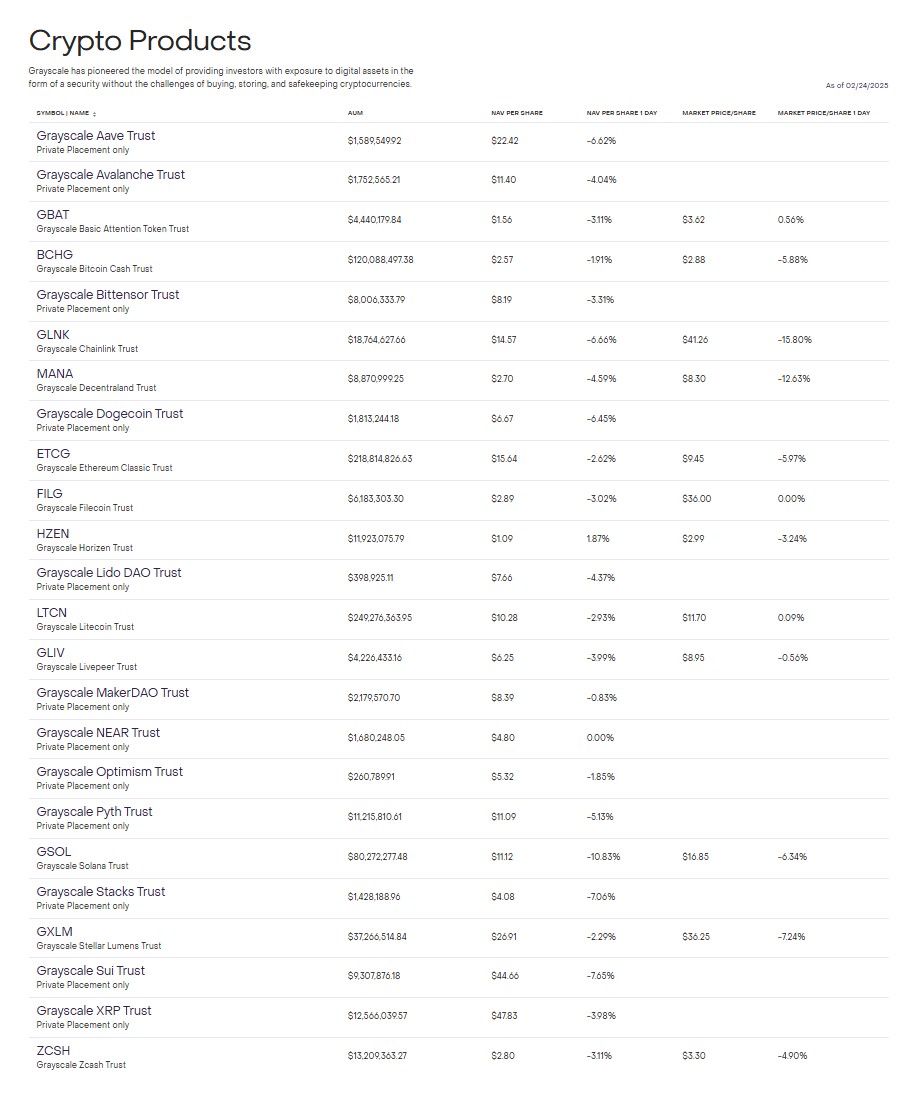
Grayscale’s single-asset crypto products. Source: Grayscale
Related: SEC acknowledges filing for Grayscale’s spot Cardano ETF
Crypto ETF filings proliferate
Grayscale is among upward of half a dozen asset managers seeking the SEC’s approval to list altcoin ETFs. Other issuers have proposed ETFs for altcoins, including Hedera (HBAR) and Official Trump (TRUMP).
Asset manager 21Shares is also seeking to list a Polkadot ETF.
Issuers are also waiting on SEC approval for proposed changes to existing ETFs, including allowances for staking, options and in-kind redemptions.
The SEC softened its stance on cryptocurrency after US President Donald Trump started his second term.
Under former President Joe Biden, the federal agency brought upward of 100 lawsuits against crypto firms, alleging various securities law violations. In 2024, the SEC approved spot Bitcoin and Ether ETFs but stymied proposed ETFs tied to other cryptocurrencies.
Bloomberg Intelligence has set the odds of an XRP ETF approval in the US at 65%. Its estimates for Litecoin and Solana ETF approval odds are even higher, at 90% and 70%, respectively.
Magazine: Unstablecoins: Depegging, bank runs and other risks loom
Litecoin txs surge 243% in 5 months amid ETF hype: Santiment
Daily transactions on the Litecoin network have hit $9.6 billion per day as exchange-traded fund issuers have been making moves to list their proposed Litecoin ETFs in the United States. Litecoin’s (LTC) market capitalization surged by 46% from Feb. 2 to 19, showing increased investor […]
Litecoin
Daily transactions on the Litecoin network have hit $9.6 billion per day as exchange-traded fund issuers have been making moves to list their proposed Litecoin ETFs in the United States.
Litecoin’s (LTC) market capitalization surged by 46% from Feb. 2 to 19, showing increased investor interest, reported Santiment on Feb. 21. It added that part of this growth comes from “its strong rise in network utility, which has been processing $9.6 billion in daily transaction volume over the past 7 days.”
Litecoin had around $2.8 billion in daily transaction volume in late August so current levels represent a surge of 243% in five months. Additionally, LTC prices have doubled since early November, outpacing the broader crypto market, which has seen gains of 42% over the same period.
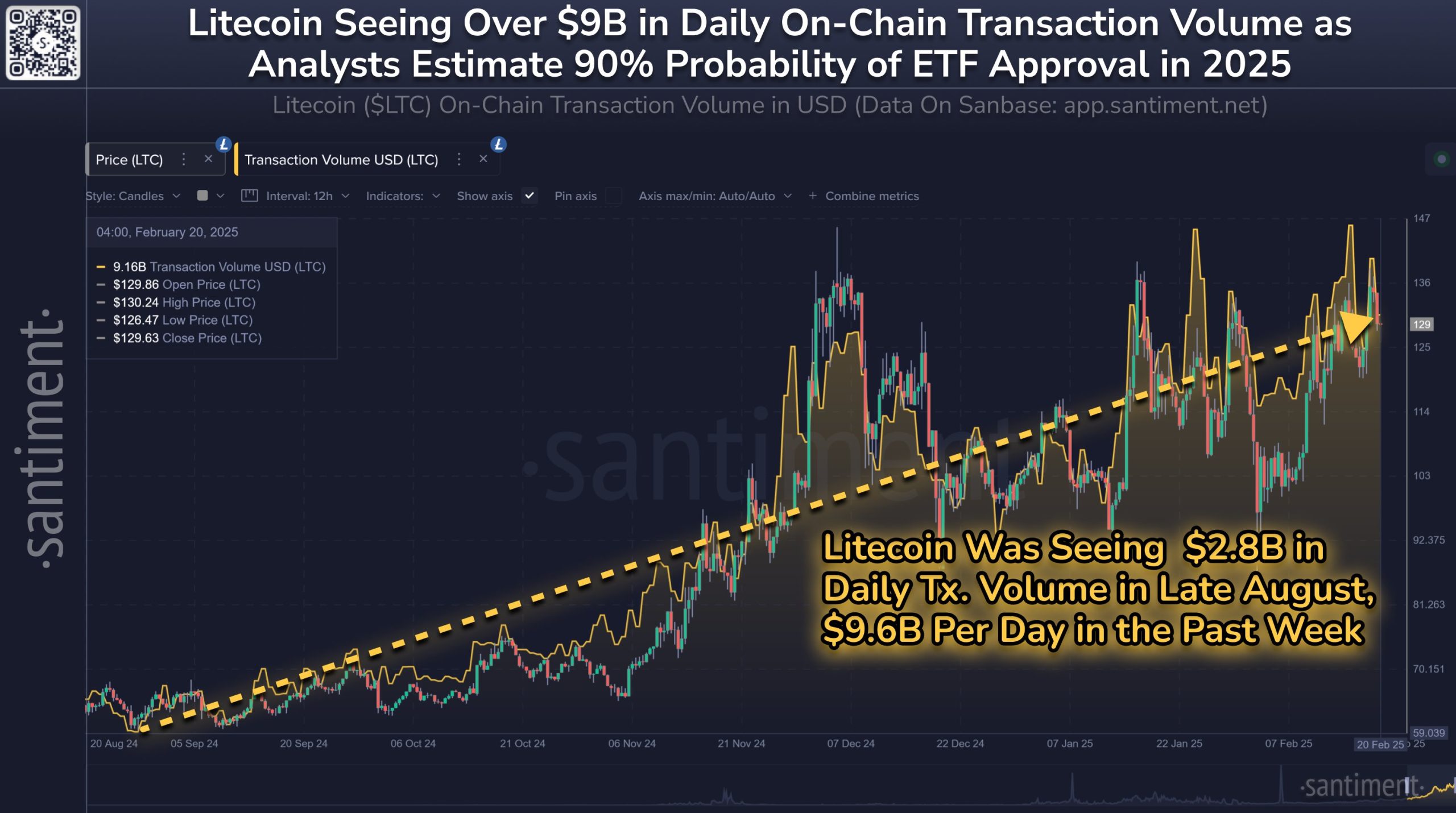
Litecoin daily transaction volume vs price. Source: Santiment
“There is clear growing excitement around a potential Litecoin ETF, 13 months after Bitcoin’s first ETFs were approved by the SEC,” said Santiment.
The Securities and Exchange Commission posted an acknowledgment for a rule change to list the CoinShares spot Litecoin ETF on the Nasdaq on Feb. 19.
Meanwhile, a listing of Canary Capital’s Litecoin ETF was spotted on the Depository Trust and Clearing Corporation (DTCC) system under the ticker LTCC on Feb. 20.
The DTCC is a key part of global financial markets and processes trillions of dollars in securities transactions each day, explained the Litecoin Foundation, which added, “It’s a key preparatory step for the fund’s potential launch.”
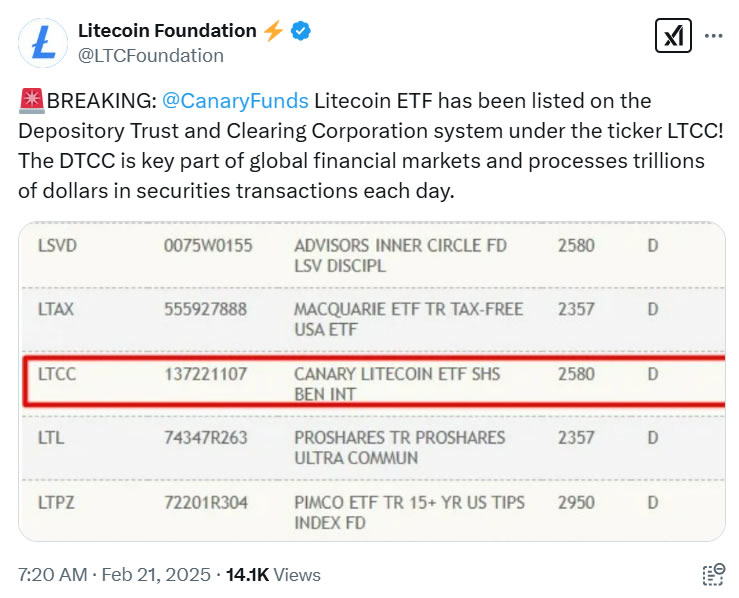
Source: Litecoin Foundation
Bloomberg ETF analyst Eric Balchunas cautioned that it doesn’t mean the product is approved or ready to start trading, “but it does show the issuer is making preparations for when it is.” He added that the analysts’ odds for approval this year were still at 90%.
Related: Analyst says spot Bitcoin ETFs used for ‘massive market manipulation’ — Is he right?
LTC prices spiked around 8.5% in response to the DTCC listing, climbing from an intraday low of $127 to $138 before a slight pullback on Feb. 21.
The asset has risen almost 30% over the past fortnight, outperforming Bitcoin (BTC), which has remained tightly range-bound since it fell back into five figures in early February.
Magazine: ETH whale’s wild $6.8M ‘mind control’ claims, Bitcoin power thefts: Asia Express

Price analysis 2/19: BTC, ETH, XRP, SOL, BNB, DOGE, ADA, LINK, XLM, LTC
On Feb. 9, Bitcoin (BTC) briefly rallied above $96,500, but the general daily price action has been more of the same sideways range trading as traders await a catalyst to start a trending move. The longer the price remains in a range, the stronger the […]
Litecoin
On Feb. 9, Bitcoin (BTC) briefly rallied above $96,500, but the general daily price action has been more of the same sideways range trading as traders await a catalyst to start a trending move. The longer the price remains in a range, the stronger the eventual breakout or breakdown from it.
CryptoQuant CEO Ki Young Ju said in a post on X that Bitcoin would remain in a bull phase even with a 30% drop to $77,000, based on historical cyclical patterns. In a separate “Quicktake” blog post, CryptoQuant contributing analyst Timo Oinonen said that a sharp correction in Bitcoin “could be multiple months or even a year away.”
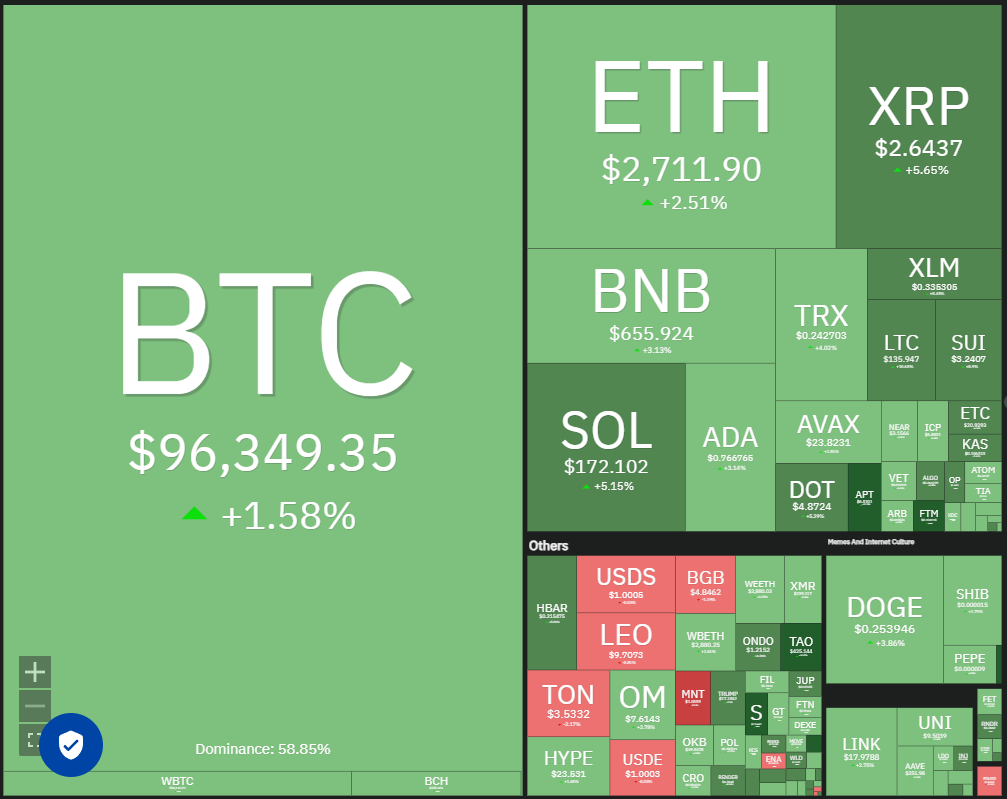
Crypto market data daily view. Source: Coin360
Even as Bitcoin consolidates, some analysts are turning positive on Ether (ETH). Santiment analysts said in a post on X that only 6.38% of Ether’s available supply remains on the exchanges as investors continue moving it to cold wallets. That reduces the possibility of a significant sell-off, but the analysts added that the data should be considered a long-term metric rather than used for swing trading.
Could Bitcoin break above the critical $100,000 resistance and pull altcoins higher? Let’s analyze the charts of the top 10 cryptocurrencies to find out.
Bitcoin price analysis
Sellers pulled Bitcoin below the $94,000 support on Feb. 18, but the long tail on the candlestick shows solid buying at lower levels.
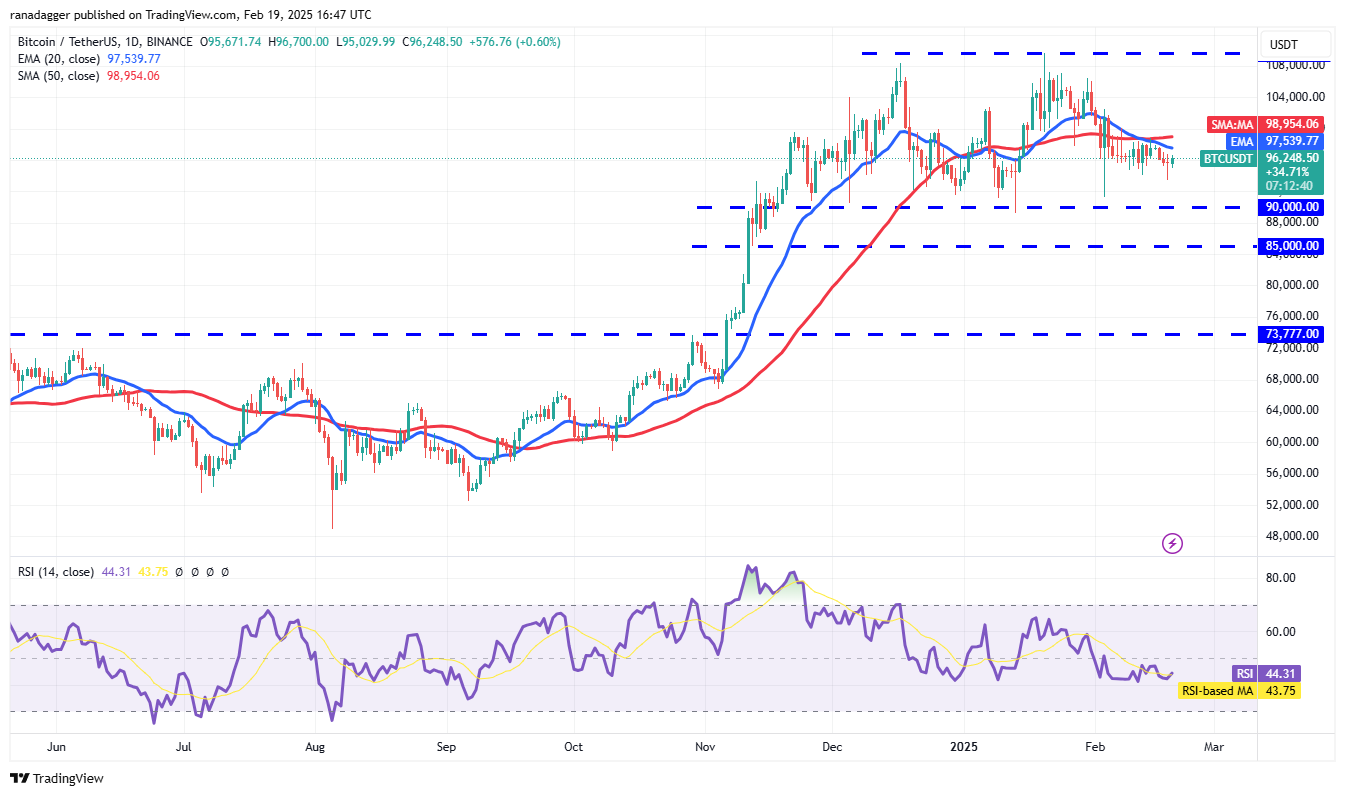
BTC/USDT daily chart. Source: Cointelegraph/TradingView
The 20-day exponential moving average ($97,539) has started to turn down, and the relative strength index (RSI) is in the negative territory, indicating a slight edge to the bears. If the price turns down from the 20-day EMA, the BTC/USDT pair could plunge to the $90,000 support. This remains the key level for the bulls to defend because a break below $90,000 will complete a double-top pattern.
If buyers want to make a comeback, they will have to push the price above the 50-day simple moving average ($98,954). If they do that, the pair could ascend to $102,500 and subsequently to $106,500.
Ether price analysis
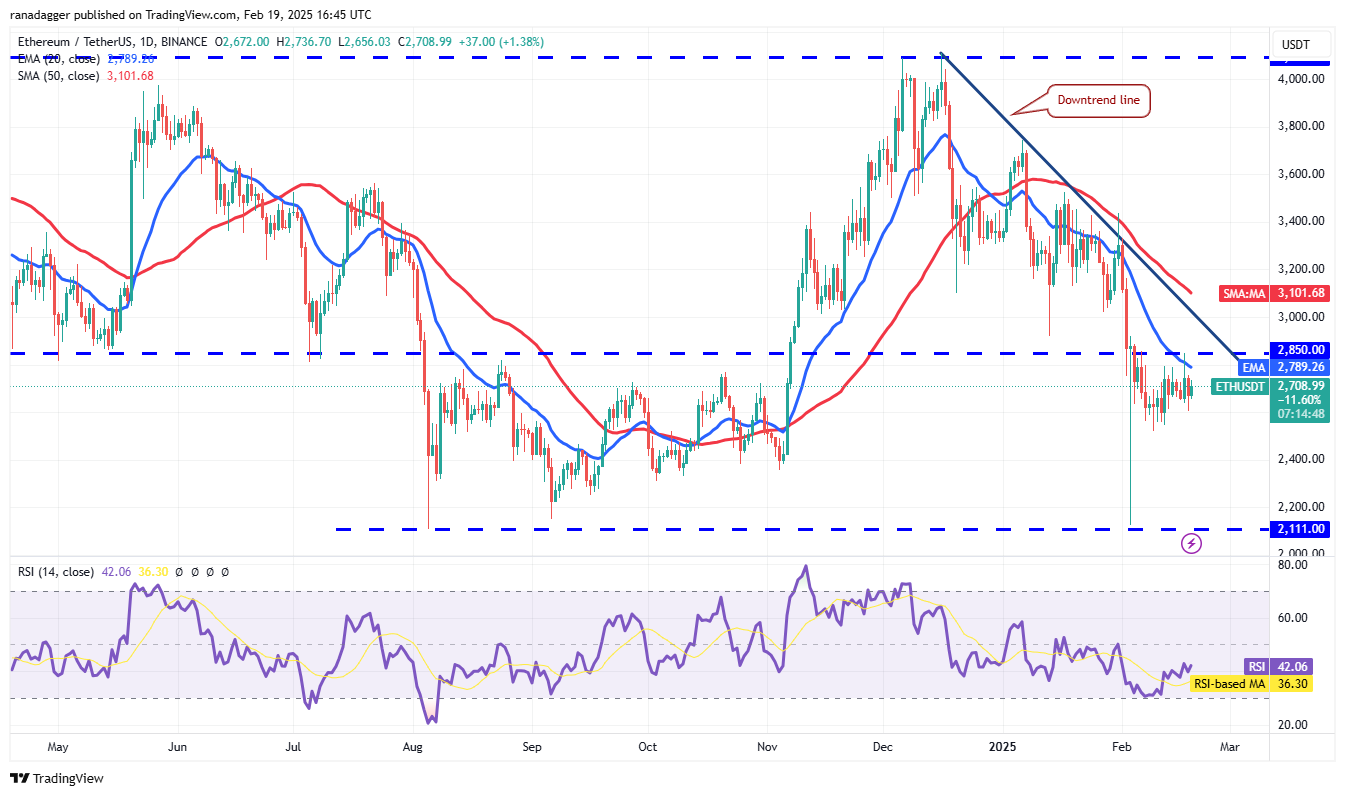
Ether has been trading below the breakdown level of $2,850 for the past few days, but the bears have failed to sink the price below $2,500. This suggests that selling dries up at lower levels.
ETH/USDT daily chart. Source: Cointelegraph/TradingView
Buyers will try to push the price to the downtrend line, a crucial level for the bears to defend. If the price turns down from the downtrend line but finds support at the 20-day EMA ($2,789), it will signal buying on dips. That increases the possibility of a break above the downtrend line. The ETH/USDT pair may then climb to $3,400.
Contrary to this assumption, if the price turns down and breaks below $2,500, the pair could decline to $2,400 and, after that, to $2,300.
XRP price analysis
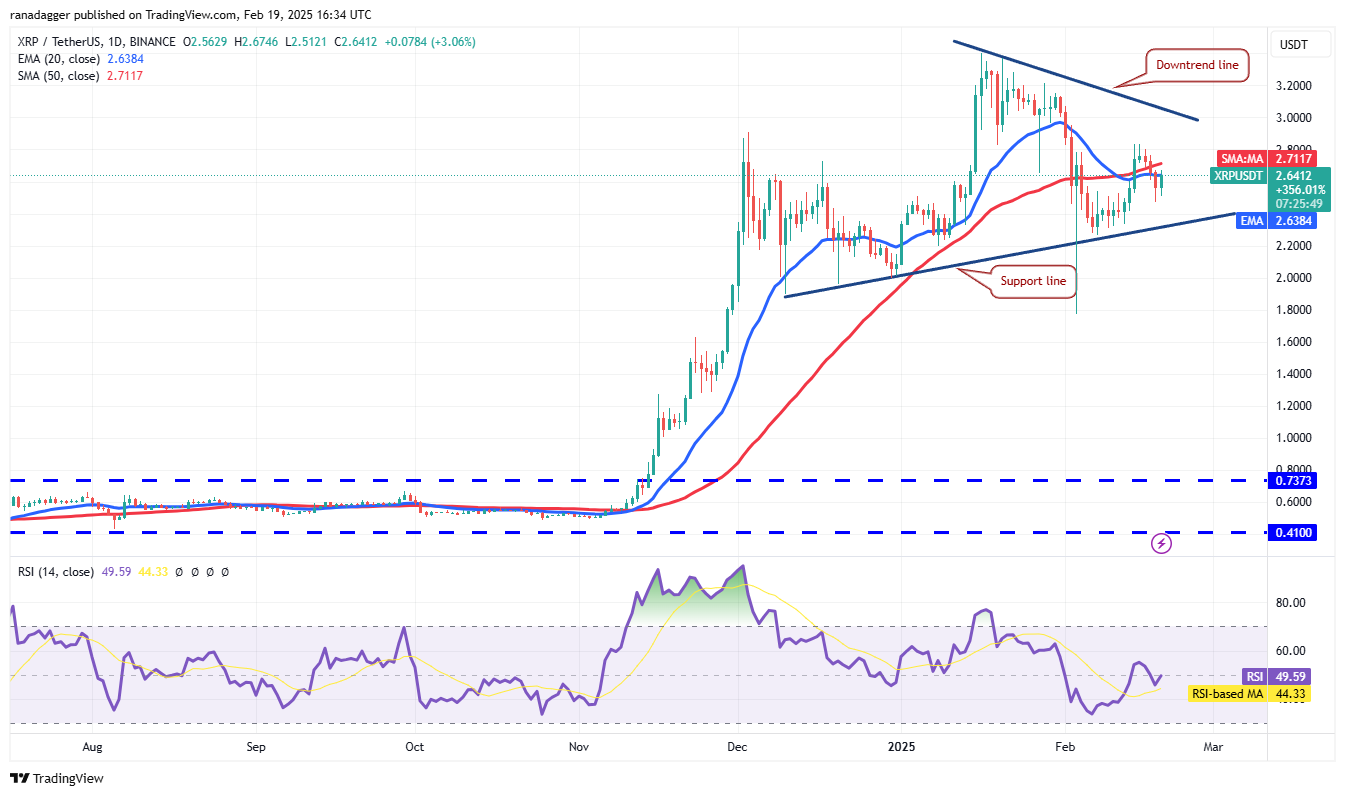
XRP (XRP) is witnessing a tough battle between the bulls and the bears near the moving averages.
XRP/USDT daily chart. Source: Cointelegraph/TradingView
If the price turns down from the moving averages, the bears will try to sink the XRP/USDT pair below the support line of the symmetrical triangle. If they succeed, the pair could collapse to the solid support at $1.77.
This negative view will be invalidated in the near term if the price rises and breaks above the moving averages. The pair could rally to the downtrend line, where the bears are expected to mount a strong defense.
Solana price analysis
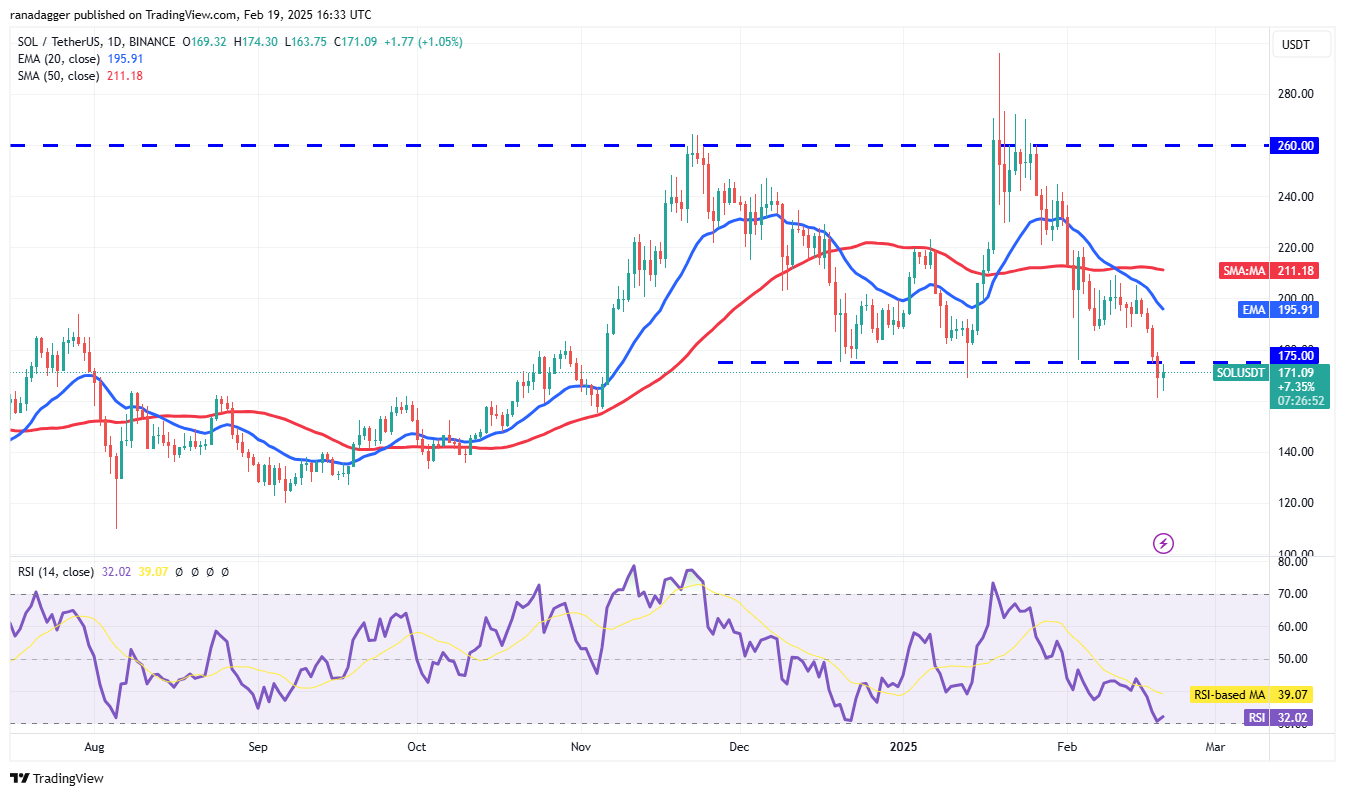
Solana (SOL) plunged and closed below the $175 support on Feb. 18, indicating the start of a deeper correction.
SOL/USDT daily chart. Source: Cointelegraph/TradingView
However, the buyers are unlikely to give up easily. They will try to push the price back above $175. If they succeed, it will suggest that the breakdown below $175 may have been a bear trap. The SOL/USDT pair could rise to the 20-day EMA ($195) and later to the 50-day SMA ($211).
On the contrary, if the price turns down from $175, it will suggest that the bears have flipped the level into support. The pair may slump to $155 and subsequently to $133.
BNB price analysis
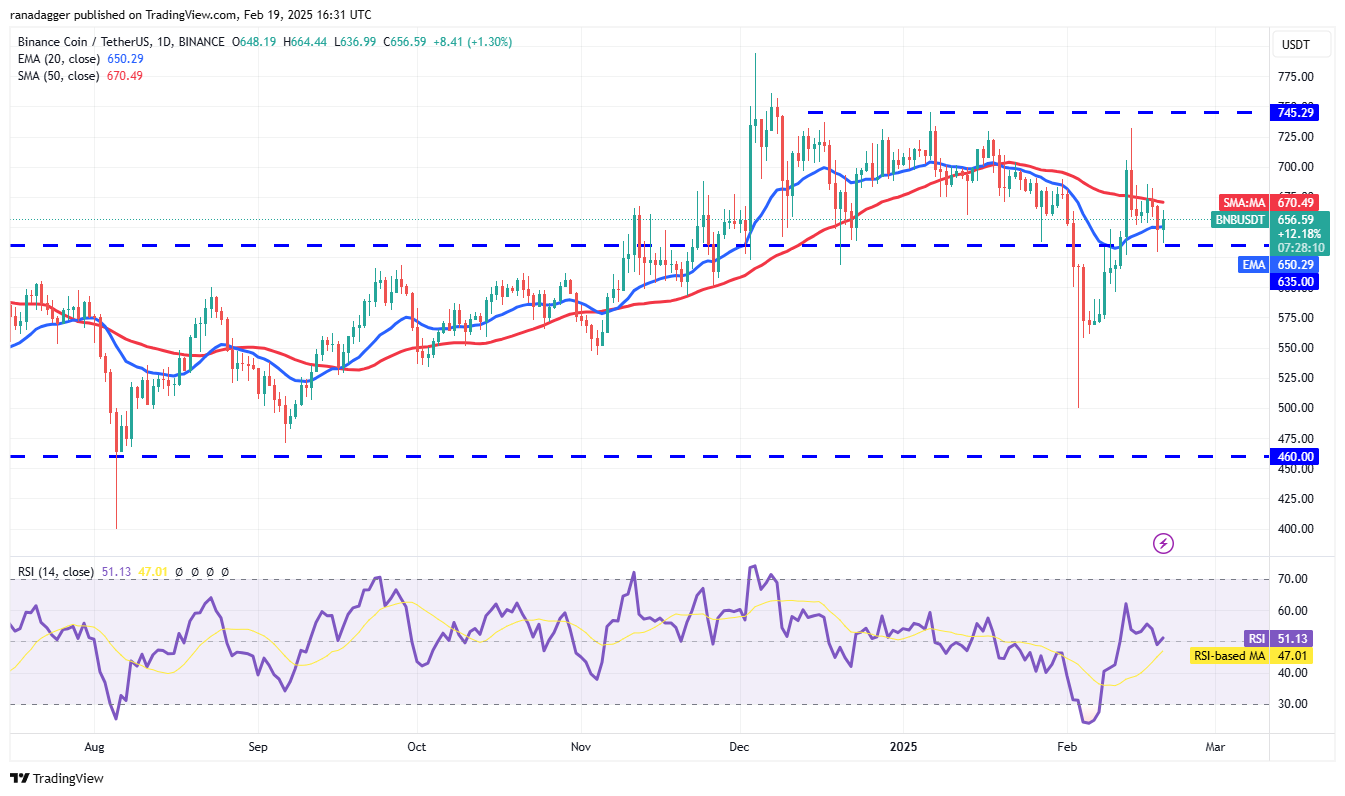
BNB (BNB) is attempting to rebound off the $635 support, signaling solid demand at lower levels.
BNB/USDT daily chart. Source: Cointelegraph/TradingView
The relief rally is expected to face selling at the 50-day SMA ($670). If buyers push and maintain the price above the 50-day SMA, it will indicate that the BNB/USDT pair could swing between $745 and $635 for a few days.
Contrarily, if the price turns down from the moving averages, it will indicate selling on minor rallies. That increases the likelihood of a break below $635. If that happens, the pair may slide to $596 and then to $557.
Dogecoin price analysis
Dogecoin (DOGE) has been gradually dropping toward the support line of the descending channel pattern, indicating that the bears are in charge.
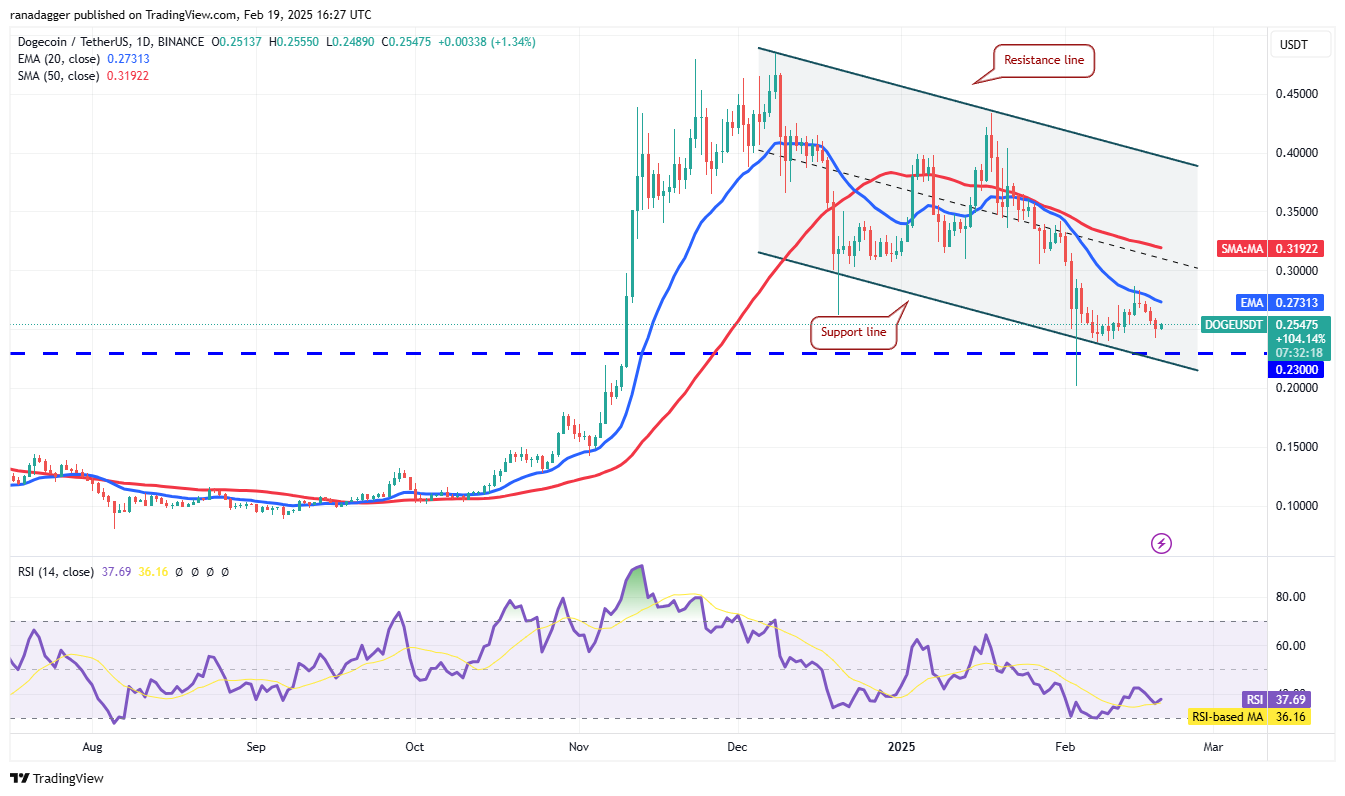
DOGE/USDT daily chart. Source: Cointelegraph/TradingView
Buyers are expected to defend the support line, but if the bears prevail, the DOGE/USDT pair could retest the Feb. 3 intraday low of $0.20. If this level also cracks, the pair could plunge to $0.15.
The first sign of strength will be a break and close above the 20-day EMA ($0.27). The pair could then rise to the 50-day SMA ($0.31), which is expected to attract strong selling by the bears.
Cardano price analysis
Cardano (ADA) turned down from the 20-day EMA ($0.79) on Feb. 18, indicating that the sentiment remains negative, and traders are selling on rallies.
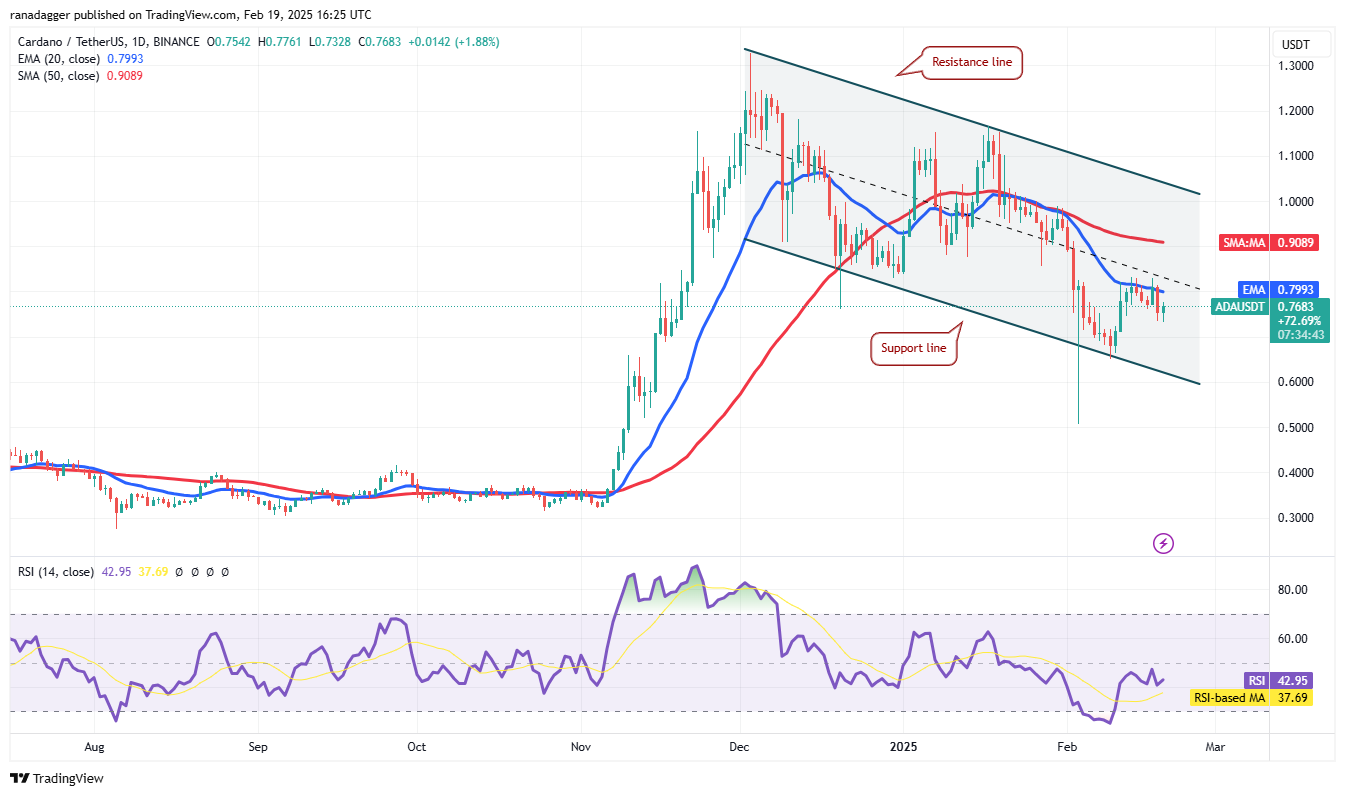
ADA/USDT daily chart. Source: Cointelegraph/TradingView
The bears will try to pull the price to the support line of the descending channel pattern, which is a critical level to watch out for. A break and close below the support line could sink the ADA/USDT pair to $0.50.
On the upside, the bulls will have to push and sustain the price above the 20-day EMA to start a move to the 50-day SMA ($0.90). Such a move suggests that the pair may extend its stay inside the channel.
Related: How long will Bitcoin’s price consolidation last?
Chainlink price analysis
Chainlink (LINK) turned down sharply from $19.25 on Feb. 18, indicating that the bears are trying to flip the level into resistance.
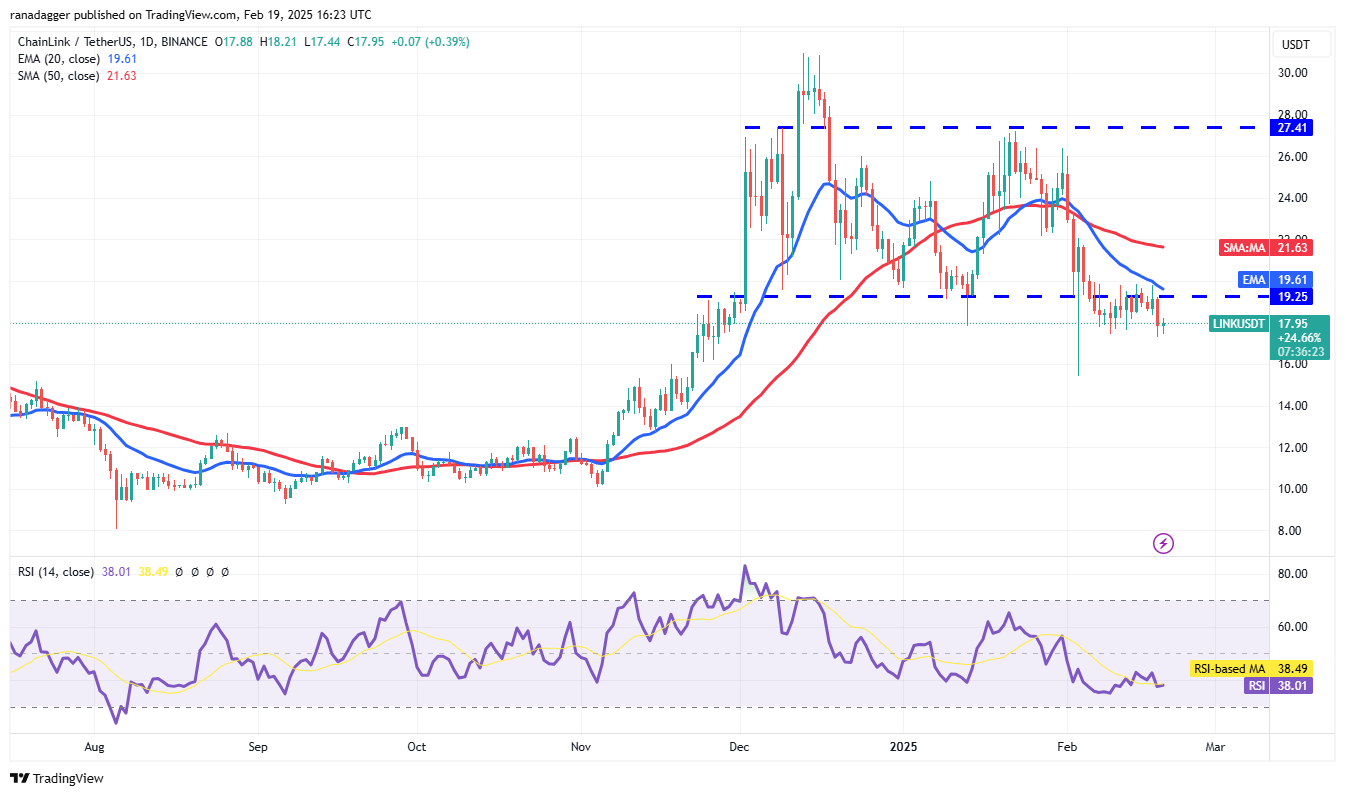
LINK/USDT daily chart. Source: Cointelegraph/TradingView
If the price closes below $17, it will signal the start of a deeper correction. The LINK/USDT pair could drop to the Feb. 3 low of $15.40. Buyers are expected to defend this level as a break below it may sink the pair to $13.
Time is running out for the bulls. If they want to make a comeback, they will have to push and sustain the price above the 20-day EMA ($19.61). The pair may then rally to $22, suggesting that the markets rejected the breakdown below $19.25.
Stellar price analysis
Stellar (XLM) has formed a large descending triangle pattern, which will complete on a break and close below $0.31.
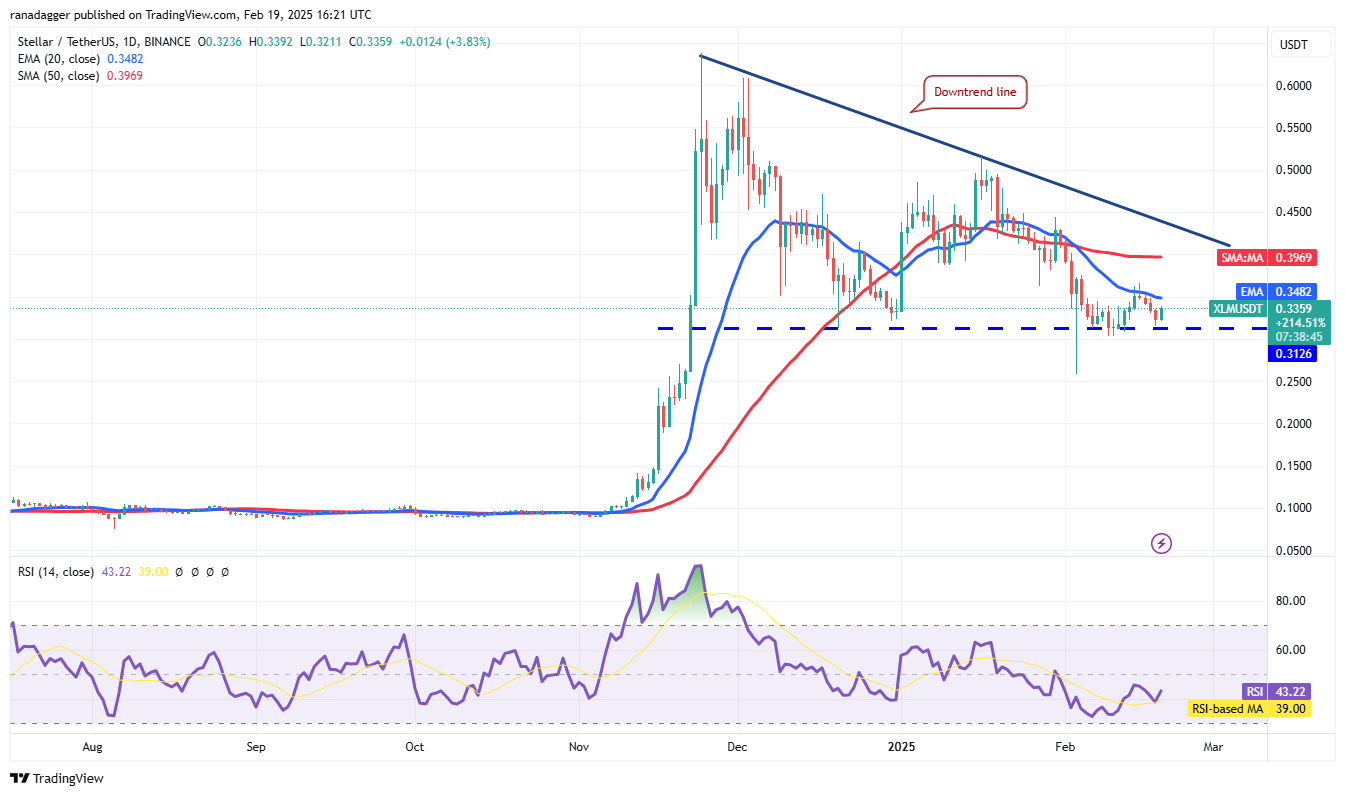
XLM/USDT daily chart. Source: Cointelegraph/TradingView
The downsloping 20-day EMA ($0.34) and the RSI in the negative territory indicate advantage to sellers. If the $0.31 support cracks, the selling could intensify, and the XLM/USDT pair could drop to $0.26 and thereafter to $0.20.
Instead, if the price breaks above the 20-day EMA, it will open the doors for a possible rally to the downtrend line. Buyers will have to pierce the downtrend line to indicate that the correction may be over.
Litecoin price analysis
Litecoin (LTC) broke above the symmetrical triangle pattern on Feb. 19, indicating that the indecision resolved in favor of the bulls.
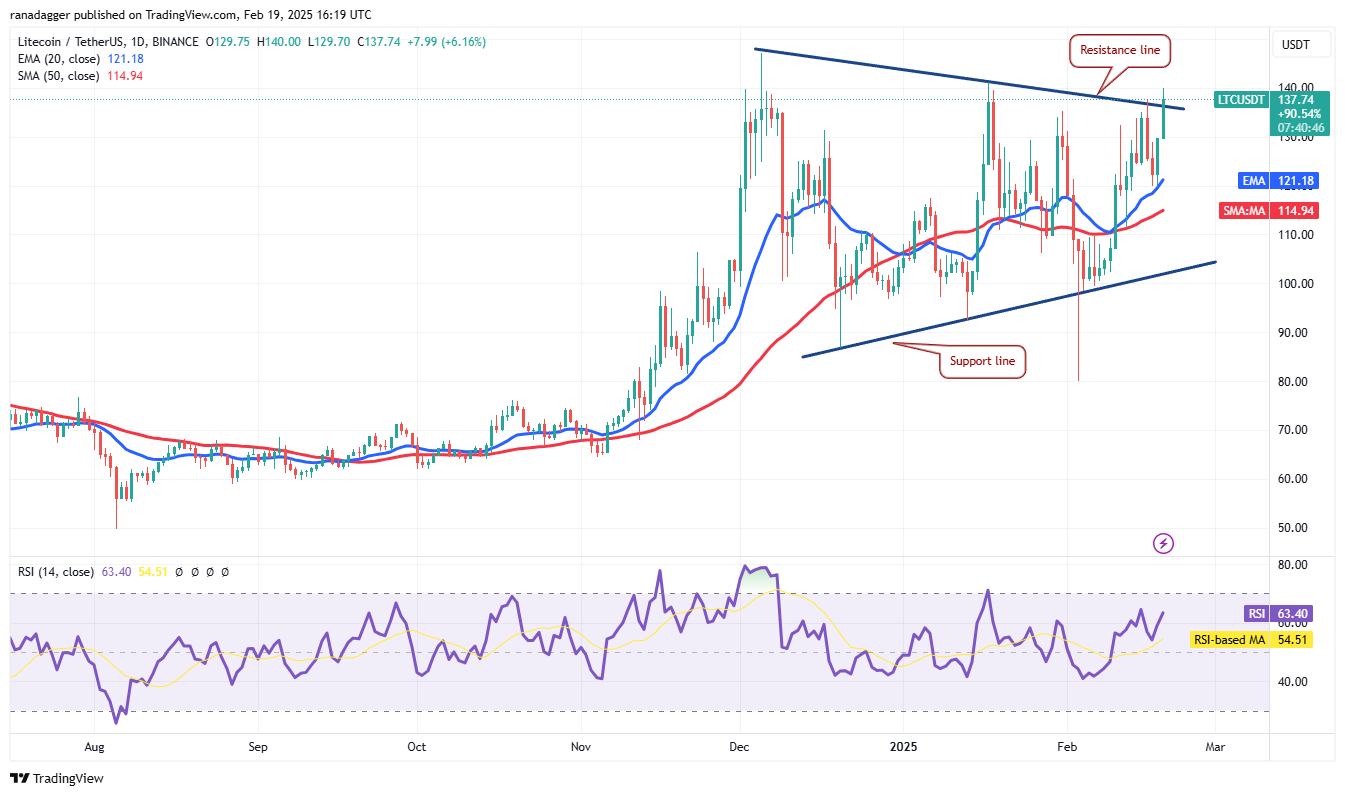
LTC/USDT daily chart. Source: Cointelegraph/TradingView
The upsloping 20-day EMA ($121) and the RSI in the positive zone suggest the path of least resistance is to the upside. If buyers maintain the price above the resistance line, the LTC/USDT pair could surge to $147. The pattern target from the breakout of the triangle is $197.
Contrary to this assumption, if the price fails to sustain above the resistance line, it will signal a lack of demand at higher levels. The pair may then drop to the 20-day EMA, which is expected to act as a strong support.
This article does not contain investment advice or recommendations. Every investment and trading move involves risk, and readers should conduct their own research when making a decision.

The $LIBRA Memecoin Scam: Inside the Presidential Pump-and-Dump That Led to a $4 Billion Crash
The post The $LIBRA Memecoin Scam: Inside the Presidential Pump-and-Dump That Led to a $4 Billion Crash appeared first on Coinpedia Fintech News After Argentine President Javier Milei endorsed the LIBRA meme coin launched on February 14, 2025, it has become the subject of investigations […]
Research report
The post The $LIBRA Memecoin Scam: Inside the Presidential Pump-and-Dump That Led to a $4 Billion Crash appeared first on Coinpedia Fintech News
After Argentine President Javier Milei endorsed the LIBRA meme coin launched on February 14, 2025, it has become the subject of investigations by experts due to a pump-dump scam. When insiders quickly sold off their shares, they withdrew $107 million, causing the coin’s value to crash and wiping out over $4 billion from its market cap within just a few hours. This report will look into how the market reacted, the overall sentiment of the community, and the effects of the coin’s launch. We’ll also explore the roles of major figures, the Argentine government, and what might happen next with the $LIBRA coin.
From Startup to Scam: All About LIBRA Meme Coin
$LIBRA is a cryptocurrency created by entrepreneur Hayden Davis, who is also the CEO of Kelsier Ventures, a crypto investment firm. Bloomberg reports that KIP Protocol, a company focused on decentralized AI technology, was involved in launching $LIBRA.
KIP claims they joined after the launch to help select tech projects and support AI efforts. The coin runs on the Solana blockchain, known for its quick and cheap transactions, popular with meme coin traders.
People could buy the token through a website named vivalalibertadproject.com, a slogan often used by Milei, whose political party is also named La Libertad Avanza.
Presidential Endorsement Ignites a Meteoric Price Surge
On the evening of February 14, Argentine President Javier Milei posted on social media that the $LIBRA token would boost Argentina’s economy and support small businesses. He linked to the token’s website, promoting it as a way to fund local companies and ventures. It was reported that the $LIBRA token was created just before Milei’s announcement and the website domain was registered the same day.
Milei claimed in his post that Argentina was attracting global investment. Initially, $LIBRA’s price started near zero and was concentrated in a few digital wallets. After Milei’s endorsement, its price skyrocketed to nearly $5, pushing its market cap over $4 billion.
However, a community warning soon appeared on his post, advising users to verify the project before engaging, suggesting it might be a scam where developers abandon the project after collecting funds. Shortly after, Milei deleted his post and claimed he wasn’t fully aware of the project details and decided to stop supporting it.
Within a few hours, the token’s value plummeted to just cents, and its market cap lost over $4.4 billion. According to The Kobeissi Letter, insiders started selling off $87.4 million worth of $LIBRA within the first three hours of its launch, and 82% of the tokens were controlled by a single group without public disclosure of the token’s economics.
Hayden Davis, the entrepreneur behind $LIBRA, admitted to keeping some profits despite the token’s sharp decline.
President’s Gamble was Unexpected
Interest among retail investors in memecoins with celebrity endorsements surged following the release of the Official Trump (TRUMP) memecoin by US President Donald Trump on January 18. This was closely followed by the launch of the Melania Meme (MELANIA) token by First Lady Melania Trump on January 19 on the Solana network, just before the President’s inauguration on January 20.
Despite admitting to the mistake by the president, he again went on to retweet a post guiding how to buy Libra memecoin. The endorsement of the Libra meme coin by the Argentine president himself is very unexpected. A promotion of a random meme coin by such a highly valued government personal is the worst thing. This move by the president has been seen as unusual and indicates his active involvement in the scam.
The scam of Libra also impacted TRUMP token, resulting in a drop of $500 million in the market cap.
Argentina Officially Launches $LIBRA Investigation
Before the collapse, other blockchain data companies had already raised concerns about the project. For example, the blockchain analysis firm Bubblemaps highlighted issues with LIBRA’s tokenomics, pointing out that 82% of the tokens were available to be sold right from the beginning.
According to a statement from Argentina’s presidential office, the Oficina del Presidente, issued on X on February 16, Milei has asked the Anti-Corruption Office to investigate himself and all other government members for possible misconduct.
Meanwhile, Milei is under pressure from political rivals calling for his impeachment following his endorsement of a cryptocurrency that led to a $100 million scam.
In his statements and tweets, Milei has denied knowing about the project beforehand. However, he has deleted these statements. Additionally, differing stories are coming from others involved. Early Monday, KIP Protocol, a crypto and AI firm that has previously worked with the Argentine government, issued a detailed statement challenging many claims about their role in the LIBRA token launch.
The firm insists that their CEO, Julian Peh, only met with President Milei once on October 19, 2024, and that meeting did not cover any specific projects, including “Viva la Libertad” or any token launches. According to the company, no other staff members had meetings with the Argentine President.
Key Players and Their $LIBRA Conspiracy Exposed
After the LIBRA coin mess, the investigative journalist Coffeezilla reached out to people connected to the 0xcEA address and its creators. He found out that Hayden Mark Devis, CEO of Kelsier Ventures, his father Tom Davis, and known scammer Arunkumar Sugadevan were behind it.
In an interview, Tom Davis confessed that their group not only made the LIBRA memecoin but also manipulated its initial sale to profit from it. They used several wallet addresses to buy early and made $6 million from these actions.
Insider Trading Tactics
The investigation into the LIBRA scam showed that the scammers behind the project used their inside knowledge to play the market to their advantage. They used multiple wallets to quickly buy up large amounts of the token as soon as it launched, a tactic known as “sniping.”
This involves purchasing a newly launched token as soon as it is released, often before regular investors have a chance to react. These early buyers then sell their large holdings a few hours later for a significant profit, leaving ordinary investors with losses.
In the LIBRA case, the snipers, linked to the wallet address 0xcEA, sold over $100 million worth of the token just as its market value peaked, capitalizing on the surge and leaving other investors with devalued assets.
Connection Between Melania and Libra Memecoin
A joint investigation by the blockchain analytics firm Bubblemaps and the pseudonymous on-chain investigator Stephen Findeisen, also known as Coffeezilla, has revealed evidence that the same group was behind the failed launches of both the LIBRA and MELANIA tokens. Bubblemaps shared on Twitter, “After analyzing cross-chain transfers and timing patterns, we’re highly confident this is the case.”
The investigation found that connected wallet activities between different projects showed how profits from one scheme were used to fund another via cross-chain transfers. For example, a key wallet on the Solana network, labeled “P5tb4,” made over $2.4 million from early trades of the MELANIA token and then transferred those funds to an Avalanche wallet “0xcEA” linked directly to the token’s creator.
Blockchain records show that the wallet 0xcEA transferred 1.6 million USDC to three Solana wallets just a few hours before the $LIBRA token was launched. These wallets then quickly bought 3.77 million $LIBRA tokens and sold them for 8.25 million USDC, making a profit of $6.65 million.
Further analysis indicates that the wallet “0xcEAe…06e2” transferred USDC from Avalanche to Solana and made payments to Dave Portnoy, suggesting that this wallet could be directly linked to the $LIBRA team.
The LIBRA token, which briefly had the support of Argentine President Javier Milei, quickly reached a multi-billion-dollar market cap before plummeting 95% when insiders pulled out $87 million. Similarly, the MELANIA token, endorsed by the U.S. first lady in January, soared in value initially but then crashed, leading to significant losses for everyday investors.
According to Bubblemaps, this group likely led several other token launches with names like TRUST, KACY, VIBES, and HOOD, all following similar patterns of quick profits followed by sharp declines.
Tracing the Same Snipers: From TRUMP to LIBRA
New data from Arkham indicates a pattern of quick large-scale purchasing by the same group behind both the TRUMP and LIBRA memecoin launches. Blockchain records show that an entity connected to the 6QS address—which sniped over $1 million worth of TRUMP tokens in the first block of its launch—went on to distribute those tokens to the 5CP wallet and related addresses, eventually selling TRUMP for substantial profits.
Shortly after President Javier Milei retweeted a “How to Buy LIBRA” post, an address linked to this same network purchased $5 million worth of LIBRA.
This rapid, high-volume buy shows the earlier TRUMP sniping strategy, suggesting a similar approach to exploiting memecoin launches and endorsements. Investigators say such repeated, large-scale tactics point to systematic insider market manipulation, bringing concerns that the individuals behind these trades are orchestrating pump-and-dump schemes across multiple projects.
Conclusion
Until the investigation concludes, we are left wondering who is really behind the scam: The President of Argentina, KIP Protocol, Kelsier Ventures, or Hayden Davis?
The LIBRA incident highlights the increasing dangers in the memecoin market. While many investors are drawn to the potential for fast returns, it’s often the insiders who actually benefit.
As more frauds are exposed, the demand for stricter regulation and greater openness in the memecoin space grows more urgent. The role of the 0xcEA wallet in the LIBRA scam showcases the darker side of the crypto space, where deceptive financial tactics and dishonesty run rampant without any checks.

Bitcoin trades in tight range as XRP, LT, OM, and GT aim to move higher
Bitcoin (BTC) has been quiet over the weekend, indicating that the bulls and the bears are waiting for the next trigger to make their move. Although traders seem uncertain in the near term, analysts remain bullish over the long term. Market analyst Gert van Lagen […]
Litecoin
Bitcoin (BTC) has been quiet over the weekend, indicating that the bulls and the bears are waiting for the next trigger to make their move. Although traders seem uncertain in the near term, analysts remain bullish over the long term.
Market analyst Gert van Lagen highlighted that Bitcoin has broken out of a megaphone pattern, which could start a parabolic rise toward the $270,000-$300,000 range by 2025. Separately, analyst apsk32 expects Bitcoin to follow gold’s rally and reach $400,000.
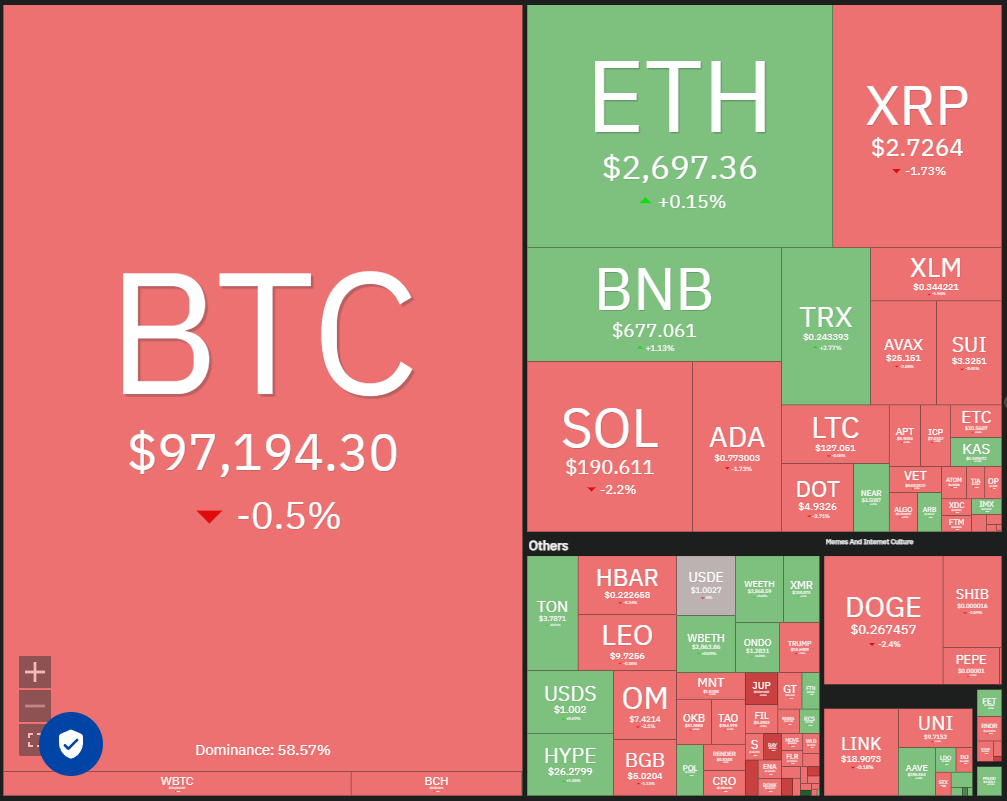
Crypto market data daily view. Source: Coin360
While analysts anticipate a large upward move in Bitcoin, they remain divided on the arrival of an altcoin season. One of the issues with altcoins is the rapid pace of new launches, which distributes traders’ liquidity thinly among tokens. CoinGecko co-founder and chief operating officer Bobby Ong said that 600,000 new tokens were created in January, a sharp rise from the roughly 50,000 new tokens minted every month in 2022-2023.
Could Bitcoin break above the tight range it has been stuck in for the past few days? Let’s look at the top cryptocurrencies that may move higher if that happens.
Bitcoin price analysis
Bitcoin is facing resistance at the moving averages, but a positive sign is that the bulls have not ceded much ground to the bears.
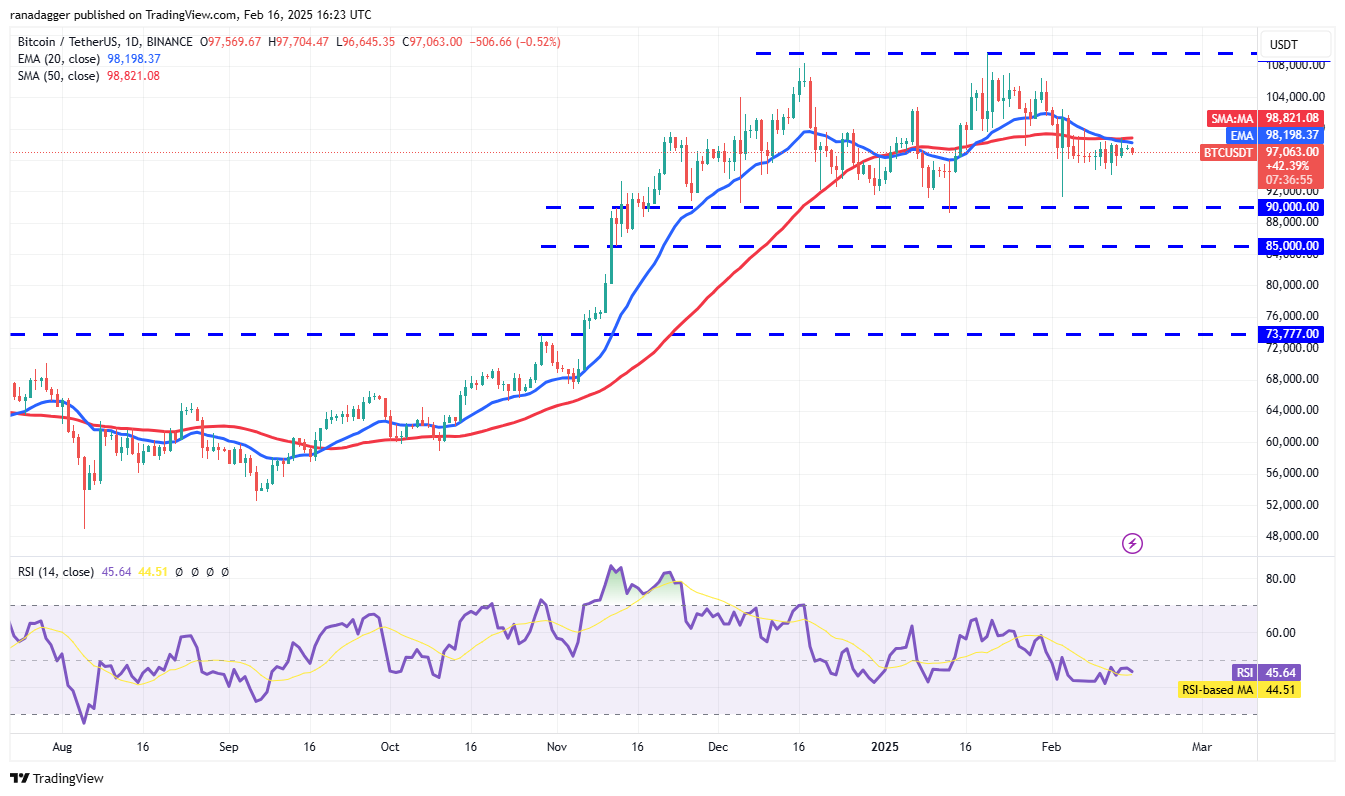
BTC/USDT daily chart. Source: Cointelegraph/TradingView
That increases the likelihood of a break above the moving averages. The $100,000 level is likely to act as a hurdle, but it is expected to be crossed. The BTC/USDT pair could rise to $102,500 and subsequently to $106,500.
If bears want to prevent the upside, they will have to drag the price below the immediate support at $94,000. That could sink the pair to the solid support at $90,000. Buyers are expected to fiercely the $94,000 level because a break below it will complete a bearish double-top pattern. The next support on the downside is $85,000.
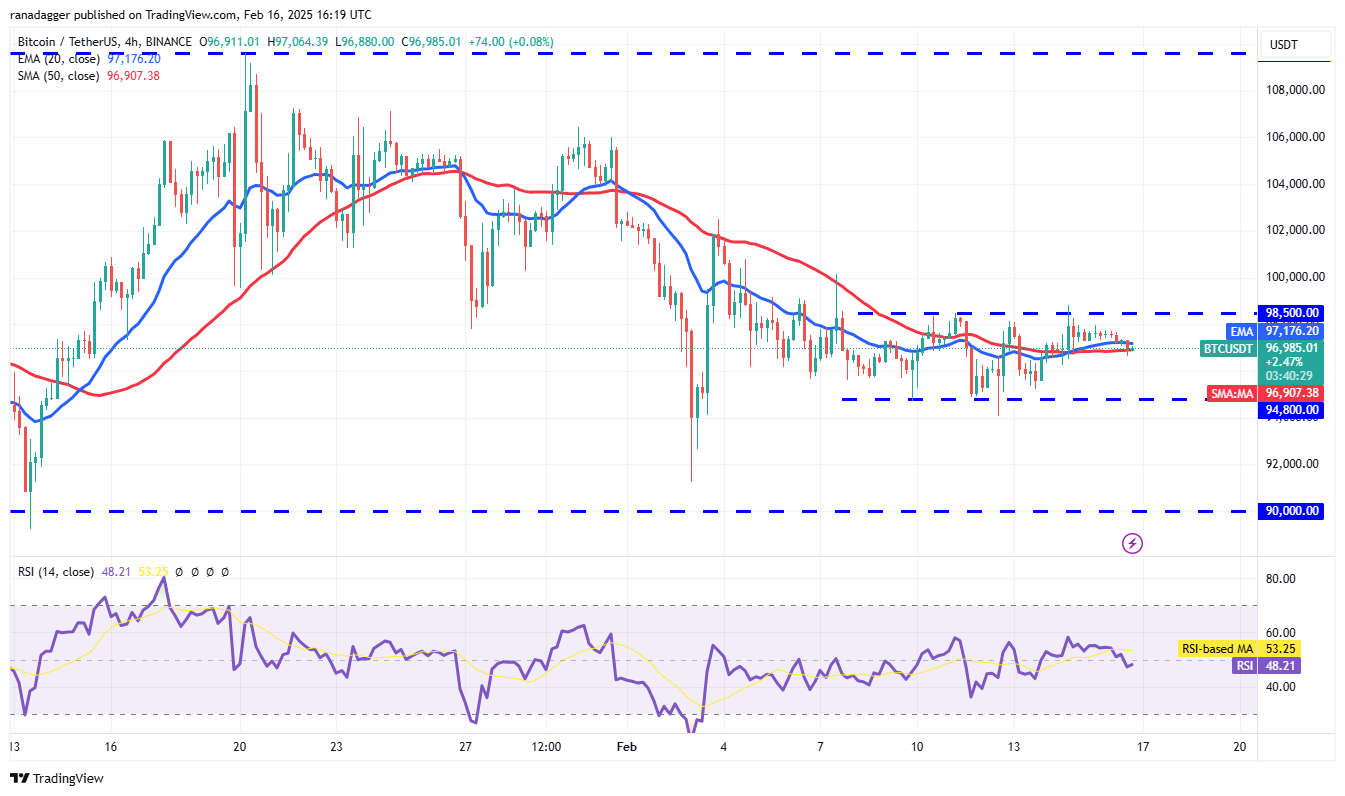
BTC/USDT 4-hour chart. Source: Cointelegraph/TradingView
The pair has been trading inside a tight range between $98,500 and $94,800. The moving averages have flattened out, and the relative strength index (RSI) is just below the midpoint, indicating a balance between supply and demand. Buyers will have to push the price above $98,500 to open the doors for a rally to $102,200.
Instead, if the price continues lower and breaks below the moving averages, it will suggest that the pair may remain inside the tight range for some more time. The short-term trend will shift in favor of the bears on a break below $94,000.
XRP price analysis
XRP (XRP) has formed a symmetrical triangle pattern, indicating indecision between the bulls and the bears.
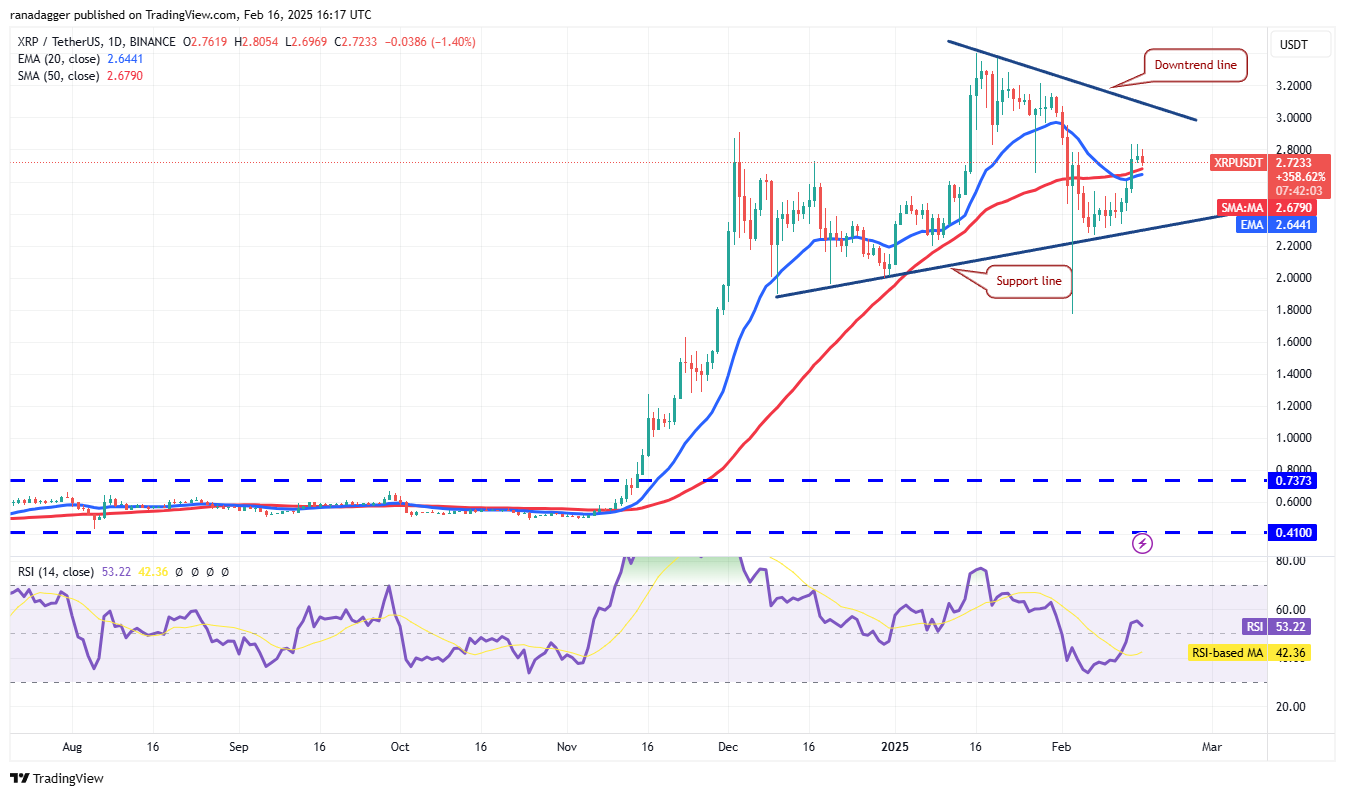
XRP/USDT daily chart. Source: Cointelegraph/TradingView
The 20-day exponential moving average ($2.64) has started to turn up gradually, and the RSI is in the positive zone, indicating a minor advantage for the bulls. The XRP/USDT pair could rise to the downtrend line, which is likely to act as a stiff resistance. Buyers will have to drive and maintain the price above the triangle to seize control.
Contrary to this assumption, if the price turns down and breaks below the moving averages, it will signal that the pair may remain inside the triangle for some more time.
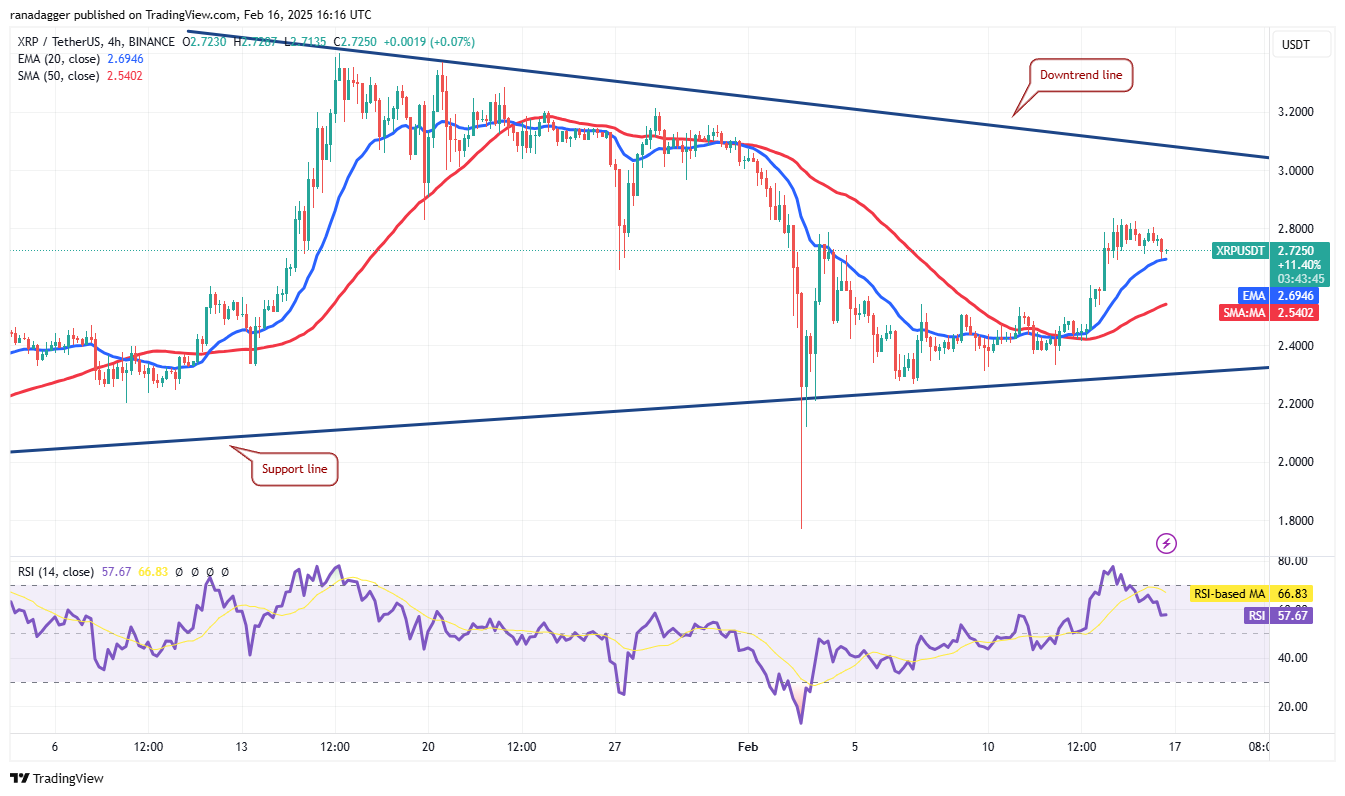
XRP/USDT 4-hour chart. Source: Cointelegraph/TradingView
Both moving averages are sloping up on the 4-hour chart, and the RSI is in the positive territory, indicating an advantage to the bulls. A break and close above $2.84 could clear the path for a rally to the downtrend line.
Conversely, a break and close below the 20-EMA could pull the pair to the 50-simple moving average. That suggests the pair may remain inside the triangle for a while longer. The bears will be back in the driver’s seat on a break below the support line.
Litecoin Token price analysis
Litecoin (LTC) has been trading inside a symmetrical triangle pattern for several days, indicating buying near the support line and selling at the resistance line.
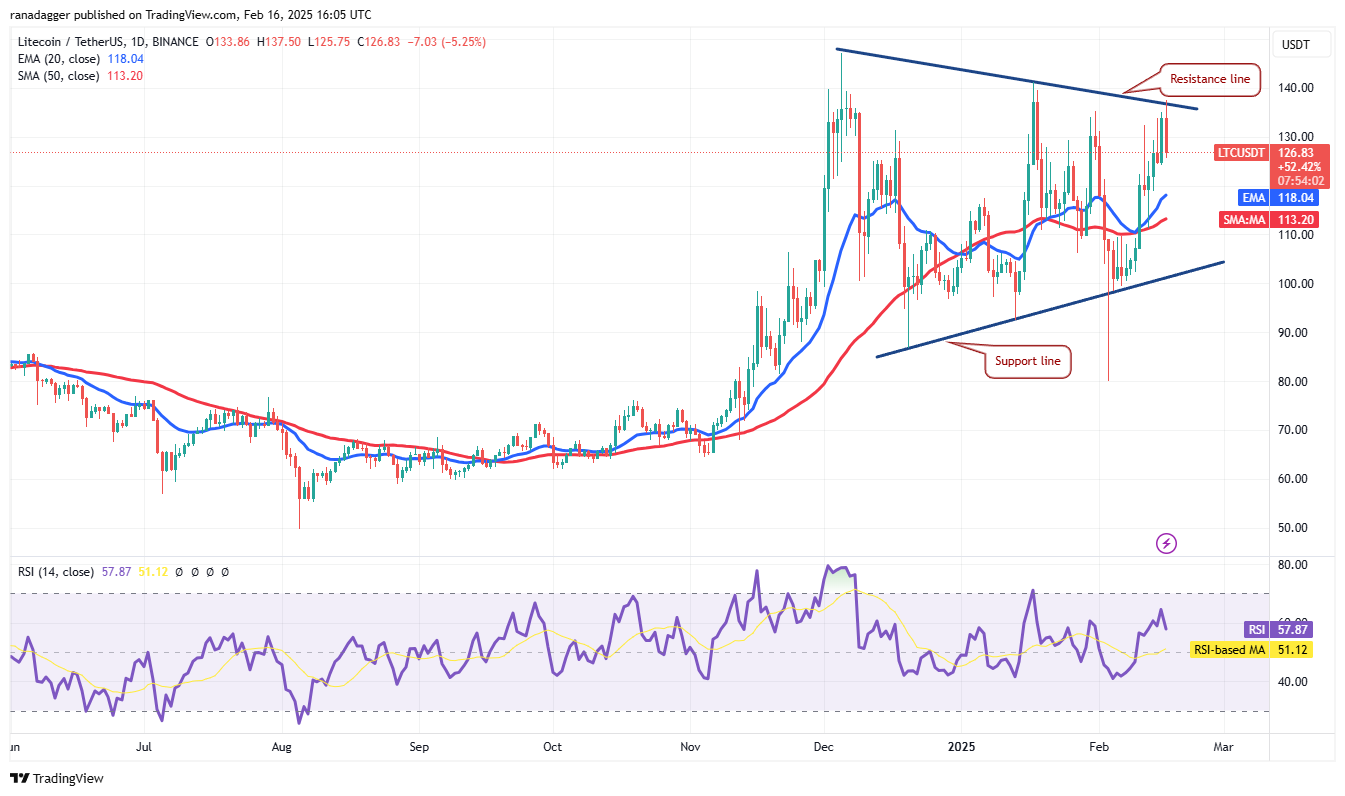
LTC/USDT daily chart. Source: Cointelegraph/TradingView
The upsloping 20-day EMA ($118) and the RSI above 57 suggest that buyers have a slight edge. If the price turns up from the current level or the 20-day EMA, it will signal buying on dips. The bulls will then try to propel the LTC/USDT pair above the triangle. If they succeed, the pair could rise to $141 and then $147.
On the other hand, a break and close below the 20-day EMA will indicate that the pair may oscillate inside the triangle for a few more days. The trend will favor the bears on a close below the support line.
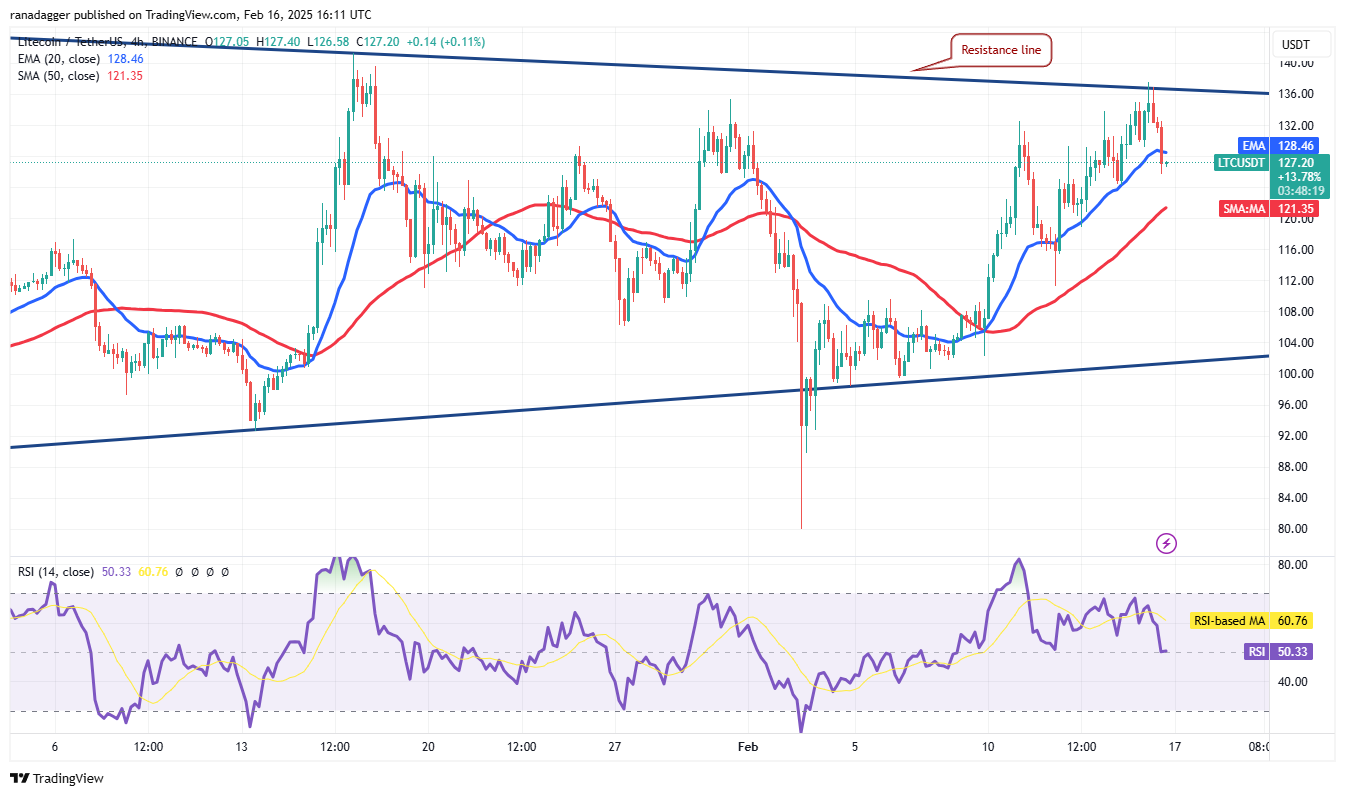
LTC/USDT 4-hour chart. Source: Cointelegraph/TradingView
The pair turned down from the resistance line and broke below the 20-EMA, suggesting profit booking by short-term traders. The bears will try to sink the price to the 50-SMA, which is a critical level for the bulls to defend. If the 50-SMA gives way, the pair could slump to $112.
This negative view will be invalidated if the price turns up from the current level or the 50-SMA and breaks above the resistance line. The pair could climb to $147, where the bears are likely to pose a substantial challenge.
Related: Here’s what happened in crypto today
MANTRA price analysis
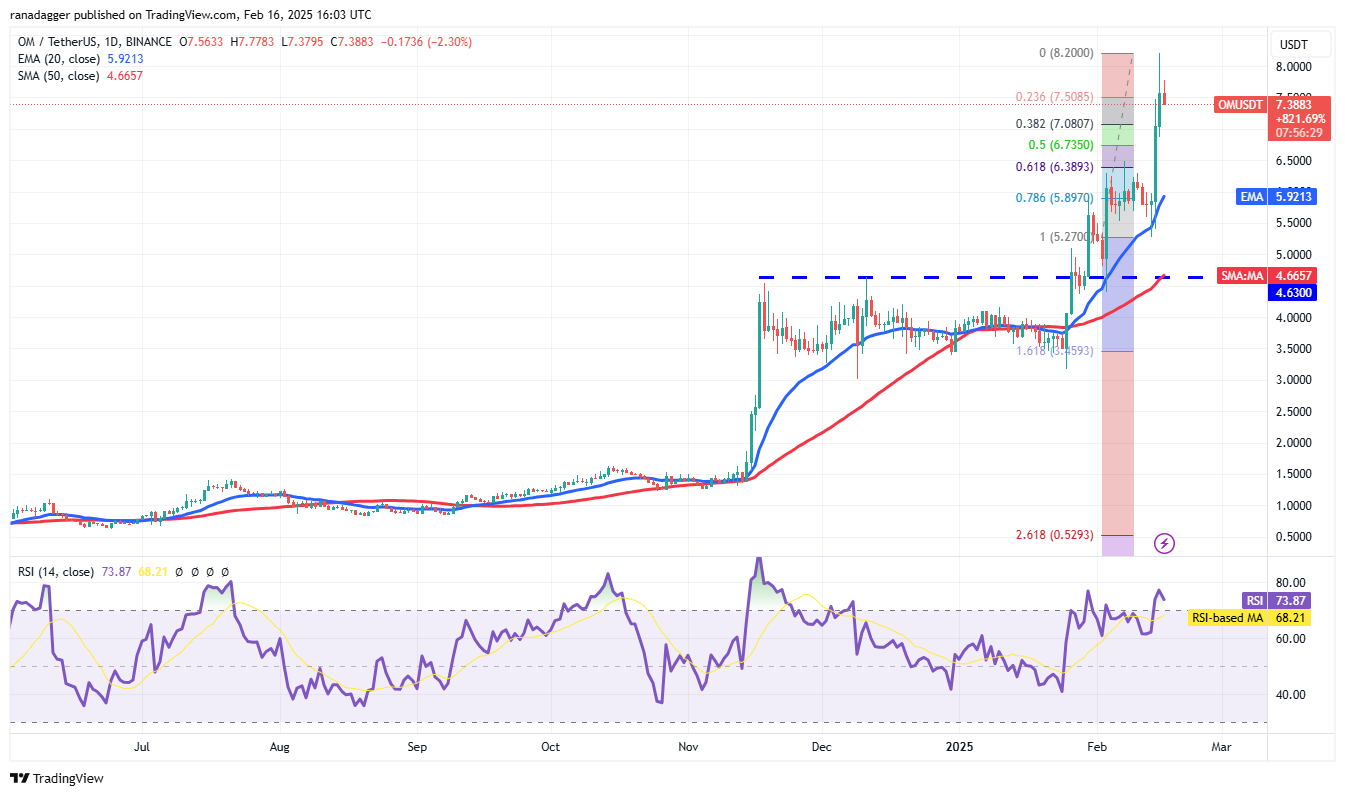
MANTRA (OM) has been in a strong uptrend, but the long wick on the Feb. 15 candlestick shows profit booking above $8.
OM/USDT daily chart. Source: Cointelegraph/TradingView
The OM/USDT pair is likely to find support at the 38.2% Fibonacci retracement level of $7.08 and then at the 50% retracement level of $6.73. A shallow pullback will increase the likelihood of the continuation of the uptrend. If the price breaks above $8.20, the pair could surge to $10.
Alternatively, a deeper pullback suggests that traders are rushing to the exit. The pair may slump to the 20-day EMA ($5.92), which is an important support to watch out for because a break below it could pull the pair to $5.27.
OM/USDT 4-hour chart. Source: Cointelegraph/TradingView
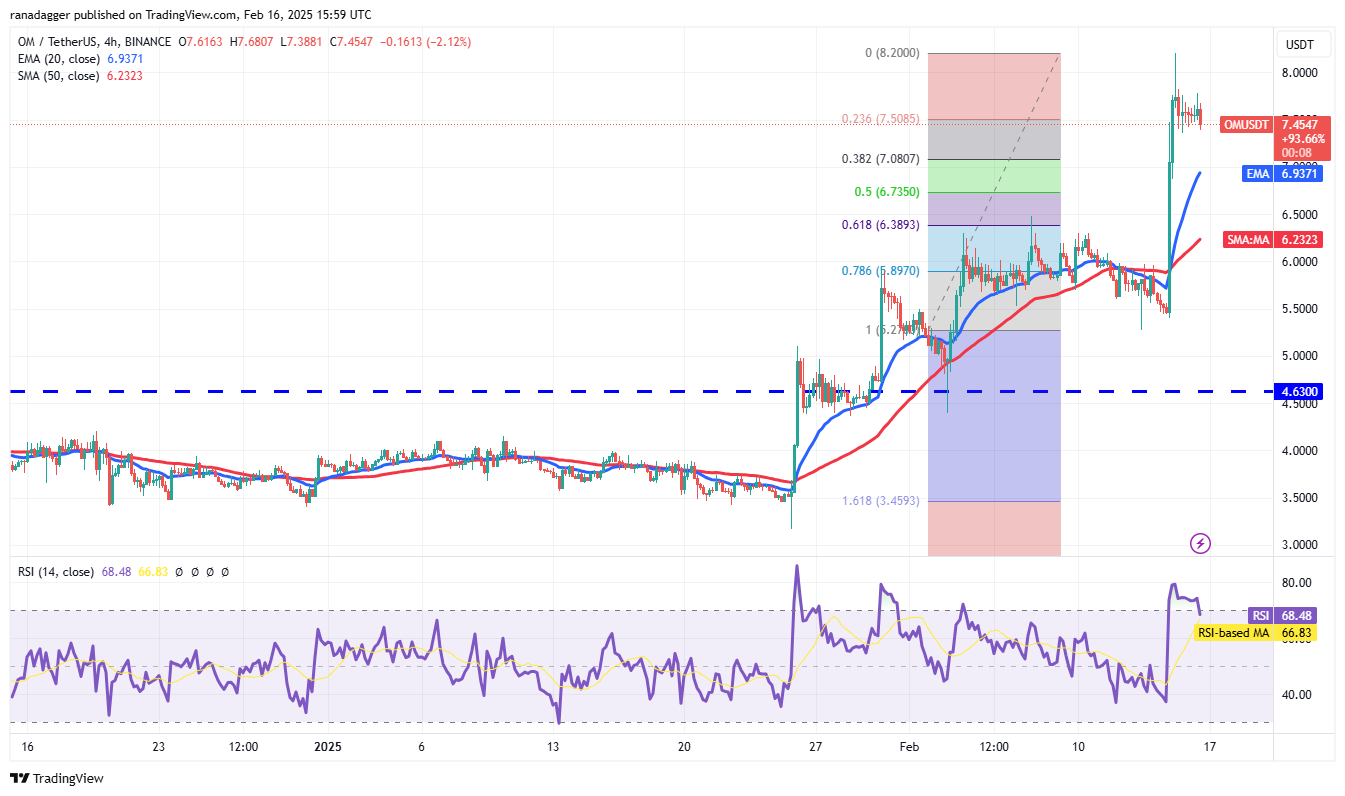
The 4-hour chart shows that the pair has been trading inside a tight range between $7.35 and $7.82. If the price turns up from the current level and rises above $7.82, the pair could rally to $8.20.
Contrarily, if the price breaks below $7.35, the pair could drop to $7.08 and, after that, to the 20-EMA. If the price rebounds off the 20-EMA, the pair will again try to resume the uptrend. Sellers will have to yank the price below the 20-EMA to start a deeper correction.
Gate Token price analysis
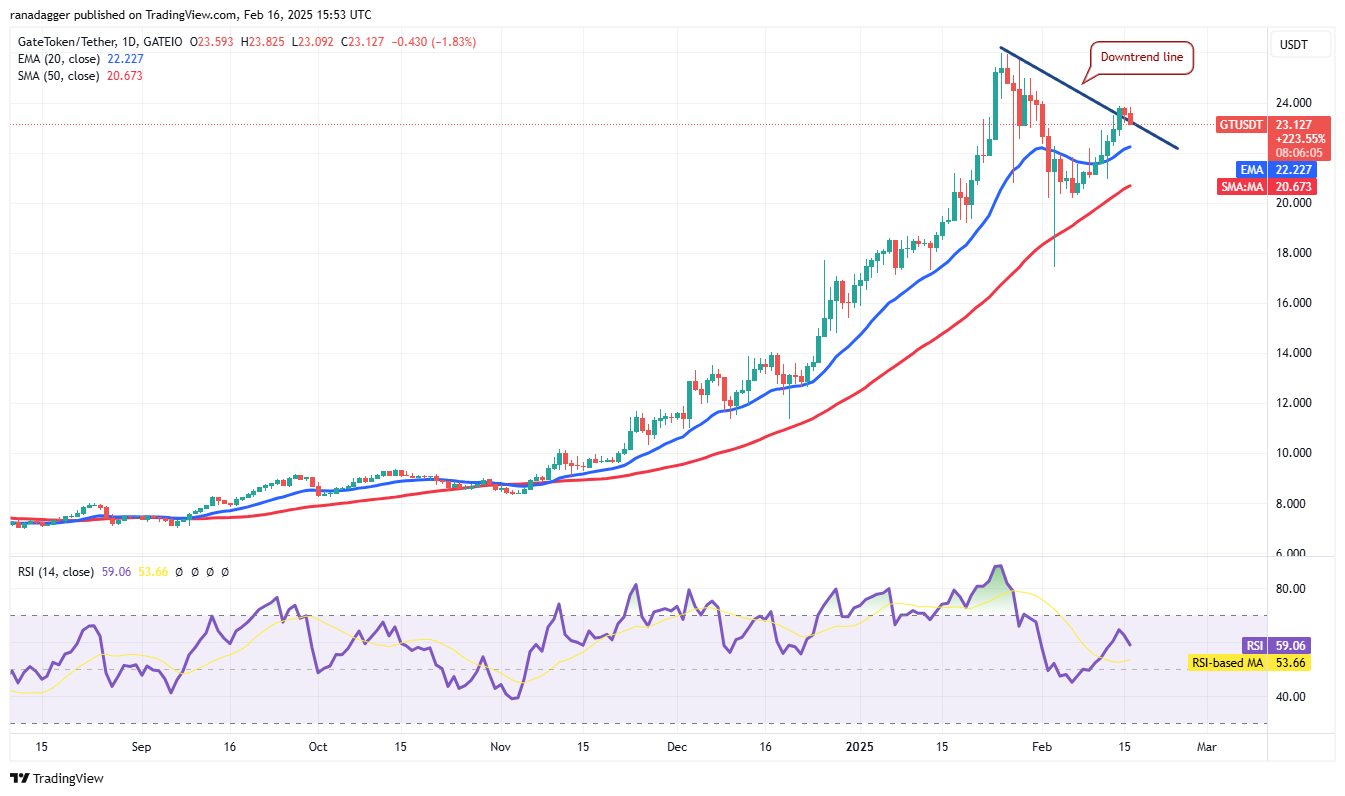
Gate Token (GT) closed above the downtrend line on Feb. 14, indicating that the bulls are trying to make a comeback.
GT/USDT daily chart. Source: Cointelegraph/TradingView
However, sellers are unlikely to give up easily. They will try to pull the price back below the downtrend line. If the price rebounds off the 20-day EMA ($22.22), it will signal that the bulls are buying on minor dips. That will improve the prospects of a rally to $26.
Instead, if the 20-day EMA cracks, the GT/USDT pair could skid to the 50-day SMA ($20.67). This is a crucial support to watch out for because a break below it may open the gates for a fall to $17.43.
GT/USDT 4-hour chart. Source: Cointelegraph/TradingView
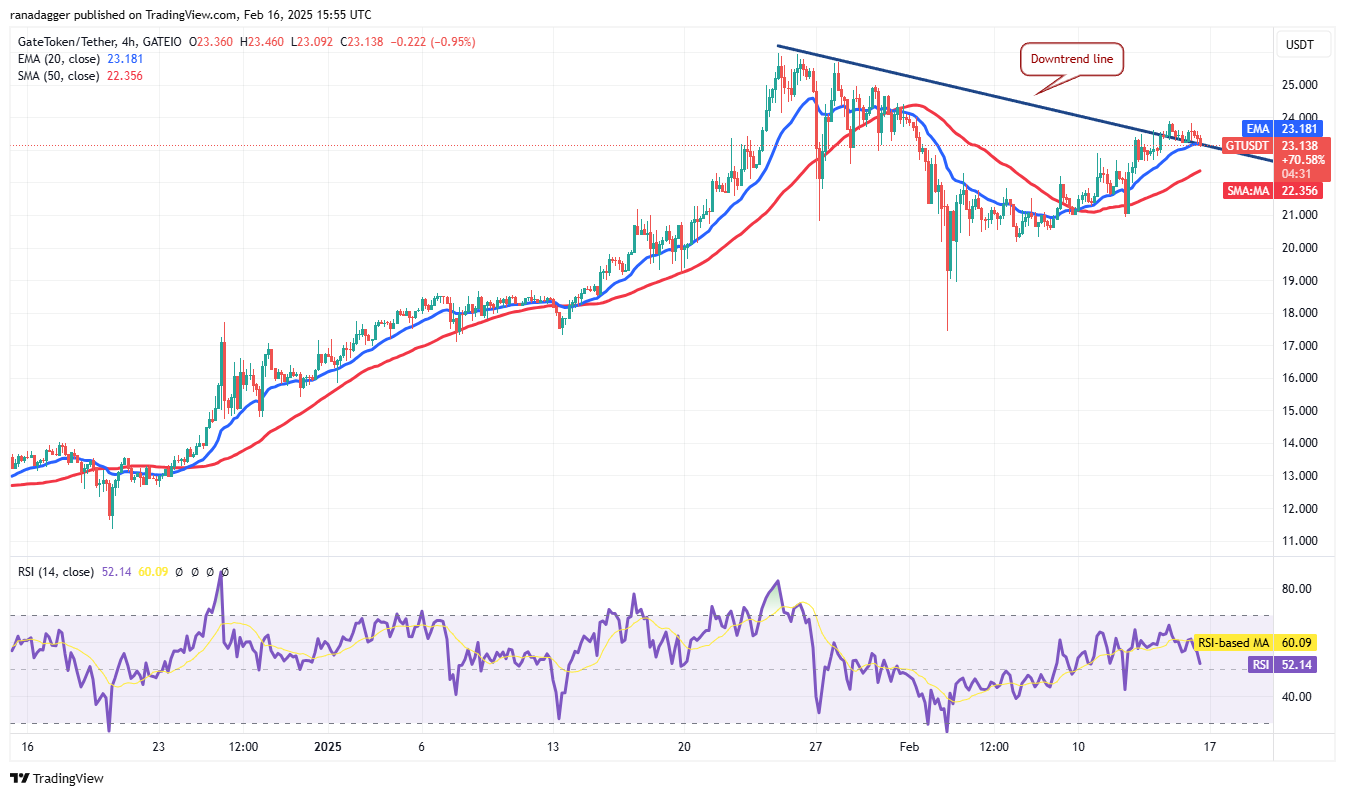
The pair is trying to take support at the 20-EMA on the 4-hour chart. If the price bounces off the 20-EMA and clears the $24 resistance, the pair could climb to $25 and subsequently to $26.
On the contrary, a break and close below the 20-EMA suggests the start of a deeper correction to the 50-SMA. Buyers will have to vigorously defend the 50-SMA because a break below it may sink the pair to $21 and later to $20.
This article does not contain investment advice or recommendations. Every investment and trading move involves risk, and readers should conduct their own research when making a decision.