Exclusive: New Crypto ETFs to Change Altcoin Season Forever
The post Exclusive: New Crypto ETFs to Change Altcoin Season Forever appeared first on Coinpedia Fintech News Crypto investing has entered an all-new era. With U.S. regulators greenlighting 19 spot cryptocurrency ETFs, including 11 for Bitcoin and 8 for Ethereum. Successively, traditional and new investors […]
Research report
Bitcoin slumps, but LTC, CRO, ENA and MNT remain strong on the charts
Bitcoin is facing selling near $115,000, but LTC, CRO, ENA and MNT are bucking the trend and showing strength on the charts.
Litecoin
XRP news update: Traders predict consolidation to $2.35 amid ETF speculation
XRP trades in a tight range between $2 and $2.35, but the next price breakout could be driven by ETF speculators.
Litecoin
Case Studies of Countries with Significant Crypto Adoption
The post Case Studies of Countries with Significant Crypto Adoption appeared first on Coinpedia Fintech News Crypto is the new trend in the global economy. It has created several impressive headlines in the recent past, as some of the economic powers have changed its attitude […]
Research report
The post Case Studies of Countries with Significant Crypto Adoption appeared first on Coinpedia Fintech News
Crypto is the new trend in the global economy. It has created several impressive headlines in the recent past, as some of the economic powers have changed its attitude towards the sector. Notably, the global crypto adoption has significantly increased in the recent past. Some countries like El Salvador have implemented certain bold policies, encouraging others to change their stand towards cryptos. Here our attempt is to explore the crypto scenario in those countries which have performed better in the crypto adoption analysis.
Some of the facts this report shares may leave you stunned. And, certain ones may disappoint you. But this mix of contradictions make this report an exceptional one. Don’t miss it.
Top Countries by Crypto Adoption Percentage
The United Arab Emirates, Vietnam and the United States are the top three countries in terms of percentage of population who own crypto.
| Countries | No. of Crypto Owners | Crypto Adoption Percentage |
| United Arab Emirates | 3M | 30.4% |
| Vietnam | 21M | 21.2% |
| US | 53M | 15.6% |
| Iran | 12M | 13.5% |
| Philippines | 16M | 13.4% |
| Brazil | 26M | 12% |
| Saudi Arabia | 4M | 11.4% |
| Singapore | 665K | 11.1% |
In the United Arab Emirates, nearly three million people own crypto, which is at least 30.4% of its population. Though the United States has 53 million crypto owners, it could not get the top post and remains in the third position, as only 15.6% of its population are crypto owners. Vietnam, which remains in the second spot, has around 21 million crypto owners. In this Asian country, at least 21.2% of its population are crypto owners. Iran and Philippines, with 13.5% and 13.4%, stay in the 4th and 5th positions.
Notably, Brazil has over 26 million crypto owners, but only 12% of its population own cryptocurrencies. Saudi Arabia, with 11.4%, and Singapore, with 11.1%, are notable members.
Top Countries by Number of Crypto Owners
If we only consider the number of crypto owners, things will change slightly. In this list, we have India and China as the top two players. The USA, though has a significant number of crypto owners, is still in the third position. Why?
| Countries | No. of Crypto Owners | Crypto Adoption Percentage |
| India | 93.5M | 6.55% |
| China | 59.1M | 4.15% |
| USA | 26M | 15.6% |
| Brazil | 26M | 12% |
| Vietnam | 21M | 21.2% |
| Pakistan | 15.9M | 6.6% |
| Philippines | 16M | 13.4% |
| Nigeria | 13.3M | 5.93% |
| Indonesia | 12.2M | 4.4% |
| Russia | 8.7M | 6.1% |
India has over 93.5 million crypto owners, and China has over 59.1 million. The said fact is impressive, but it does not make these countries prominent players. The reason is simple. Only 6.55% of the Indian population owns cryptocurrencies, and in China, the scenario is even worse. The Chinese crypto community enjoying the benefits of crypto ownership is just 4.15% of its total population. Certainly, the USA and Brazil, with 15.6% and 12%, deserve to be considered as top players.
Other prominent countries in the list are Vietnam (21M), Pakistan (15.9M), Philippines (16M), Nigeria (13.3M), Indonesia (12.2M), and Russia (8.7M). Among these, Vietnam and Philippines are significant, as the former’s crypto ownership percentage against its population is as high as 21.2%, and the latter’s is over 13.4%.
Crypto Adoption by Region
Let’s make the analysis a little more interesting. How about entering a little bit deeper and doing a regional-focused analysis? Sounds great, right?
For our convenience, we can divide our geography into three segments: the Europe, Middle East and Africa segment, the Amercians segment and the Asia-Pacific segment.
Crypto Adoption in Europe, Middle East and Africa
Like what the name suggests, the Europe, Middle East and Africa segment covers the countries in the Europe, Middle East and Africa region.
| Countries | No. of Crypto Owners | Crypto Adoption Percentage |
| Nigeria | 13.3M | 5.93% |
| Russia | 8.7M | 6.1% |
| Ukraine | 3.9M | 10.57% |
| UK | 3.9M | 5.74% |
Generally, people expect that a European country would be a dominant player in the list. To an extent, the expectation is right. But in terms of the number of crypto owners index, none of the European countries match the performance of Nigeria, in which nearly 13.3 million people are crypto owners. Russia, a European superpower, with 8.7M crypto owners, stays in the second position. Ukraine and the UK have 3.9M and 3.9M crypto owners respectively. In the list, Ukraine does have an upperhand, as at least 10.57% of its population are crypto owners. In Nigeria, only 5.93% of its population are crypto-owners, and in Russia and the UK, the values are just 6.1% and 5.74% respectively.
Crypto Adoption in the Americas
There are some surprises in the American segment also. As you know, this segment primarily covers the USA, Canada and Latin America. There is a rumour that the entire crypto industry revolves around this region. Is there any truth to that? Let’s see!
| Countries | No. of Crypto Owners | Crypto Adoption Percentage |
| USA | 26M | 15.6% |
| Brazil | 26M | 12% |
| Mexico | 8.4M | 6.55% |
| Argentina | 4.45M | 9.73% |
| Canada | 2.7M | 7% |
The USA is the leading player in the region in the crypto adoption landscape, undoubtedly. Otherwise, it would not have such a large number of crypto users. It has over 26 million crypto users – the US crypto community makes at least 15.6% of the country’s total population. Does it sound impressive? But when we consider the adoption rate in other prominent players in the region, it sounds doubtful whether these values are high enough to be considered as a country with the best crypto adoption environment.
Even Brazil has over 26 million crypto users. In that Latin American country, at least 12 percent of its total population own cryptocurrencies. The case is similar in Mexico, where there are over 8.4 million crypto owners – roughly 6.55% of the population. Even Argentina has over 4.45 million crypto owners. Contrary to the general expectation, Canada is very weak in terms of crypto adoption. It only has 2.7 million crypto owners – approximately under seven percent of the country’s total population.
Crypto Adoption in Asia-Pacific
The analysis of the crypto adoption scenario in the Asian-Pacific segment can definitely leave most non-Asians perplexed – particularly those in the developed west. Why? Just go through the below given numbers. Isn’t it enough to ring the bell?
| Countries | No. of Crypto Owners | Crypto Adoption Percentage |
| India | 93.5M | 6.55% |
| China | 59.1M | 4.15% |
| Vietnam | 20.9M | 21.2% |
| Pakistan | 15.9M | 6.6% |
| Philippines | 15.8M | 13.4% |
| Indonesia | 12.2M | 4.4% |
| Thailand | 6.9M | 9.61% |
| Japan | 5.1M | 4.13% |
| Bangladesh | 4.3M | 2.5% |
No longer can anyone deny the dominant role that the Asia Pacific region plays in the crypto sector. India and China alone have over 1526M crypto owners. In Vietnam, at least 21.2% of its population are crypto owners, and in the Philippines, more than 13.4% of its population are crypto owners. Even in Bangladesh and Pakistan – which are currently struggling due to political unrest and economic uncertainties, there are over 4.3 million and 15.9 million crypto owners respectively. Japan is a crucial player, with 6.9 million crypto owners. Thailand, known for its flourishing tourism sector, even has 6.9 million crypto users.
‘Is the Asia-Pacific adopting cryptos much faster than other two regions’ is a question that can create a lot of headlines in the coming days. With Hong Kong and Singapore, the two prominent financial hubs in the region, eagerly revamping its financial environment to embrace the new possibilities after the advent of the crypto and blockchain technology, the said question is less likely to sound this much indigestible in the future.
Countries with Cryptocurrency as a Legal Tender
Do you know that certain countries have recently accepted cryptocurrencies as legal tender?
El Salvador is the first country to accept cryptos as legal tender. The Central African Republic is the second. In El Salvador, the policy to accept crypto as legal tender was adopted on 9th June 2021. Approximately a year later, on 23rd April, 2022, the Central African Republic joined the league, boldly.
It is said that many counties particularly in the Africa and Latin America region have such a plan.
Crypto Adoption Index Score
Let’s approach the crypto adoption scenario from a different angle. The data set developed by Henley & Partners is an easy way to do so. This data set allows us to approach the crypto adoption scenario using some interesting parameters like public adoption and infrastructure adoption.
At first, we can consider the two prime parameters, public adoption, and infrastructure adoption, and see which country will come at the top in the list when these three are considered together. And later, we can take each parameter individually and see how the scenario changes. Ready?
When we consider these two parameters together, the UK gets the maximum score of 23.2. Australia and Singapore follow with 23 and 22.6 scores.
| Countries | Crypto Adoption Index Score |
| UK | 23.2 |
| Australia | 23 |
| Singapore | 22.8 |
| USA | 22.6 |
| Switzerland | 21.8 |
| UAE | 21.7 |
| Hong Kong | 20.8 |
| Canda | 19.7 |
| Turkey | 18.5 |
| Malta | 17.0 |
USA is in the fourth position with 22.6 score. Switzerland and UAE follow with 21.8 and 21.7 respectively. Hong Kong, Canada, Turkey and Malta are the other prominent players. Hong Kong scores 20.8. Canada, Turkey and Malta show 19.7, 18.5 and 17, respectively.
Crypto Adoption Score By Public Adoption
Time to consider each parameter individually. First, we can consider the parameter of public adoption.
| Countries | Score |
| Singapore | 7.1 |
| UAE | 7.1 |
| USA | 6.3 |
| UK | 5.5 |
| Australia | 5.1 |
| Canada | 5.1 |
| Mauritius | 4.7 |
| Hong Kong | 4.6 |
| Switzerland | 3.9 |
| Malta | 3.6 |
Singapore and UAE dominate with the same score of 7.1. USA follows with a score of 6.3. The UK and Australia report 5.5 and 5.1 respectively, and Canada and Mauritius record 5.1 and 4.7 respectively. Hong Kong and Switzerland are other two important players. The former has a score of 4.6 and the latter has a score of 3.9. Malta, with 3.6 score, also enjoys a place in the list.
Crypto Adoption Score By Infrastructure Adoption
Let’s consider the parameter of infrastructure adoption. As expected, the US is the country which enjoys the top position in the list.
| Countries | Score |
| USA | 9.6 |
| Canada | 9.3 |
| Switzerland | 9.2 |
| Australia | 9.1 |
| UK | 7.7 |
| Hong Kong | 7.5 |
| Thailand | 7.5 |
| Monaco | 7.5 |
| Greece | 7.5 |
| New Zealand | 7.4 |
The US shows a score of 9.6. Canada, Switzerland, and Australia closely follow with 9.3, 9.2 and 9.1, respectively. The UK, Hong Kong, Thailand, Monaco, Greece and New Zealand are the other countries who sit in this list. The UK has a score of 7.7, and New Zealand 7.4. The four remaining ones have the same score of 7.5.
Countries with the Best Regulatory and Tax Environment for Cryptos
One of the prime factors that influence a country’s crypto adoption is its regulatory and tax environment. In the Henly & Partners’ data set, there are provisions to generate a score considering the parameters of crypto regulation and tax environment.
The below is the list of these countries which score the highest when the said parameters are considered.
Singapore naturally remains in the top most position with 18.5, reflecting how dedicated is the Asian region in developing their environment to embrace the emerging digital finance possibilities.
| Countries | Score |
| Singapore | 18.5 |
| Switzerland | 16.5 |
| Antigua and Barbuda | 15.8 |
| Hong Kong | 15.7 |
| UAE | 15.6 |
| Mauritius | 15.4 |
| Netherlands | 14.7 |
| Malaysia | 14.5 |
| Malta | 14.4 |
| Monaco | 14.4 |
Switzerland and Antigua and Barbuda are the countries that follow Singapore. Switzerland shows 16.5, and Antigua and Barbuda displays 15.8. Another Asian financial centre, Hong Kong, with 15.7, enjoys the fourth position in the list. UAE and Mauritius score 15.6 and 15.4 respectively. Netherlands, Malaysia, Malta and Monaco are the other prominent players. Their scores range from 14.7 to 14.4.
Top Countries with the Best Economic Factors for Crypto Adoption
Is creating a crypto friendly regulatory and tax environment enough to improve the crypto adoption scenario of a country? In most cases, it is inadequate. The fact is that in the absence of a right economic environment, any effect to revamp a country’s regulatory scenario would be counter productive.
As per the Henley & Partners data set, here are the top countries with the best economic factors suitable for the flourishing of the crypto adoption environment.
The list is dominated by two powerful financial hubs from the Asia-Pacific region. You may have already guessed it. Yes, Hong Kong, with 9.1, and Singapore, with 8.9, are the two countries which sit in the top most positions in the list.
| Countries | Score |
| Hong Kong | 9.1 |
| Singapore | 8.9 |
| Switzerland | 8.6 |
| UAE | 8.4 |
| New Zealand | 8.4 |
| Luxembourg | 8.3 |
| USA | 8.2 |
| Netherlands | 8.1 |
| Thailand | 8.1 |
| Canada | 8.1 |
Switzerland, with 8.6, and UAE, with 8.4, remain in the third and fourth positions, respectively. New Zealand, Luxembourg, the USA, the Netherlands, Thailand and Canada are the other prominent countries in the list. New Zealand and Luxembourg and the USA have 8.4, 8.3 and 8.2 scores respectively. All the three remaining ones. the Netherlands, Thailand and Canada display the same score of 8.1.
Endnote
In conclusion, what is clear from the data collected is that the Asia-Pacific region currently leads the world in crypto adoption, with countries like Singapore and Hong Kong poised to become global hubs for the crypto economy. As these nations continue to innovate and set new standards, they are likely to shape the future of digital finance and serve as a model for others to follow. It does not mean that the other regions perform poorly in crypto adoption. It is important to watch the developments in certain important crypto economies like the USA, India, China, Thailand, the Philippines, El Salvador, the Central Asian Republic, Brazil and even Bangladesh and Pakistan. One thing is clear that this crypto revolution is set to continue, and is likely to transform the lives of millions in near future.

Plus Token Ponzi-linked wallet moves $2B ETH after 3.3 years of dormancy
Update (Aug. 8 at 1:48 am UTC): Lookonchain deleted the X post that is the subject of this article after analysts argued the X post was inaccurate as most of the funds had been sold in 2021. A new article covering that latest development can […]
Litecoin
Update (Aug. 8 at 1:48 am UTC): Lookonchain deleted the X post that is the subject of this article after analysts argued the X post was inaccurate as most of the funds had been sold in 2021. A new article covering that latest development can be found here.
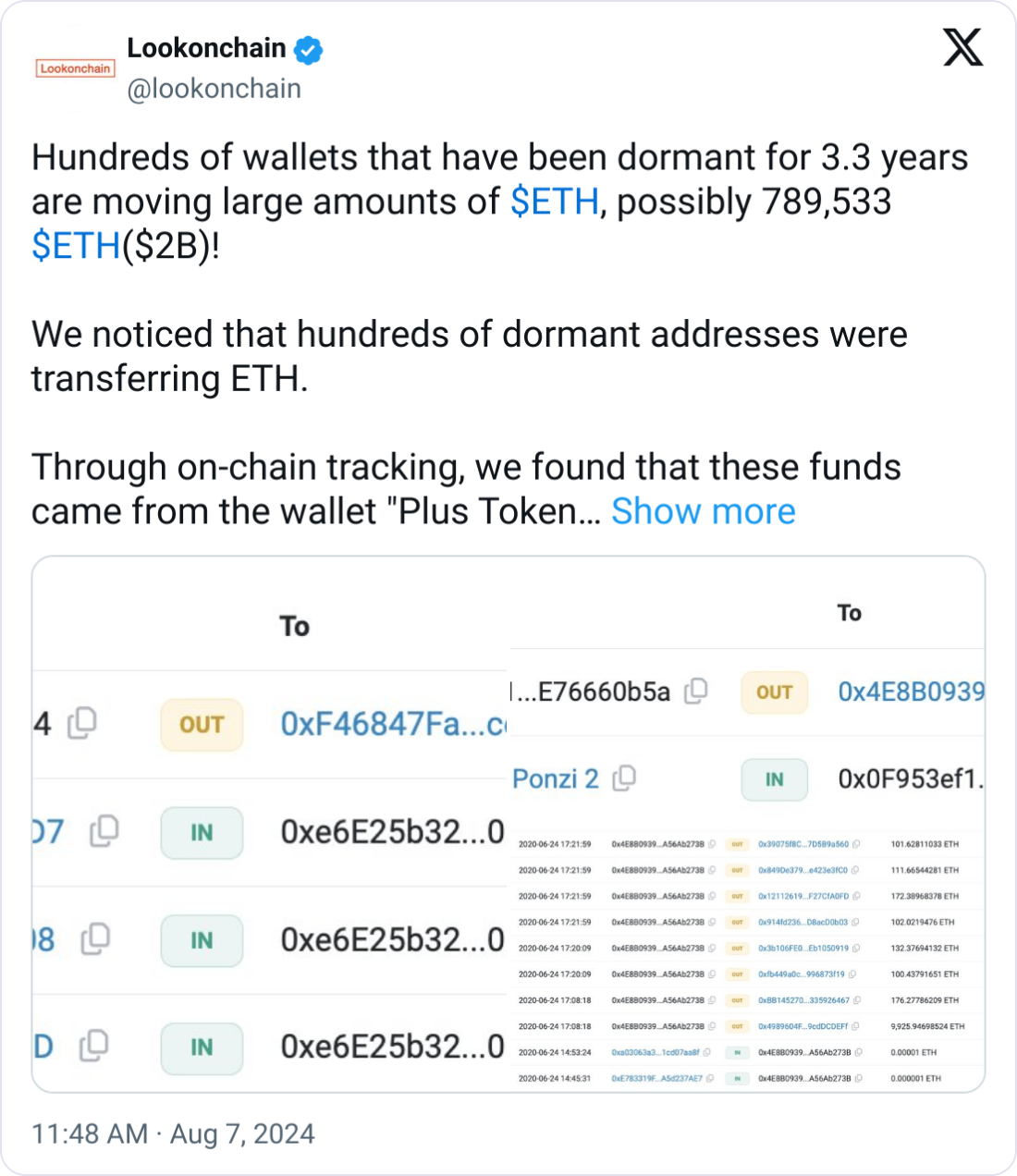
Hundreds of cryptocurrency wallets that have remained inactive for over three years have suddenly started shifting large amounts of Ether (ETH).
According to onchain analyst Lookonchain, up to 789,533 ETH was linked to the Plus Token Ponzi scheme and has not been moved since April 2021.
Onchain tracking revealed the tokens were associated with the “Plus Token Ponzi 2” wallet, which dispersed the ETH to thousands of smaller wallets in 2020.
Related: Judge labels 2 obscure altcoins as commodities in $120M Ponzi case
Chinese authority involvement
During the crackdown, Chinese authorities seized around $4.2 billion in multiple crypto assets, including the Plus Token scam.
The assets included 194,775 Bitcoin (BTC), 833,083 ETH, 497 million XRP (XRP), 6 billion Dogecoin (DOGE) and other assets such as Bitcoin Cash (BCH), Litecoin (LTC) and USDT (USDT).
Although the combination of seized tokens was worth around $4.2 billion in late 2020, the total funds are now worth around $13.5 billion as current asset prices are much higher.
Related: FBI busts $43M crypto and Las Vegas hospitality Ponzi scheme
Implications for the crypto market
The reactivation of these wallets and the potential for a sell-off of the seized funds by the Chinese authorities could trigger panic in the market, but this has yet to be seen.
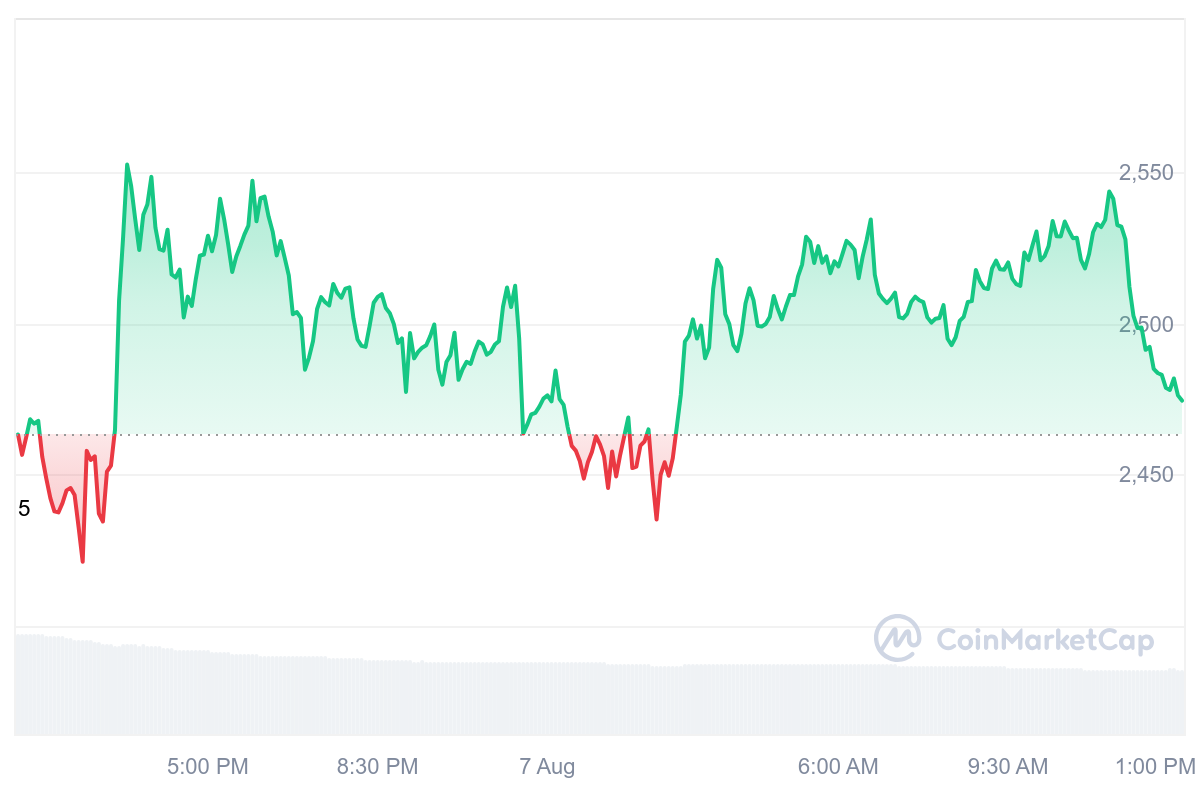
At the time of writing, ETH’s price was around $2,474, up around 1% on the day, and so far, the ETH outflows from the wallets began at 10:17 am UTC on Aug. 7.
Related: New York jury convicts two promoters of IcomTech crypto ‘Ponzi’
What defines a Ponzi?
On July 4, an Illinois district judge sided with the United States Commodity Futures Trading Commission (CFTC) in labeling two altcoins as commodities in a crypto Ponzi scheme case.
The Ponzi scheme defrauded its victims by promising “steady returns” of 15% annually from investments in “digital asset commodities.”
According to the CFTC, the digital currencies involved in the case fell “into the same general class at Bitcoin, on which there is regulated futures trading.”
Magazine: How crypto bots are ruining crypto — including auto memecoin rug pulls
Trump’s $35 Trillion Debt Plan: Analysing The Impact on Cryptos
The post Trump’s $35 Trillion Debt Plan: Analysing The Impact on Cryptos appeared first on Coinpedia Fintech News Recently, Donald Trump proposed an audacious idea: using Bitcoin to address the United States’ staggering national debt. This suggestion has ignited intense debate, particularly within the cryptocurrency […]
Research report
The post Trump’s $35 Trillion Debt Plan: Analysing The Impact on Cryptos appeared first on Coinpedia Fintech News
Recently, Donald Trump proposed an audacious idea: using Bitcoin to address the United States’ staggering national debt. This suggestion has ignited intense debate, particularly within the cryptocurrency community. Can Bitcoin truly be a remedy for the national debt? What would this mean for the crypto industry, and how might Bitcoin’s price be affected? Let’s explore these questions in detail!
Understanding the US Debt Crisis
As per the official data published by the US government, the national debt of the United States, or the amount of outstanding borrowing the government accumulated over the nation’s history, is nearly $35.05 trillion, as of 6th August, 2024.
Here’s a snapshot of the national debt’s growth over the past century:
| Year | U.S. National Debt |
| 1923 | $403 B |
| 1943 | $2.40 T |
| 1963 | $3.07 T |
| 1983 | $4.20 T |
| 2003 | $11.24 T |
| 2013 | $21.93 T |
| 2023 | $33. 17T |
In 1923, almost 100 years ago, the US national debt was just $403 B. Between 1923 and 1943, the growth of the depth was comparatively slower. In 1943, the debt was a little more than $2.40 T. In 1963 and 1983, the values were $3.07 T and $4.20T. Between 1943 and 1983, the depth growth was majorly stagnant. Post 1983, it was a period of sharp rise. In 2003, the debt reached as high as $11.24 T. In 2013, it nearly doubled to $21.93 T. In 2023, it reached a shocking high of $33.17 T. Now, it stands at $35.05 trillion.
What reveals a country’s ability to pay down the country’s debt to its GDP ratio. Shocking is the US’ debt to its GDP ratio. It now stands far above one hundred per cent. In fact, it surpassed the mark of 100% as early as 2013 itself. In 2023, it was 123%.
Here is the US’ debt-to-GDP ratio:
| Year | US Debt to GDP |
| 1948 | 96% |
| 1958 | 58% |
| 1974 | 32% |
| 1996 | 66% |
| 2001 | 55% |
| 2020 | 127% |
| 2023 | 123% |
In 1948, the ratio was around 96%. But it fell to 58% in 1958, and further to 32% in 1974. In 1996, it reached 66%. Later, in 2001, it cooled down to 55%. Later, it saw a sharp rise. In 2020, it touched a peak of 127%. In 2023, it slightly came down to 123%.
The data indicates that the biggest crisis the United States and its people now face is its growing debt and the weakening debt-to-GDP ratio.
Trump’s Bitcoin Debt Solution Plan Explained
Trump’s Bitcoin debt solution revolves around using Bitcoin and cryptos to manage the US debt. In a recent interview, he proposed that Bitcoin could be used strategically to address the growing financial burden. Making Bitcoin a strategic reserve was a major part of his plan.
BTC Holdings Owned by Governments
The United States government at present owns nearly 207,189 bitcoins, which is 0.98% of the total holdings. The current value of its entire holdings is $10,458,345,453.
As per a data set published in bitcointreasuries.com, here are the top governments by BTC Holdings.
| Country | No. of BTC | Value | Percentage |
| USA | 207,189 | $10,458,345,453 | 0.987% |
| China | 194,000 | $9,792,600,080 | 0.924% |
| UK | 61,000 | $3,079,116,520 | 0.29% |
| Ukraine | 46,351 | $2,339,674,259 | 0.221% |
| Germany | 22,846 | $1,153,204,853 | 0.109% |
| El Salvador | 5,748.76 | $290,181,998 | 0.027% |
| Finland | 1,981 | $99,995,571 | 0.009% |
| Georgia | 66 | $3,331,503 | 0.0% |
China is the country that holds the highest number of BTCs after the USA. It owns nearly 194,000 BTC (0.92%), valued at $9,792,600,080. The UK, Ukraine and Germany are also top players with 61,000, 46,351, and 22,846 BTCs respectively.
The Feasibility of Trump’s Plan
The current price of Bitcoin is $55,645.47 and its market cap is $1,095,191,354,069. For Trump’s plan to work, each Bitcoin would need to be worth $180 million. Critics argue that expecting BTC to reach such an astronomical value is unrealistic.
Peter Schiff, a financial expert, opines that Trump’s proposal is unrealistic. He claims that the idea of Bictoin reaching such high values without causing inflation is logically inconsistent.
Bitcoin Annual Price Change Analysis
This analysis shows how Bitcoin’s value fluctuates each year. It is capable of providing insights into growth trends.
In 2023, the annual price change of Bitcoin was +155.4%. In 2013, 2011 and 2017, Bitcoin witnessed massive changes of +4,435%, +1,435% and +1.369%. Since 2011, only three times that Bitcoin witnessed a negative yearly price change. In 2018, 2022 and 2014, it marked negative changes of -73.3%, -64.3% and -57.6%. This year the value stands at around +32.3%.
Potential Impact on the Crypto Industry
If Trump’s plan were to gain traction, it could have significant impacts on the crypto industry. Increased government involvement in Bitcoin could lead to more regulations. But, it could also boost confidence in Bitcoin.
BTC Historical Price Change Analysis
In the last 24 hours, Bitcoin has seen a rise of 5.0% ($2,134 change). Year to Date, the change is +30.3%, which is $12,799. In the last six months, a change of +27.6%, which is around $11,907, has been recorded. In the Q1 of 2024, the BTC provided a return of +68.7%. But, the last quarter, that is the Q2 of 2024, was a period of great volatility. The period ended with an unimpressive return of -12%. In April and June, BTC saw negative returns of -14.7% and -7.02%. In May, it witnessed a positive return of +11.1%. In the second quarter’s closing price was just $62,743, far less than the first quarter’s price of $71,262. In the last three months, a negative return of -11.8% was recorded, and in the last 30 days, a return of -4.27% was reported.
At present, the price of BTC stands at around $55,124. In the beginning of the month, the price was around $65,246. On 2nd, 4th and 5th August, the Bitcoin market witnessed long red candlesticks. Between 1st and 6th August 2024, a steep drop in price occurred in the market. The trend we are witnessing now in the market is in stark contrast to the one we saw last month, when the price experienced an upward momentum between 8th July and 28th July. Actually, it was in late July, especially on 29th July, that this new selling pressure stepped in. Between 29 July and 5th Aug, we see only one green candle.
Endnote
Trump’s proposal to use Bitcoin to tackle the $35 trillion US debt is undeniably bold. While it highlights the increasing interest in cryptocurrencies as potential strategic assets, it also raises questions about feasibility and market impact.
By examining inflation data, government Bitcoin holdings, historical price trends, and recent changes, we gain a clearer understanding of the potential and challenges of this idea. Whether Trump’s plan benefits the crypto industry remains uncertain, but it undoubtedly fuels crucial discussions about the future of cryptocurrency and its role in the global economy.
Also Check Out: Bitcoin and Ethereum Q2 Price Movement Analysis Report
As the debate heats up, one thing is clear: Trump’s Bitcoin proposal could either revolutionize how we think about national debt or simply add more fuel to the crypto fire. Stay tuned to see where this bold idea will lead!

Number of crypto ATMs installed nears its all-time record
The number of cryptocurrency ATMs installed worldwide has spiked 17.8% to 38,279 over the last 12 months — inching closer to its record of 39,541 set in December 2022. As of 2024, there have been 2,564 new cryptocurrency ATMs installed, indicating a positive trend compared […]
Litecoin
The number of cryptocurrency ATMs installed worldwide has spiked 17.8% to 38,279 over the last 12 months — inching closer to its record of 39,541 set in December 2022.
As of 2024, there have been 2,564 new cryptocurrency ATMs installed, indicating a positive trend compared to the net loss of 2,861 machines in 2023, according to Coin ATM Radar.
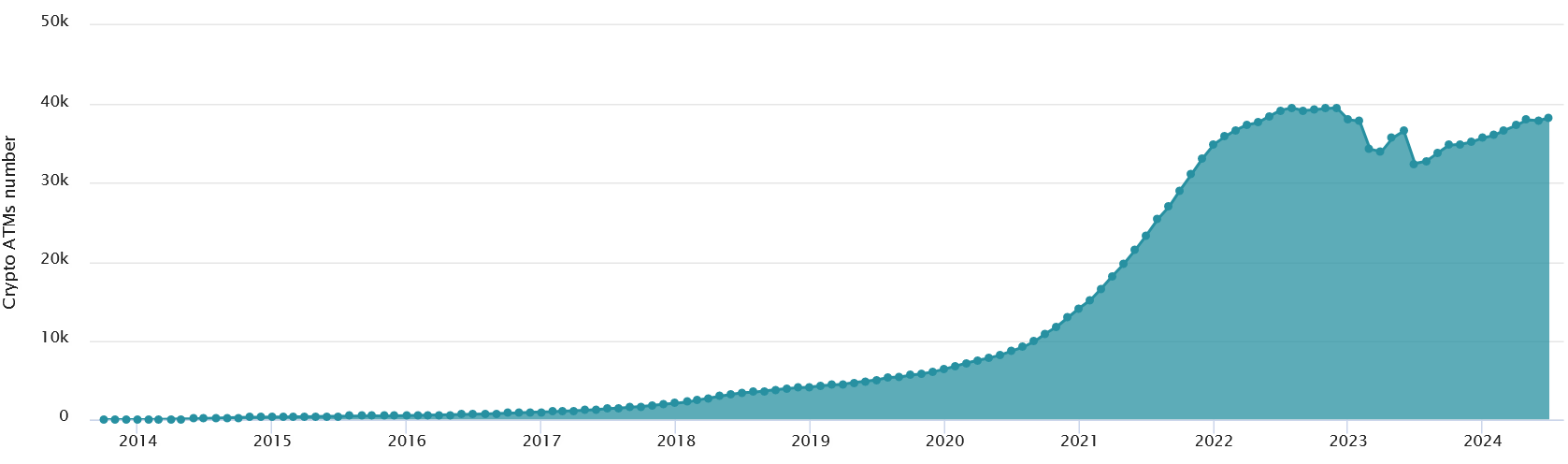
The tally increased every month between July 2023 and May 2024.
Installations from May to June fell by 115, but June rebounded strongly with a net increase of 377.
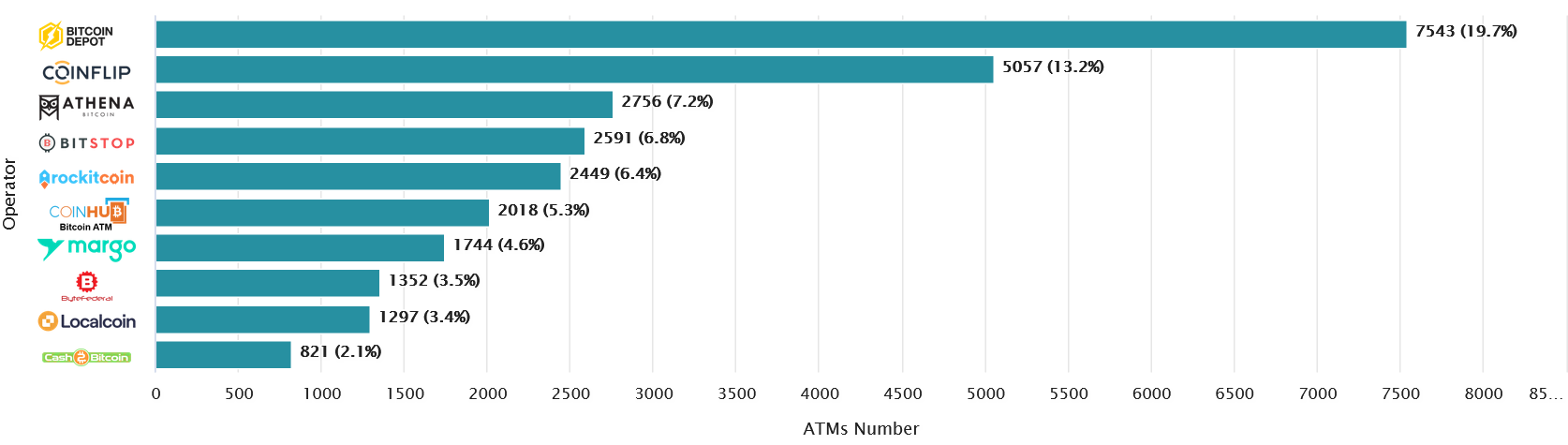
Bitcoin Depot, Coinflip and Athena Bitcoin are the leading cryptocurrency ATM operators, with 7,543, 5,057 and 2,756 machines, respectively.
Bitcoin (BTC) is by far the most popular cryptocurrency transacted with, while Bitcoin Cash (BCH), Ether (ETH) and Litecoin (LTC) also feature prominently
More than 82% of the world’s cryptocurrency ATMs are in the United States, while Canada comes in second at 7.7%.
Australia has seen a surge in installations, increasing nearly 17-fold to 1,107 machines over the last two years.
At the current installation rate, Australia is well-positioned to surpass Europe’s 1,584 ATMs.
Other countries with significant cryptocurrency ATM installations include Spain (313), Poland (279), El Salvador (215), Poland (211), Germany (177) and Hong Kong (169).
Romania, Georgia, Switzerland, Austria and New Zealand are the other countries with more than 100 ATMs.
Among the 193 United Nations-recognized countries worldwide, 72 host a cryptocurrency ATM.
Related: Corporate adoption is in ‘amateur league’ despite Bitcoin ETFs
Between December 2022 and July 2023, installations experienced a significant net decline, reaching an 18-month low of 32,764.
Coin ATM Radar’s data suggests cryptocurrency ATM manufacturer BitAccess contributed to that fall, with its net installations falling 26% from 9,160 in August 2022 to 6,774 in January 2024.
However, it has managed to increase its net installations by 1,208 since then.
Magazine: El Salvador’s national Bitcoin chief has been orange-pilling Argentina

Cboe reorganization will merge or eliminate digital arm’s activities
Equity exchange network Cboe Global Markets has announced plans to reorganize its digital assets trading operations, including eliminating its digital spot market. Cboe said it will remove digital asset derivative trading from Cboe Digital and integrate it into its Global Derivatives and Clearing businesses. The […]
Litecoin
Equity exchange network Cboe Global Markets has announced plans to reorganize its digital assets trading operations, including eliminating its digital spot market.
Cboe said it will remove digital asset derivative trading from Cboe Digital and integrate it into its Global Derivatives and Clearing businesses. The Cboe Digital Spot Market will close in the third quarter of 2024. The exchange will move cash-settled Bitcoin (BTC) and Ether (ETH) futures contracts from the Cboe Digital Exchange to the Cboe Futures Exchange in the first half of 2025, subject to regulatory review and “certain corporate approvals.”
The Cboe Digital clearing arm, Cboe Clear Digital, will be “aligned” with Cboe Clear Europe under the unified leadership of Cboe Clear Europe president Vikesh Patel. The exchange said in a statement that:
“These changes are being made as part of Cboe’s strategic review, taking into consideration the lack of regulatory clarity in the digital space, and are aligned with Cboe’s longer term strategy.”
Cboe Digital offers Bitcoin, Bitcoin Cash (BCH), Ether, USD Coin (USDC) and Litecoin (LTC) products. The potential status of ETH as a security may be a factor in the current reorganization.
The exchange went on to note that it would enjoy significant savings from closing its digital spot trading arm. It called the $2 million to $4 million savings it would experience in 2024 an “immaterial impact” on its 2024 net revenue, but added that savings would reach $11 million to $15 million annually.
Related: Decentralized dilemma: Could Ethereum survive if SEC ruled ETH a security?
“We expect to continue to see greater demand for exchange-traded [digital asset] derivatives to help manage crypto exposures, hedge risk and enhance capital and operational efficiencies,” Cboe Global Markets global president David Howson said.

Cboe greatly expanded its presence in the digital asset space through the May 2022 acquisition of ErisX, which operated a spot market, derivatives market and clearing platform and was transformed into Cboe Digital. The timing of that deal was unfortunate, as the crypto winter was just around the corner.
In August 2022, Cboe declared a $460 million goodwill impairment in its second-quarter earnings results due to its acquisition of ErisX. A goodwill impairment is the amount a company loses from buying an asset for a sum greater than the asset’s book value when the value of that asset later declines. In November 2022, Cboe Digital brought 13 investor partners into the business.
Magazine: DeFi, derivatives and fixing an antiquated financial system: Kristin Boggiano

Coinbase to launch DOGE futures, says it ‘transcended’ meme origins
Crypto exchange Coinbase believes Dogecoin’s (DOGE) “enduring popularity” suggests it has transcended its meme origins to become a staple in the cryptocurrency industry, with the exchange now planning to launch futures trading products for the cryptocurrency. In three separate letters to the United States Commodity Futures […]
Litecoin
Crypto exchange Coinbase believes Dogecoin’s (DOGE) “enduring popularity” suggests it has transcended its meme origins to become a staple in the cryptocurrency industry, with the exchange now planning to launch futures trading products for the cryptocurrency.
In three separate letters to the United States Commodity Futures Trading Commission (CFTC) on March 7, Coinbase Derivatives announced its plans to launch cash-settled futures contract products for Dogecoin, Litecoin (LTC) and Bitcoin Cash (BCH) as soon as April 1.
Notably, the letters said that Coinbase Dervitiatives could list the futures contracts on its platform before receiving any official approval from the CFTC.
Coinbase explained that it would invoke the “self-certification” method to launch the futures contracts so long as they followed the regulatory guidelines laid out by the agency.
“Coinbase Derivatives […] hereby submits for self-certification its initial listing of the Dogecoin Futures contract to be offered for trading on the Exchange on or after April 1, 2024,” read the letter concerning the Dogecoin futures product.
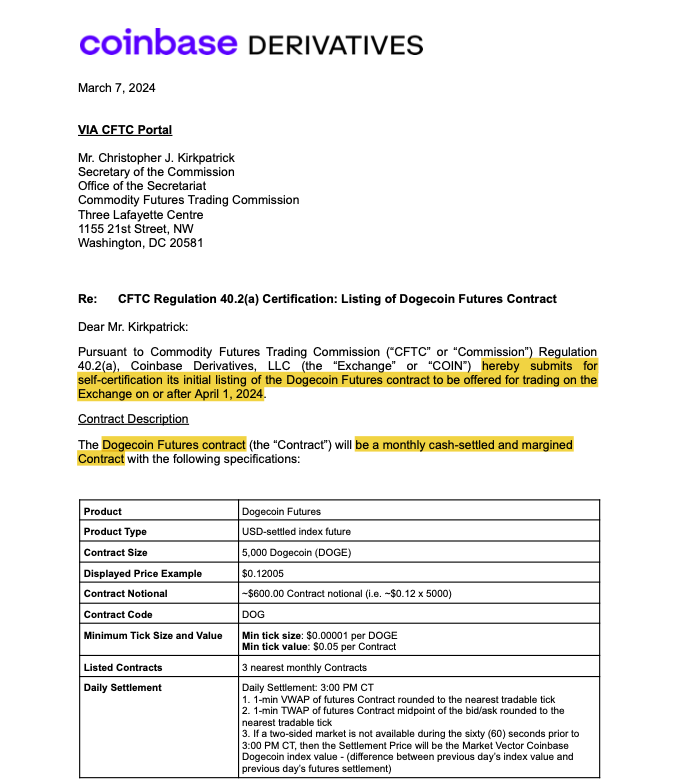
Coinbase justified its announcement of listing Dogecoin by claiming that the memecoin had transcended its origin as merely a joke and had risen to become a foundational element of the crypto industry.
“Dogecoin’s enduring popularity and the active community support suggest that it has transcended its origins as a meme to become a staple of the cryptocurrency world.”
The price of DOGE is currently up 17% on the day and is trading for $0.15 at the time of publication, according to data from CoinMarketCap.
While several market commentators across social media seemed puzzled by the move, analysts hinted that listing futures contracts could have been a calculated move by Coinbase to force the hand of the Securities and Exchange Commission.
Related: Franklin Templeton goes ‘full degen’ with investor note on memecoins
In a March 20 post to X, Bloomberg exchange-traded fund analyst James Seyffart noted that the filings may have been a strategic play to force the SEC from classifying any crypto assets that were based on the same proof-of-work consensus mechanism as Bitcoin from being declared a “security.”
“Wonder if the SEC objects to these being classified ‘commodities futures’ vs ‘securities futures,’” wrote Seyffart. “These [are all based on] Bitcoin so ‘these are securities’ claims would be hard to make after spot Bitcoin ETF approvals.”

In 2022, Coinbase acquired the CFTC-regulated FairX derivatives exchange to roll out crypto derivatives trading for its customers in the United States.
Coinbase stated at the time: “We want to make the derivatives market more approachable for our millions of retail customers.”
Magazine: Inside Pink Drainer — Security analyst defends his crypto scam franchise

Crypto landscape: ten years of growth, change, advances and retreats
While some digital assets have stood the test of time, others have tumbled below the thousands of new digital currencies that exist today. Price of Bitcoin on Christmas Day 2023: $43,2542022: $16,8492021: $50,8882020: $23,7602019: $7,2662018: $4,0212017: $14,3022016: $8942015: $4562014: $3182013: $669 — CoinGecko (@coingecko) December […]
Litecoin
While some digital assets have stood the test of time, others have tumbled below the thousands of new digital currencies that exist today.
Price of Bitcoin on Christmas Day
2023: $43,254
2022: $16,849
2021: $50,888
2020: $23,760
2019: $7,266
2018: $4,021
2017: $14,302
2016: $894
2015: $456
2014: $318
2013: $669— CoinGecko (@coingecko) December 25, 2023
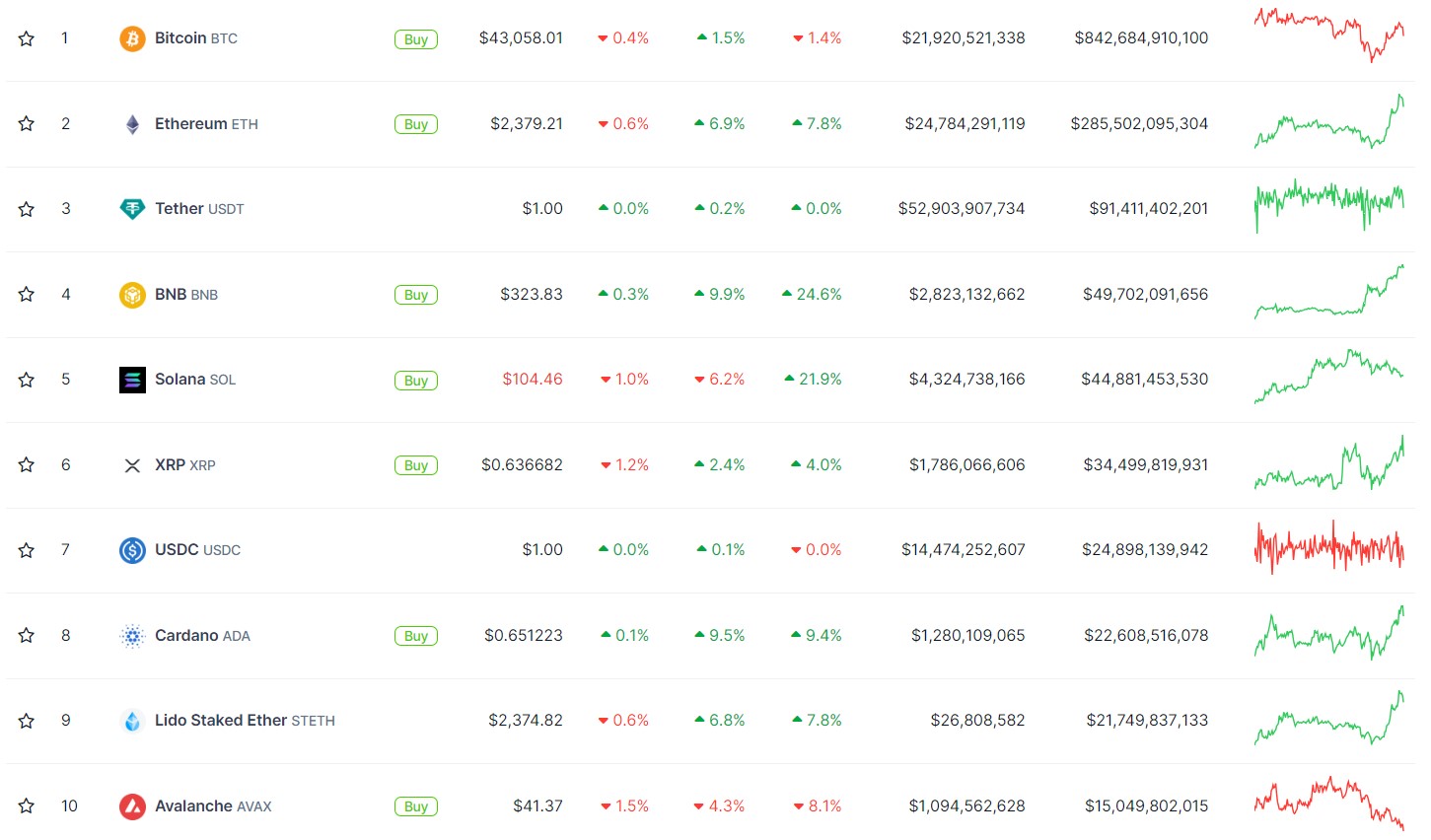
On Dec. 28, the total market capitalization for the crypto space stood at around $1.77 trillion, with Bitcoin (BTC) still leading the charge at $842 million. It’s followed by market leaders like Ether (ETH), BNB (BNB), and Solana (SOL), as well as stablecoins like Tether (USDT) and USD Coin (USDC).
Projects like XRP (XRP), Cardano (ADA) and Avalanche (AVAX) are also in the top ten digital assets by market cap and have proved their resilience over the years. In addition, Lido Staked Ether (stETH), which represents staked ETH in the liquid staking protocol Lido and combines the value of the initial deposit and staking rewards, is also in the top ten.
On Dec. 28, 2013, the top ten tokens by market cap looked very different compared to today. A snapshot from coin data tracker CoinMarketCap shows that the total market cap for crypto was around $12 billion. BTC traded at $726.89, with a total market cap of $8.8 billion. This means that the digital asset has grown by almost 100 times since then.
Related: ‘Revenge of the ETH’ — Is Ethereum’s 9% jump the start of something big?
Another token leading the charts ten years ago was Ripple, now known as XRP. A decade ago, the token followed BTC, taking the number two spot in market capitalization. The token traded at $0.027 with a market cap of $2.6 billion. The next token was Litecoin (LTC), which cost $22.66 at the time and had a $550 million market cap. Both coins had price appreciations and are still some of the most traded tokens today.
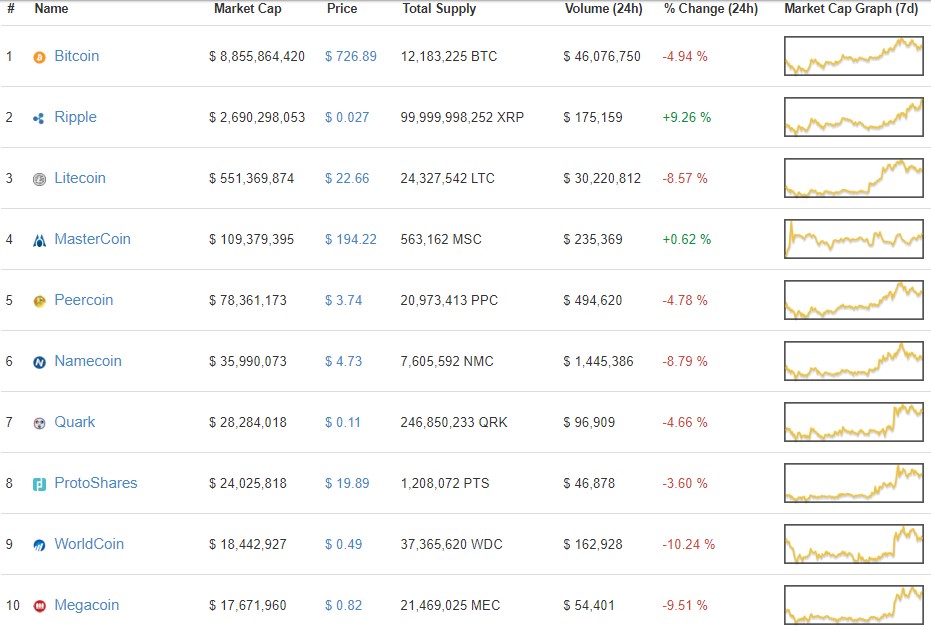
While the top three tokens have grown in price and total valuation, the same can’t be said for the rest of the list. MasterCoin, now known as Omni, used to be in the top four, with a market cap of around $100 million. Today, the token is ranked 2337 at CoinGecko, with a total valuation of $1 million.
From the top five up to the top ten tokens a decade ago, the crypto assets have either fallen off into the ranks of thousands or have been delisted from coin-tracking websites altogether. Within the ranks, a token with the same name as Sam Altman’s Worldcoin (WLD) can be seen, but it had a different ticker, WDC. The token has no relation to today’s popular eye-scanning crypto project.
Magazine: Lushsux: A decade of ass-whoopin’ and skullduggery in a single NFT