Germany’s DZ Bank secures MiCA license for ‘meinKrypto’ platform
Retail crypto access will initially cover Bitcoin, Ether, Litecoin and Cardano through participating cooperative banks.
Litecoin
Exclusive! Coinpedia’s 2025 Crypto Report Reveals Market Prices, ETF Growth, Hacks & Funding
The post Exclusive! Coinpedia’s 2025 Crypto Report Reveals Market Prices, ETF Growth, Hacks & Funding appeared first on Coinpedia Fintech News Table of contents 1. Executive Summary Key Themes of 2025 Market State vs Previous Cycles Key structural differences observed in 2025: Crypto’s Role in […]
Research report
Crypto funds pulled $47B inflows in 2025, shy of 2024 record as altcoins led
Altcoins, led by Ether, XRP and Solana, drove crypto ETP growth in 2025, while Bitcoin fund inflows fell 35%.
Litecoin
How to file crypto taxes in the US (2024–2025 tax season)
Key takeaways US crypto investors must file their 2024 tax returns by April 15, 2025, ensuring all crypto transactions are accurately reported to the IRS. Crypto held for less than a year is taxed as ordinary income (10%-37%), while holdings over a year qualify for […]
Analysis
Key takeaways
-
US crypto investors must file their 2024 tax returns by April 15, 2025, ensuring all crypto transactions are accurately reported to the IRS.
-
Crypto held for less than a year is taxed as ordinary income (10%-37%), while holdings over a year qualify for lower capital gains rates (0%, 15%, or 20%).
-
Selling, trading, or spending crypto triggers taxes, while holding or transferring between wallets does not.
-
Mining, staking, airdrops, and crypto payments are taxed as income at applicable rates.
US crypto investors must file their 2024 tax returns by April 15, 2025, ensuring all crypto transactions are accurately reported to the IRS.
Crypto held for less than a year is taxed as ordinary income (10%-37%), while holdings over a year qualify for lower capital gains rates (0%, 15%, or 20%).
Selling, trading, or spending crypto triggers taxes, while holding or transferring between wallets does not.
Mining, staking, airdrops, and crypto payments are taxed as income at applicable rates.
The world of cryptocurrencies can indeed be an exciting space for investors, but as the tax season approaches, many US investors find themselves grappling with confusion and uncertainty.
With the upcoming tax filing deadline of April 15, 2025, it’s a critical time to get a handle on crypto tax obligations. Ask most US crypto investors, and they’ll likely tell you that figuring out what transactions trigger a taxable event feels like navigating a maze.
Understanding various aspects of tax filing is crucial for accurately filing taxes, avoiding penalties and staying compliant with the Internal Revenue Service (IRS). This article breaks down key elements like tax brackets, rates, exemptions and other critical details.
How does the IRS tax crypto?
The Internal Revenue Service, the agency responsible for collecting US federal taxes, treats cryptocurrencies as property for tax purposes. You pay taxes on gains realized when selling, trading or disposing of cryptocurrencies. For short-term capital gains (held less than a year), you pay taxes at the rates of 10%–37%, depending on your income bracket.
Long-term capital gains (assets held for over a year) benefit from reduced rates of 0%, 15% or 20%, also based on your taxable income.
When you dispose of cryptocurrency for more than its purchase price, you generate a capital gain. Conversely, selling below the purchase price results in a capital loss. You must report both your capital gains and losses for the year in which the transaction occurs, with gains being taxable and losses potentially offsetting gains to reduce your tax liability.
With the upcoming April 15, 2025, deadline for filing 2024 tax returns, US crypto investors need to ensure these transactions are accurately tracked and reported.
To illustrate, suppose you purchased Ether (ETH) worth $1,000 in 2023 and sold it after a year in 2024 for $1,200, netting a $200 profit. The IRS would tax that $200 as a long-term capital gain, applying the appropriate rate based on your 2024 income.
Taxes are categorized as capital gains tax or income tax, depending on the type of transactions:
-
Capital gains tax: Applies to selling crypto, using crypto to purchase goods or services, or trading one cryptocurrency for another.
-
Income tax: Applies to crypto earned through mining, staking, receiving it as payment for work, or referral bonuses from exchanges.
These distinctions are crucial for accurate reporting by the April 15 deadline. Gains are taxed, while losses can help offset taxable income, so detailed record-keeping is a must.
Did you know? In Australia, gifting cryptocurrency triggers a capital gains tax (CGT) event. The giver may need to report gains or losses based on the asset’s market value at the time of transfer, though certain gifts — like those between spouses — may qualify for exemptions. While this differs from US rules, it highlights how crypto taxation varies globally.
How crypto tax rates work in the US
In the US, your crypto tax rate depends on your income and how long you’ve held the cryptocurrency. Long-term capital gains tax rates range from 0% to 20%, and short-term rates align with ordinary income tax rates of 10%–37%. Transferring crypto between your own wallets or selling it at a loss doesn’t trigger a tax liability.
You only owe taxes when you sell your crypto, whether for cash or for any other cryptocurrency. Consider this example: Suppose you bought crypto for $1,000 in 2024, and by 2025, its value rose to $2,000. If you don’t sell, no tax is due — unrealized gains aren’t taxable.
If you sell cryptocurrency after holding it for a year or less, your profits are subject to short-term capital gains tax. These gains are taxed as ordinary income, meaning they are added to your total taxable earnings for the year.
Tax rates are progressive, based on income brackets, so different portions of your income are taxed at different rates. For instance, a single filer in 2025 pays 10% on the first $11,000 of taxable income and 12% on income up to $44,725. Short-term rates are higher than long-term rates, so timing your sales can significantly impact your tax bill.
Understanding crypto capital gains tax in the US
If you sell cryptocurrency after holding it for a year or less, your profits are subject to short-term capital gains tax. These gains are treated as ordinary income and added to your total taxable earnings for the year. Since tax rates are based on income brackets, different portions of your earnings are taxed at different rates, as explained above.
2024–2025 federal income tax brackets for crypto earnings
Here are the federal income tax rates for the 2024–2025 tax year. You apply the 2024 tax brackets to income earned in the 2024 calendar year, reported on tax returns filed in 2025.

Long-term capital gains tax for crypto earned in 2024
You pay long-term capital gains tax if you sell cryptocurrency after holding it for more than a year. Unlike short-term gains, these aren’t taxed as ordinary income. Instead, tax rates are based on your total taxable income and filing status. Long-term capital gains tax rates are 0%, 15% or 20%, making them lower than short-term rates. Holding crypto longer can reduce your tax burden significantly.
Here is a table outlining long-term crypto capital gains tax for the calendar year 2024. These rates are applicable when filing tax returns in 2025.

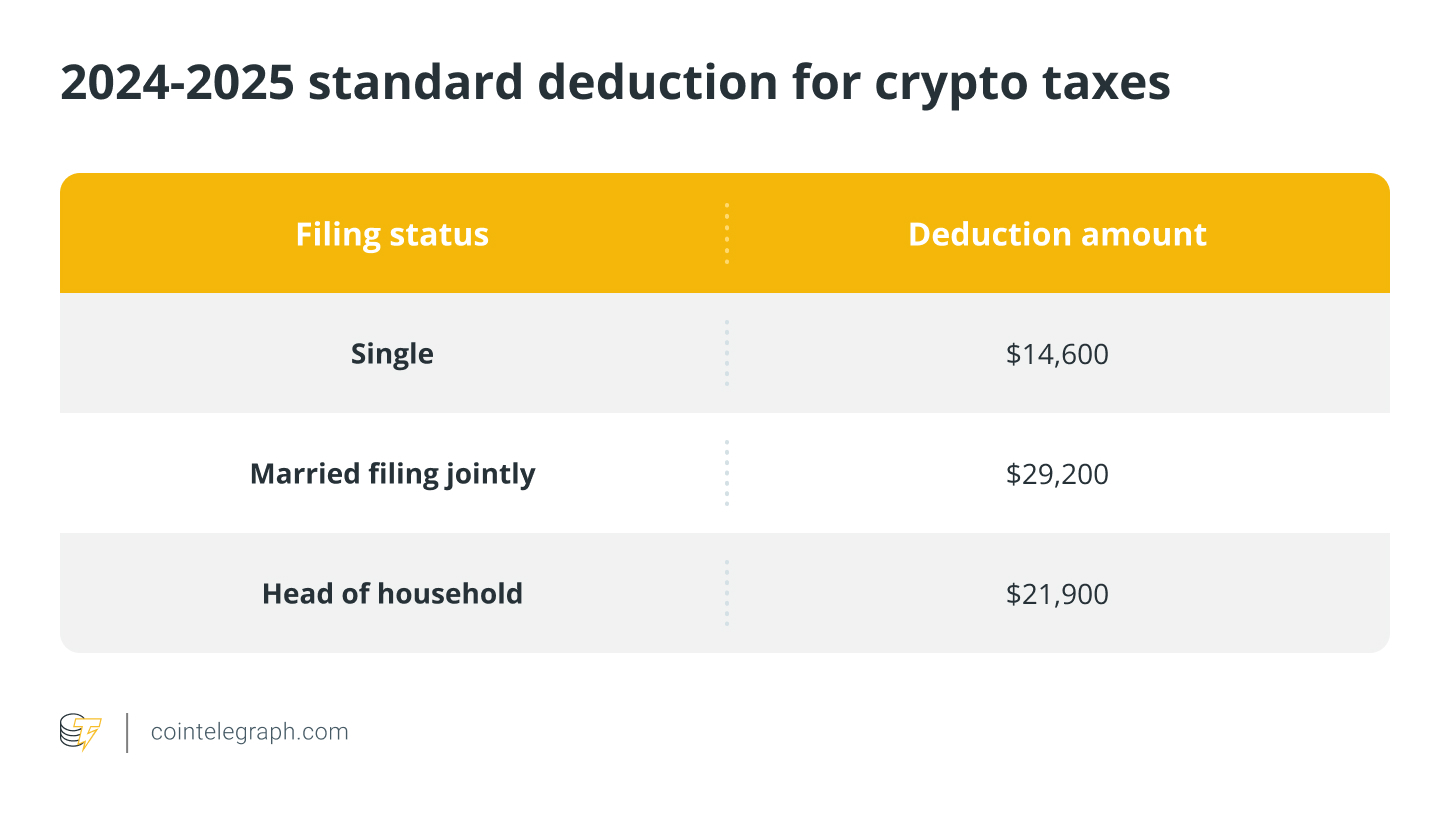
2024–2025 standard deduction: Reduce your crypto taxable income
The standard deduction is the portion of your income that’s exempt from federal taxes before tax rates are applied, reducing your taxable income.
Here is a table regarding tax deductions in the calendar year 2024. These amounts are applicable when filing for tax returns in 2025.
How are crypto airdrops taxed in the US?
In the US, crypto airdrops are treated as ordinary income by the IRS and taxed at the time they come under the taxpayer’s full control. The taxable amount is based on the tokens’ fair market value at that moment, even if the taxpayer didn’t request them. Later, selling or trading those tokens may trigger capital gains tax, depending on the price difference between receipt and disposal.
The taxable event hinges on control: If tokens automatically appear in a taxpayer’s wallet, the income is typically recognized upon arrival. If the tokens require manual claiming (e.g., through a transaction), the taxable event occurs when the claim is completed. Either way, the fair market value at that point determines the income reported.
When the taxpayer sells or trades the airdropped tokens, they incur a capital gain or loss, calculated as the difference between the value at receipt (the basis) and the value at sale or trade. Moreover, the holding periods matter: If sold within a year, gains are taxed at ordinary income rates (10%–37%, based on income brackets). If held longer than a year, gains qualify for lower long-term capital gains rates (0%, 15% or 20%, depending on income). Proper tracking of receipt dates and values is essential for accurate tax reporting.
Crypto gifting rules and tax implications in the US
In the US, gifting cryptocurrency is generally not a taxable event for either the giver or the recipient, meaning no immediate tax is owed. However, specific thresholds and reporting requirements must be followed to stay compliant with IRS rules.
For the 2024 tax year (filed by April 15, 2025), if the total value of crypto gifts to a single recipient exceeds $18,000, the giver must file a gift tax return using Form 709.
When the recipient eventually sells the gifted cryptocurrency, they’ll calculate capital gains or losses based on the giver’s original cost basis — the price the giver paid for the crypto. If this cost basis isn’t documented or available, the recipient may need to assume a basis of $0, which could increase their taxable gain upon sale. To avoid complications, both parties should keep detailed records of the gift’s fair market value at the time of transfer and the giver’s original cost basis.
Did you know? In the UK, giving cryptocurrency as a gift may result in capital gains tax for the giver, except for gifts to spouses or civil partners. Additionally, inheritance tax could apply if the giver dies within seven years of the gift.
Essential forms for filing crypto taxes in 2024
With the April 15, 2025, deadline nearing, here are the key forms for reporting 2024 crypto transactions:
-
Form 8949: For reporting capital gains and losses from crypto sales, trades and disposals. Each transaction must be listed individually.
-
Schedule D (Form 1040): Summarizes total capital gains and losses from Form 8949; used for calculating taxable income.
-
Schedule 1 (Form 1040): Reports additional income, including staking rewards, airdrops and hard forks, if classified as taxable income.
-
Schedule C (Form 1040): Used by self-employed individuals or businesses to report crypto-related income from mining, consulting or freelance work.
-
Form 1099-MISC: Issued for staking, mining or payment income over $600
-
Form 1040: The main return form to combine income, deductions and tax liability.
-
FBAR (FinCEN Form 114): File separately if foreign crypto accounts exceeded $10,000 in 2024.

Step-by-step guide to filing crypto taxes for the 2024–2025 tax season
Here’s how to file, step by step, leveraging the detailed tax rates and forms outlined above.
Step 1: Gather all crypto transaction records
Collect records for every 2024 crypto transaction:
-
Dates of buying, selling, trading or receiving crypto
-
Amounts (e.g., 0.5 Bitcoin) and US dollar fair market value (FMV) at the time
-
Cost basis (what you paid, including fees) and proceeds (what you received).
To ensure complete records, pull data from wallets, exchanges (e.g., Coinbase) and blockchain explorers. Export transaction histories or CSVs, and note staking rewards, airdrops or mining income separately with their FMV on receipt.
Step 2: Identify taxable events
Pinpoint which 2024 actions trigger taxes:
-
Taxable: Selling crypto for cash/stablecoins, trading crypto, spending crypto or earning it (mining, staking, airdrops).
-
Non-taxable: Buying and holding with USD, moving crypto between your wallets, gifting up to $18,000 per recipient.
Classify each taxable event as short-term (≤1 year) or long-term (>1 year) for rate purposes.
Step 3: Calculate capital gains and losses
For taxable sales or trades:
-
Formula: Proceeds (FMV at disposal) – Cost Basis = Gain/Loss
-
Example: Bought 1 Ether (ETH) for $2,000 in May 2024, sold for $2,500 in November 2024 = $500 short-term gain.
Use first-in, first-out or specific identification for cost basis (be consistent). Sum your net gains/losses. See the “2024 Federal Income Tax Brackets” section for how these are taxed.
Step 4: Calculate crypto income
For earnings (mining, staking, airdrops):
-
Record FMV in USD when received (e.g., 10 Cardano worth $5 on June 1, 2024 = $5 income).
-
Add to your other 2024 income to set your tax bracket, detailed in the sections above.
Step 5: Apply the 2024 standard deduction
Lower your taxable income with the standard deduction:
-
Single: $14,600
-
Married filing jointly: $29,200
-
Head of household: $21,900
Subtract this from total income (including short-term gains and crypto income). Long-term gains are taxed separately.
Step 6: Determine your tax rates
Apply rates to your gains and income (refer to “How Crypto Tax Rates Work in 2024”):
-
Short-term gains and income: Ordinary rates (10%–37%).
-
Long-term gains: 0%, 15% or 20%, based on income.
-
Offset gains with losses (up to $3,000 net loss against other income; carry forward excess).
Step 7: Complete the necessary tax forms
Fill out the required IRS forms (see “Essential Forms for Filing Crypto Taxes in 2024”):
-
List capital gains/losses and income on Form 8949, Schedule D and Schedule 1 as applicable.
-
Use Schedule C if self-employed (e.g., mining business).
-
Combine everything on Form 1040.
-
Check Form 1099-MISC if received and file FBAR for foreign accounts over $10,000.
Step 8: File your return by April 15, 2025
-
Submit via IRS e-file or mail, postmarked by April 15, 2025.
-
Need more time? File Form 4868 for an extension to Oct. 15, 2025, but pay estimated taxes by April 15 to avoid penalties.
Step 9: Pay any taxes owed
Estimate your tax from Step 6, then pay via IRS Direct Pay or check. Late payments after April 15 incur a 0.5% monthly penalty plus interest.
Step 10: Keep records for audits
Store transaction records and forms for three to six years. The IRS is intensifying crypto scrutiny — be prepared.
Did you know? In Canada, giving cryptocurrency as a gift is generally considered a taxable disposition, requiring the giver to determine and report any capital gains or losses.
Important dates and deadlines for 2024–2025 tax season and beyond
Here are important dates regarding the 2024–2025 tax season and 2025 transition:
2024 tax season
-
Jan. 31, 2025: Some exchanges may issue voluntary 1099s (e.g., 1099-MISC).
-
April 15, 2025: File taxes on crypto earned in 2024.
2025 transition
-
Jan. 1, 2025: Form 1099-DA reporting begins.
-
Dec. 31, 2025: Safe harbor ends for adjusting universal cost basis.
-
Jan. 31, 2026: Receive Form 1099-DA for 2025 trades.
Quarterly estimates
-
June 15, Sept. 15, 2025, etc., for active traders.
New IRS crypto tax rules for 2025: What you need to know
The IRS introduced new rules for tax filing and reporting aimed at US cryptocurrency taxpayers, but these regulations have encountered significant pushback. Both the US Senate and House of Representatives voted to repeal them under the Congressional Review Act (CRA), and President Donald Trump has signaled support for the rollback. Despite this uncertainty, understanding these rules remains crucial, especially with deadlines looming in 2025.
A core component of the new rules is calculating taxes using a cost basis — the original amount invested in an asset, including fees or commissions. Accurately tracking cost basis is vital for proper tax reporting and prevents double taxation on reinvested earnings. It’s the starting point for determining capital gains or losses.
Under the updated IRS guidelines, crypto investors must now track the cost basis (original purchase price) separately for each account or wallet, moving away from a universal tracking approach. This requires recording the purchase date, acquisition cost and specific transaction details.
The rules also mandate specific identification for every digital asset sale, requiring taxpayers to report the exact purchase date, quantity and cost of the assets sold. If this information isn’t provided, the IRS defaults to the first-in, first-out (FIFO) method — selling your earliest coins first — which could inflate taxable gains if those initial purchases had lower costs.
For taxpayers previously using a universal cost basis method, the IRS requires reallocating their basis across all accounts or wallets accurately by Dec. 31, 2025, to comply with these standards.
Form 1099-DA: What to expect for crypto taxes in 2025–2026
As of March 27, 2025, Form 1099-DA is set to become a pivotal tool for the 2025–2026 tax season, simplifying how cryptocurrency transactions are reported in the US. This new form, tailored specifically for digital assets, will be issued by exchanges to both taxpayers and the IRS, providing a detailed breakdown of activities like sales, trades and other taxable crypto events from 2025.
It’s designed to streamline compliance and bolster IRS oversight, reflecting the agency’s growing focus on tracking digital asset income. For taxpayers, it promises easier, more accurate reporting, while exchanges take on a larger role in tax documentation.
For the 2024 tax year — due by April 15, 2025 — this form isn’t yet available; filers must still rely on existing forms like Form 1099-MISC until Form 1099-DA officially takes effect for 2025 earnings.
IRS crypto tax penalties: What happens if you don’t report or under-report in 2024?
US taxpayers who fail to meet their tax obligations may face penalties from the IRS. When tax obligations go unmet, the IRS sends a notice or letter detailing the penalty, its reason (e.g., late filing, non-payment or inaccurate reporting) and your next steps.
Penalties vary:
-
Late filing or non-payment can incur fines up to 25% of the unpaid tax, plus interest that accrues until settled.
-
Other triggers — like bounced checks or fraudulent claims — add further costs, and the IRS may launch an audit to scrutinize your filings.
-
Individuals may face penalties of up to $100,000 and criminal sanctions, including imprisonment for up to five years.
-
Corporations can be fined up to $500,000.
These stakes are high, especially as the IRS ramps up crypto enforcement in 2024. To dodge these consequences, double-check any notice for accuracy and act fast: Request a filing extension with Form 4868 if needed (due by April 15, 2025), arrange a payment plan for unaffordable penalties, or dispute the penalty if you believe it’s unjustified. Prompt action can save you from escalating costs and legal headaches.

Is Cardano (ADA) a “zombie crypto”?
For years, Cardano (ADA) has been a cornerstone of the crypto landscape, consistently ranking among the top digital assets by market capitalization. Yet, despite its prominence, ADA’s performance has left many investors questioning its long-term prospects. While it recently made headlines for being included in […]
Analysis
For years, Cardano (ADA) has been a cornerstone of the crypto landscape, consistently ranking among the top digital assets by market capitalization. Yet, despite its prominence, ADA’s performance has left many investors questioning its long-term prospects.
While it recently made headlines for being included in US President Donald Trump’s initial proposal for a national crypto stockpile, its price action and onchain activity tell a different story — one that has even led some critics to brand it a “zombie.”
Recent findings suggest that the ecosystem behind ADA, the Cardano network, lags significantly behind in decentralized finance (DeFi) adoption. With only a fraction of the total value locked (TVL) compared with Ethereum and Solana, Cardano struggles to attract liquidity and stablecoin activity.
While some argue that its DeFi sector is still in its early stages, several newer blockchains have outpaced it in user engagement and trading volume. The question now is whether upcoming developments can reverse the trend.
With key catalysts on the horizon, such as a potential ADA exchange-traded fund (ETF) and its emerging role in Bitcoin’s DeFi ecosystem, 2025 could be a pivotal year for ADA. But will these developments be enough to turn the tide?
To uncover the full story and explore the current state of Cardano’s native token, watch the full video now on the Cointelegraph YouTube channel!

How to buy Bitcoin in Australia
Key takeaways Bitcoin is legal in Australia and is regulated by AUSTRAC and the Australian Taxation Office (ATO). You can buy Bitcoin on various platforms, including centralized exchanges, decentralized exchanges (DEXs), P2P platforms and Bitcoin ATMs Payment options are diverse, including credit cards, debit cards, […]
Analysis
Key takeaways
-
Bitcoin is legal in Australia and is regulated by AUSTRAC and the Australian Taxation Office (ATO).
-
You can buy Bitcoin on various platforms, including centralized exchanges, decentralized exchanges (DEXs), P2P platforms and Bitcoin ATMs
-
Payment options are diverse, including credit cards, debit cards, bank transfers and fiat cash deposits at ATMs
-
Store your Bitcoin securely and opt for cold wallets, which protect you better than custodial wallets from crypto exchanges.
Bitcoin is legal in Australia and is regulated by AUSTRAC and the Australian Taxation Office (ATO).
You can buy Bitcoin on various platforms, including centralized exchanges, decentralized exchanges (DEXs), P2P platforms and Bitcoin ATMs
Payment options are diverse, including credit cards, debit cards, bank transfers and fiat cash deposits at ATMs
Store your Bitcoin securely and opt for cold wallets, which protect you better than custodial wallets from crypto exchanges.
Bitcoin adoption continues to grow. More and more Australians are discovering the cryptocurrency as an investment vehicle, with ownership rising from 23% in 2023 to 32.5% in 2025, an impressive 41.3% increase. Because there are several platforms to choose from, buying Bitcoin is low-threshold and secure.
This article covers several methods and describes the steps to safely start investing in Bitcoin.
Is Bitcoin legal in Australia?
Yes, Bitcoin is legal in Australia, but it’s not considered a legal tender. The local government considers owning cryptocurrencies like Bitcoin (BTC) as property. Any profit you might make from Bitcoin is subject to capital gains tax (CGT), with Australian Transaction Reports and Analysis Centre (AUSTRAC) ensuring AML and CTF compliance.
Of course, there are also various regulatory requirements to abide by. AUSTRAC requires cryptocurrency companies to comply with Anti-Money Laundering (AML) and counter-terrorism-financing (CTF) regulations. This framework aims to protect Australian investors by safeguarding the crypto market against financial crime.
A significant update in 2025 requires major crypto platforms to obtain an Australian Financial Services License (AFSL) for enhanced consumer protection, as outlined in government proposals.
Did you know? Some Australian exchanges offer instant verification, allowing you to start trading Bitcoin within minutes.
Prerequisites to buying Bitcoin in Australia
Before buying Bitcoin in Australia, it is essential to prepare properly. To get you started, here are some points of interest:
-
Understand the legal landscape: Bitcoin is legal and regulated in Australia by AUSTRAC, but it is not a legal tender. You can safely deal with cryptocurrencies because the government minimizes risks such as money laundering.
-
Platforms to buy Bitcoin in Australia: If you want to buy Bitcoin or other crypto assets in Australia, use a reliable platform. Choose CoinSpot, Swyftx or Binance. These exchanges comply with local regulations, allowing you to trade safely. Of course, don’t forget to complete your KYC verification. Please note that Binance offers spot trading only, as its derivatives license was canceled in 2023.
-
Set up a non-custodial wallet for self-custody: Choose a non-custodial wallet, such as Trust Wallet or Exodus. This allows you to keep control of your private keys. If you go for long-term storage of your coins, always choose a cold wallet that stores your assets offline.
-
Payment methods and fees: The fastest and safest way is to initiate transactions with a reliable payment method, such as bank transfer, credit card or PayID. Always check the associated transaction fees so you don’t incur unexpected (sometimes high) fees.
-
Secure your investment: Take precautions for your security, too. Enable two-factor authentication (2FA) on your accounts and back up private keys regularly. Ensure your platform offers strong security features such as encryption and cold storage.
How to buy Bitcoin in Australia on a centralized exchange
Want to buy Bitcoin through a central exchange, such as CoinSpot? You can do this easily and quickly:
-
Step 1: Create an account. Sign up to CoinSpot with your email address and a secure password. Go through the KYC process with ID verification and get started. As of 2025, CoinSpot complies with AUSTRAC regulations and the new AFSL requirement, ensuring enhanced consumer protection.
-
Step 2: Add a payment method. Link a payment method, such as bank transfer, debit card or Australian-only PayID. CoinSpot supports low-fee options like bank transfers (free via POLi) and PayID, while credit/debit card transactions may incur fees up to 2.58%, so review these costs upfront.
-
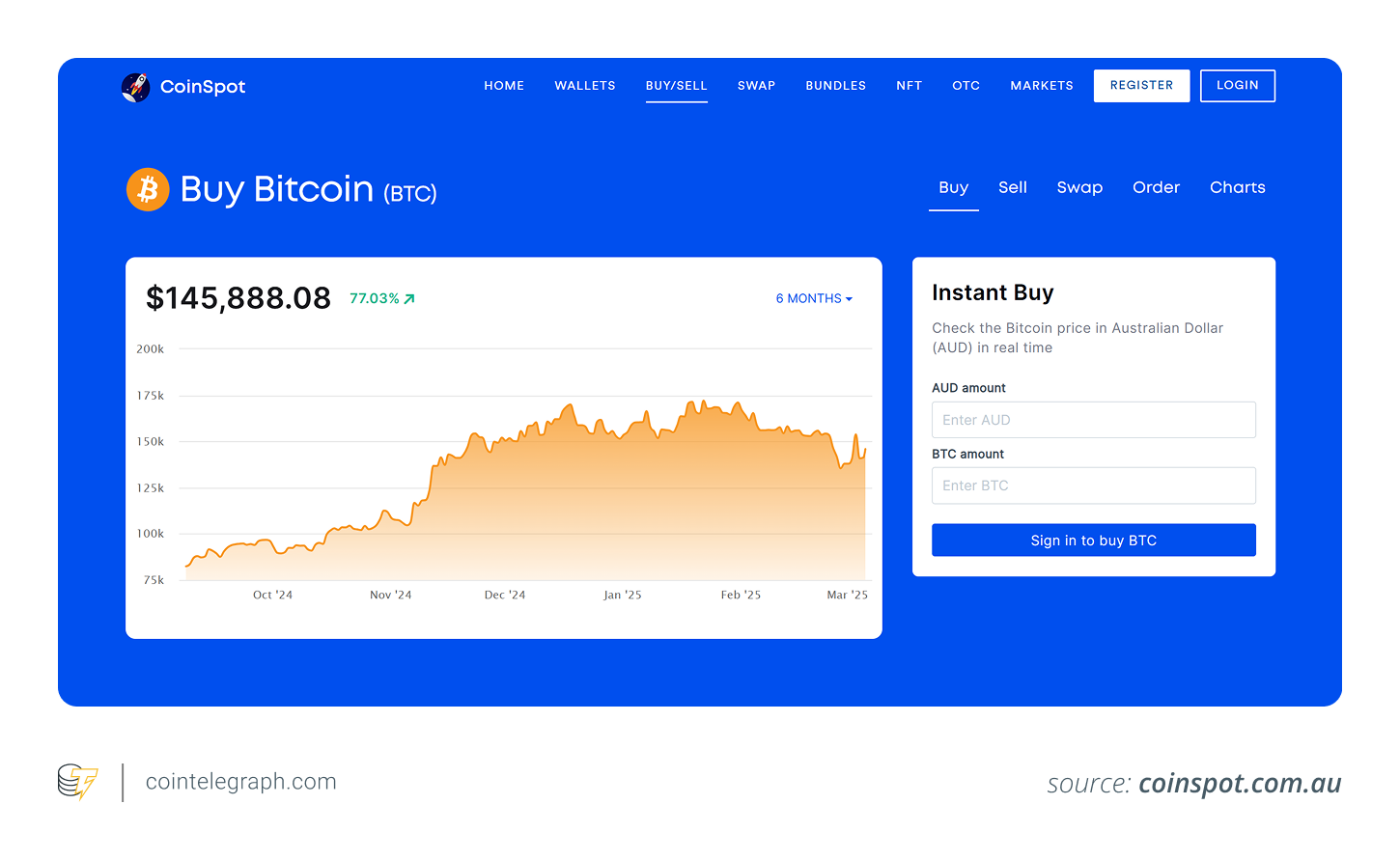
Step 3: Navigate to the Bitcoin purchase section. Go to “Buy/Sell” on CoinSpot’s website or in the app and select Bitcoin from the list of over 350 supported cryptocurrencies.
-
Step 4: Enter the amount. Enter how much Bitcoin you want to buy in AUD. The platform will display how much Bitcoin you are buying based on the current exchange rate.
-
Step 5: Check the transaction. Check the details, including fees, before confirming the purchase.
-
Step 6: Confirm and complete the purchase. Click “Buy Now” to complete the transaction. The Bitcoin you bought will appear immediately in your CoinSpot wallet. For added security, you could consider transferring your BTC to a non-custodial wallet like Exodus after purchase to retain full control over your private keys.
This efficient process makes Bitcoin accessible to beginners and experienced users, all in a secure, regulated environment.
How to buy Bitcoin in Australia using a non-custodial wallet
Non-custodial wallets give you full control over your Bitcoin. If you want to know how to buy Bitcoin with your Trust Wallet, go through the steps below:
-
Step 1: Set up a Trust Wallet. Download Trust Wallet from the App Store or Google Play. Create a wallet, set a secure password and write down the 12-word recovery phrase.
-
Step 2: Link a payment method. Link a payment method, such as a debit card or bank transfer, via MoonPay or Simplex. Use a service that supports Trust Wallet in Australia.
-
Step 3: Select Bitcoin and start the purchase. Tap “Buy” on Trust Wallet, select Bitcoin (BTC) and enter the amount in AUD. Review the transaction details before finalizing the purchase.
-
Step 4: Confirm and complete the transaction. After confirming the payment details, tap “Confirm” to complete the purchase. The Bitcoin will appear in your Trust Wallet as soon as it is finalized.
Use a non-voluntary wallet to always have your Bitcoin in your possession and optimize privacy and security.
How to buy Bitcoin in Australia on a decentralized exchange (DEX)
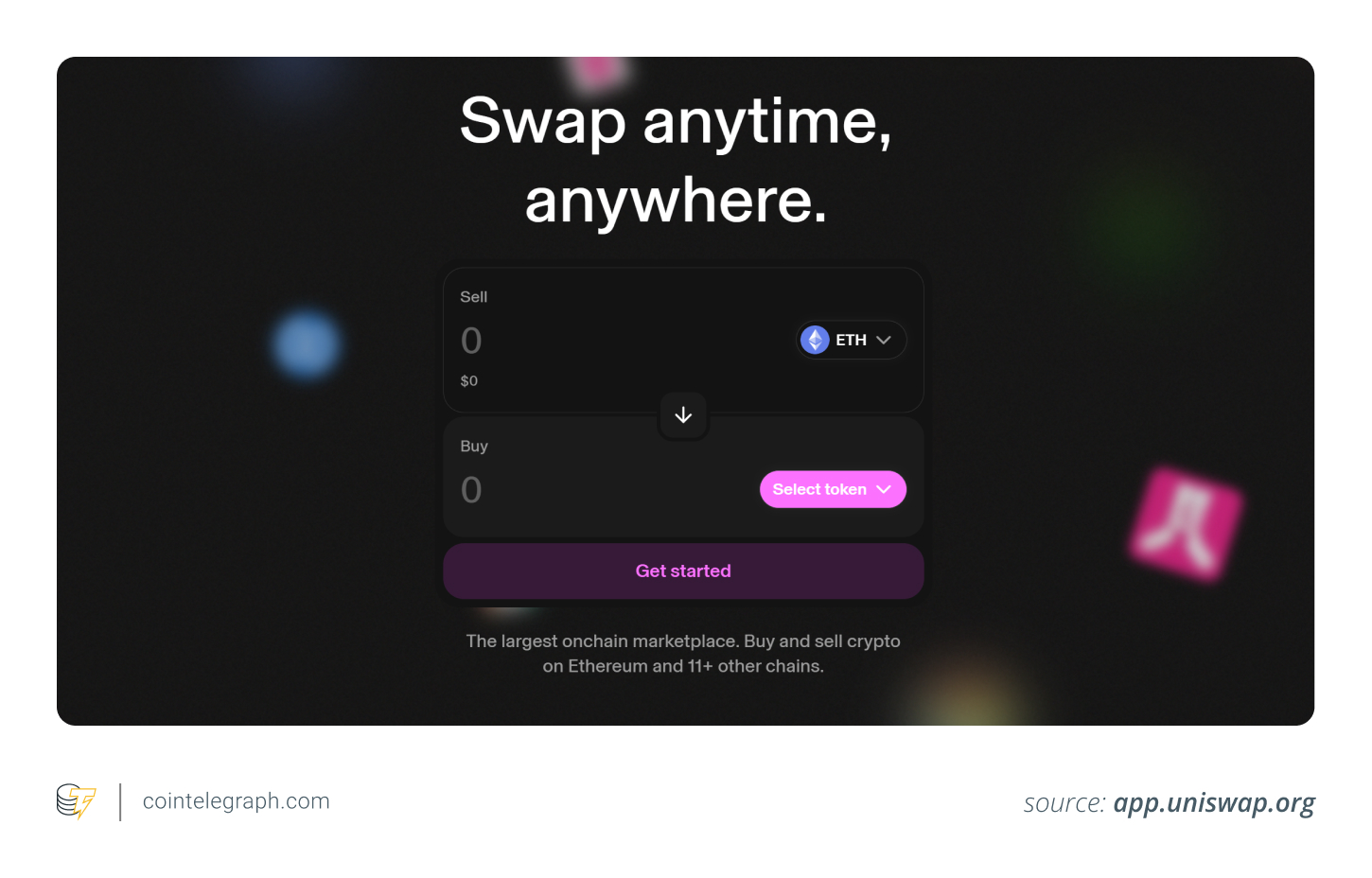
Buying Bitcoin on a DEX, such as Uniswap, gives you complete freedom over managing your assets. Here’s how to buy Bitcoin through a DEX:
-
Step 1: Set up a crypto wallet. Download MetaMask and create a wallet. Save the 12-word recovery phrase and put ETH in your wallet to cover transaction costs.
-
Step 2: Connect to the DEX (Uniswap). Visit the Uniswap website and click on “Connect Wallet.” Choose MetaMask or WalletConnect for mobile users.
-
Step 3: Select Bitcoin to buy. Select ETH as the token to exchange and Wrapped Bitcoin (WBTC) as the token to purchase.
-
Step 4: Review and approve the transaction. Check the details, including the ETH amount and WBTC to be received, and confirm the transaction.
-
Step 5: Confirm and complete the purchase. Once you have confirmed everything, the transaction will be processed on the Ethereum blockchain. Your WBTC will appear in your MetaMask wallet.
Using a DEX ensures you maintain control over your private keys while enjoying a decentralized trading experience.
Did you know? Bitcoin adoption in Australia has been rising recently, leading many Australians to deploy cryptocurrency to diversify their investment portfolios.
How to buy Bitcoin in Australia via P2P platforms
In Australia, you have peer-to-peer (P2P) cryptocurrency platforms such as Binance P2P to buy Bitcoin directly from other users, offering flexibility and privacy. Here’s how you can buy Bitcoin on P2P platforms:
-
Step 1: Create an account. Sign up and complete the KYC verification. Have your ID ready and verify your contact details during the process. Notably, Binance P2P, registered with AUSTRAC, ensures compliance with AML/CTF regulations, making it a reliable choice for Australians.
-
Step 2: Search for Bitcoin offers. Browse available offers, filtering by payment method (e.g., bank transfer, PayID), price or seller reputation. Prioritize sellers with high feedback scores (e.g., 95%+ positive ratings) and a history of 100+ completed trades for trustworthiness. Binance P2P displays these metrics clearly. As of 2025, Binance P2P supports over 31 fiat currencies and 700+ payment methods globally, tailoring offers to Australian users.
-
Step 3: Start a trade. Select the amount of Bitcoin or fiat currency you want to trade and click “Buy.”
-
Step 4: Make the Payment. Pay via bank transfer, PayID or another accepted payment method. The platform holds the Bitcoin in escrow until the payment is confirmed. Notably, PayID transactions are instant and free on Binance P2P, while bank transfers may take 1-2 hours. Confirm receipt with the seller via the platform’s messaging system to avoid delays.
-
Step 5: Receive your Bitcoin: Once the seller verifies your payment, the escrowed Bitcoin is released to your P2P wallet (e.g., Binance wallet). This typically happens within minutes for instant methods like PayID.
For maximum security, you could immediately transfer your BTC to a non-custodial wallet like Trust Wallet or a hardware wallet like Ledger. P2P platforms aren’t designed for long-term storage.
This P2P process offers a direct, flexible way to buy Bitcoin, with Binance P2P standing out in 2025 for its robust escrow system and wide payment options. Always double-check seller credibility and avoid off-platform payments to mitigate risks, aligning with best practices for P2P trading.
How to buy Bitcoin in Australia using Bitcoin ATMs
By using a Bitcoin ATM, you can buy Bitcoin quickly and easily. This is how:
-
Step 1: Find a Bitcoin ATM. Search for Bitcoin ATMs with CoinATMRadar. These machines are usually found in shopping centers in major Australian cities.
-
Step 2: Verify your identity. Most ATMs require a government-issued ID, such as a driver’s license or passport.
-
Step 3: Start the transaction. Select “Buy Bitcoin” and enter the amount you want to purchase in AUD or Bitcoin.
-
Step 4: Enter your wallet address. Scan the QR code of your Bitcoin wallet to enter the address so you can receive Bitcoin.
-
Step 5: Deposit the money. Deposit the money in the ATM to complete the transaction.
-
Step 6: Confirm and complete. Check the transaction and confirm the purchase. The Bitcoin will arrive in your wallet after processing.

Quick checklist for Bitcoin ATM use in Australia
-
Locate a verified ATM via CoinATMRadar.
-
Bring a pre-set wallet QR code and ID.
-
Compare fees/rates to online alternatives.
-
Use in a safe, public location.
-
Confirm receipt and track the transaction.
-
Avoid unofficial QR codes or support contacts.
-
Start with a small test transaction.
How to buy Bitcoin ETFs in Australia
Buying Bitcoin ETFs in Australia is straightforward. Just follow these steps:
-
Step 1: Choose a brokerage platform. Open an account with a brokerage that offers Bitcoin ETFs on the ASX. Make sure it complies with Australian financial regulations.
-
Step 2: Complete KYC verification. Submit proof of identity and proof of address for verification.
-
Step 3: Deposit funds. Transfer funds to your account using secure methods, such as bank transfer.
-
Step 4: Search for Bitcoin ETFs. Use the platform’s search function to find Bitcoin ETFs, such as VanEck Bitcoin ETF (VBTC) or Global X 21Shares Bitcoin ETF (EBTC).
-
Step 5: Place your order. Choose the number of units you want to buy and select a market or limit order.
-
Step 6: Confirm the purchase. Check and confirm the transaction. The ETF units will be added to your portfolio after the transaction has been completed.
Did you know: Bitcoin ETFs in Australia are scrutinized by ASIC and ASX to ensure high transparency and investor protection.
Best practices for buying Bitcoin in Australia
Store your Bitcoin securely after purchase using a reputable platform that complies with ASIC and AUSTRAC regulations. Ensure you have a secure internet connection and enable two-factor authentication (2FA).
Choose cost-effective payment methods such as bank transfers instead of credit cards. After you have purchased the Bitcoin, move it to an unsecured wallet to have complete control over your private keys.
Use a cold wallet for maximum security. Stay up to date on market trends, tax obligations, and changes in regulations to protect your investments. The crypto landscape evolves rapidly, and keeping up to date will help you make better investment decisions while ensuring compliance with Australian laws.

What are crypto payment gateways, and how do they work?
Key takeaways Crypto payment gateways enable businesses to accept cryptocurrency payments from customers. They act as intermediaries, converting crypto payments into the business’s preferred currency (crypto or fiat). Crypto payment gateways reduce transaction fees compared to traditional banking systems and provide access to a global […]
Analysis
Key takeaways
-
Crypto payment gateways enable businesses to accept cryptocurrency payments from customers.
-
They act as intermediaries, converting crypto payments into the business’s preferred currency (crypto or fiat).
-
Crypto payment gateways reduce transaction fees compared to traditional banking systems and provide access to a global customer base.
-
These gateways leverage blockchain technology to offer secure and faster transactions with fewer intermediaries, enhancing transparency and reducing the risk of fraud.
Crypto payment gateways enable businesses to accept cryptocurrency payments from customers.
They act as intermediaries, converting crypto payments into the business’s preferred currency (crypto or fiat).
Crypto payment gateways reduce transaction fees compared to traditional banking systems and provide access to a global customer base.
These gateways leverage blockchain technology to offer secure and faster transactions with fewer intermediaries, enhancing transparency and reducing the risk of fraud.
The cryptocurrency industry faces significant challenges, particularly in the area of seamless conversion between digital assets and fiat currencies. This issue makes it difficult for businesses and users to adopt cryptocurrencies for everyday transactions.
Crypto payment gateways address this need by simplifying the process of converting digital currencies into fiat, enabling smooth and efficient transactions.
This article explores what crypto payment gateways are, how these gateways work, and their pros and cons.
Cryptocurrency payment gateways, explained
A cryptocurrency payment gateway is a digital transaction facilitator that enables businesses to accept crypto payments while ensuring seamless processing and settlement.
These gateways act as intermediaries between customers who pay with digital assets and merchants who receive crypto payments, helping businesses navigate the complexities of blockchain transactions. Examples of crypto payment gateways include BitPay, Coinbase Commerce and PayPal’s crypto payment service.
One of the key advantages of using a crypto payment gateway is that businesses can receive payments in cryptocurrency while opting to convert them into fiat currency, which is then deposited into their bank accounts. This eliminates concerns about crypto price volatility while allowing merchants to offer additional payment options to their customers.
Are crypto payment gateways necessary for accepting digital currencies?
While crypto payment gateways simplify the process of accepting digital assets, they are not the only way for businesses to receive cryptocurrency payments.
Merchants can choose to accept crypto directly by using personal wallets, bypassing third-party processors. However, without a payment gateway, they would need to manually manage transactions, track payments on the blockchain, and handle currency conversion if they wish to receive fiat instead of crypto.
For businesses looking to integrate cryptocurrency payments alongside traditional methods, crypto payment gateways provide an efficient solution. These services offer real-time transaction processing, automatic conversion to fiat and additional security features that protect businesses from fraudulent transactions.
However, be aware of fees. Coinbase Commerce charges a 1% fee on all crypto payments. After your customer completes a payment, this fee is collected in the settlement currency of the transaction.
For example, if your customer makes a $250 purchase in Bitcoin (BTC), and your settlement currency is in euros, it would collect 2.5 euros (1% of the payment amount) as a fee.
Types of crypto payment gateways: Custodial vs. non-custodial
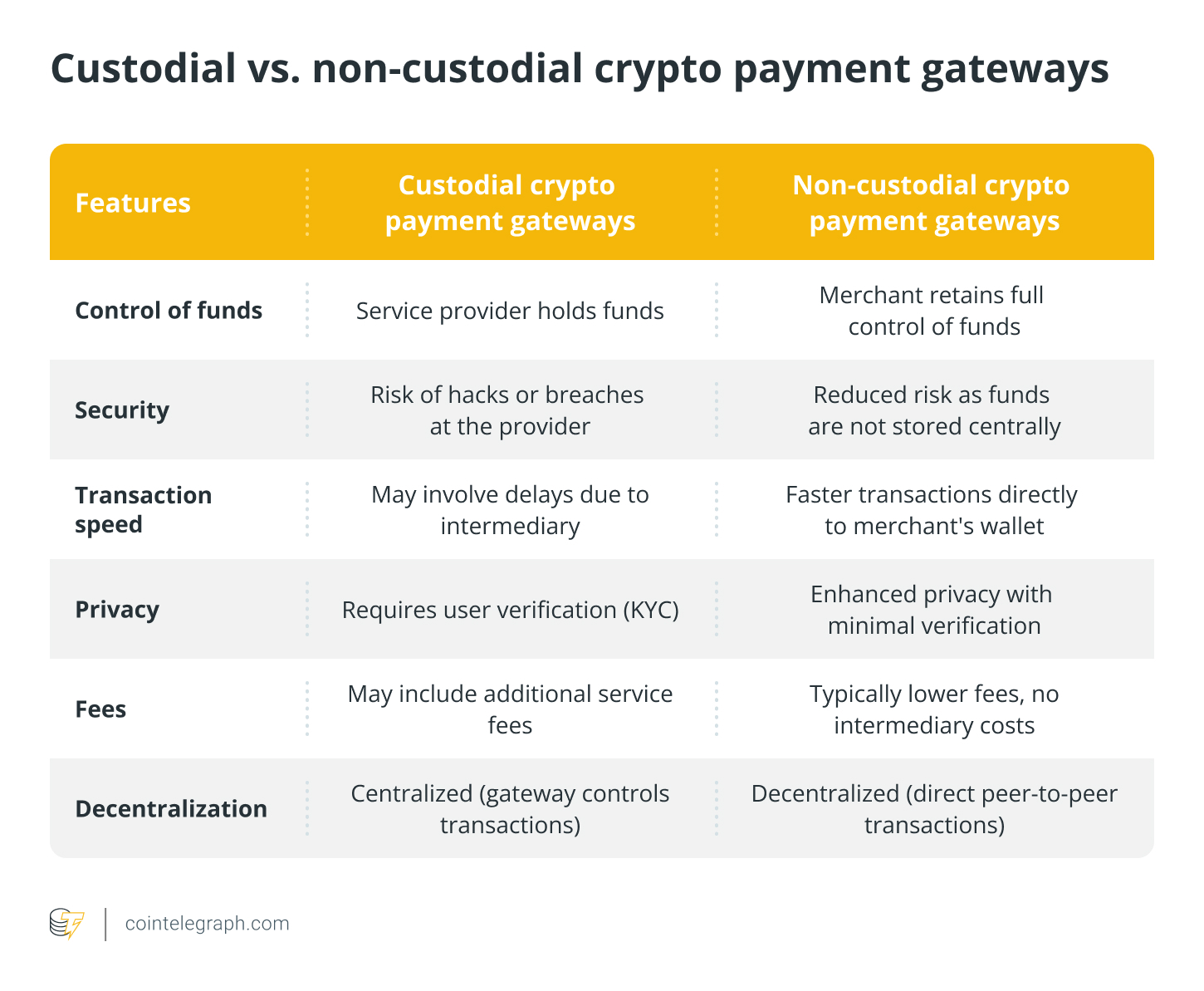
Crypto payment gateways can be classified into two main types: custodial and non-custodial. The choice between these options depends on a business’s preferences regarding security, control and ease of use.
Custodial crypto payment gateways
Custodial gateways function similarly to traditional payment processors. They receive and temporarily hold payments before allowing merchants to withdraw funds to their crypto wallets or convert them to fiat currency. This model is ideal for businesses that want a streamlined experience without dealing with direct wallet management.
Key characteristics of custodial payment gateways include:
-
Automated fiat conversion: Payments can be converted to local currency instantly, mitigating volatility risks.
-
User-friendly dashboard: Merchants can manage transactions, track payment history, and withdraw funds through an online portal.
-
Compliance features: Many custodial gateways implement Know Your Customer (KYC) and Anti-Money Laundering (AML) measures to meet regulatory requirements.
Non-custodial crypto payment gateways
Non-custodial payment gateways provide merchants with full control over their funds by immediately transferring payments to their wallets without holding them on behalf of the business. These solutions prioritize decentralization and security, allowing merchants to manage their own private keys.
Key characteristics of non-custodial payment gateways include:
-
Enhanced security: Funds are not stored by the gateway, which reduces the risk of hacks or third-party control.
-
Direct crypto transfers: Payments are sent straight to the merchant’s wallet, which eliminates withdrawal processes.
-
Greater privacy: Merchants can accept payments without undergoing extensive KYC verification.
-
Lower fees: Transaction costs are reduced for both parties since no intermediaries are involved.
-
Increased transparency: The blockchain records transactions, providing an immutable and traceable record.
-
Full control over funds: Merchants retain complete ownership and access to their crypto assets.
Did you know? Major banks and fintechs, including Bank of America, Standard Chartered, PayPal, Revolut, and Stripe, are entering the stablecoin market to enhance cross-border payments.
How do crypto payment gateways differ from traditional fiat payment gateways?
Traditional payment gateways, such as those used for credit card processing, facilitate transactions in government-issued currencies like the US dollar or euro. These fiat gateways connect a merchant’s payment system to a bank, verifying transactions based on the customer’s bank details before authorizing or declining payments.
Key distinctions between fiat and crypto payment gateways include:
-
Currency type: Fiat gateways exclusively process national currencies, whereas cryptocurrency gateways support digital assets like BTC, Ether (ETH) and stablecoins.
-
Decentralization: Traditional payment gateways rely on centralized financial institutions, while crypto payment gateways leverage blockchain technology for peer-to-peer transactions.
-
Transaction speed: Crypto payments can be settled in minutes, whereas fiat transactions, especially international payments, may take days to clear.
-
Chargeback protection: Unlike fiat payments, where chargebacks can be issued, crypto transactions are irreversible once recorded on the blockchain.
While fiat payment gateways remain essential for conventional banking transactions, crypto payment gateways are expanding payment possibilities by integrating blockchain-based financial solutions.
As cryptocurrency adoption continues to grow, businesses must evaluate their payment strategies and choose the right gateway solution that aligns with their operational needs.
Pros and cons of cryptocurrency payment gateways
You must be aware of the pros and cons of cryptocurrency payment gateways before using them, whether for business transactions or everyday personal use.
Pros of crypto payment gateways
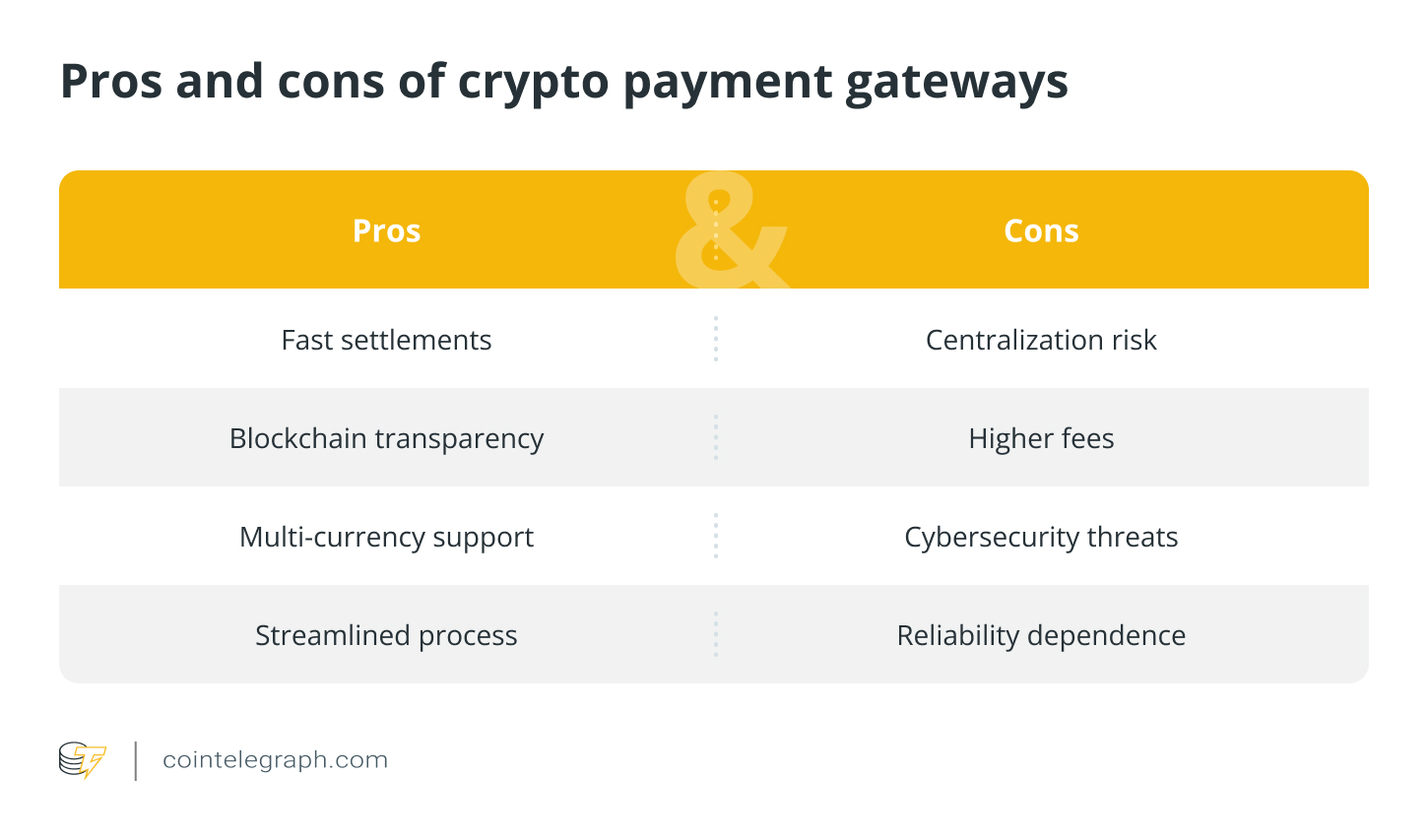
One of the major advantages of using cryptocurrency payment gateways is the ability to settle transactions quickly. These platforms typically charge a minimal network fee (covered by the service provider) and a small service fee for customers. The streamlined process involves just one intermediary — the crypto payment processor — which enhances the user experience for both businesses and their clients.
Additionally, crypto payment systems benefit from the transparency of blockchain technology, offering protection for merchants against chargeback fraud. Unlike traditional fiat payment systems, where transactions can sometimes result in businesses not receiving the funds after they have been deducted from a customer’s account, crypto payments provide more certainty. Furthermore, these gateways can handle a variety of cryptocurrencies, mitigating the risk of market volatility for merchants.
Cons of crypto payment gateways
However, crypto payment gateways are still intermediaries in the process, meaning settlements are not fully decentralized. This centralization could pose a risk. For instance, if a crypto payment processor experiences operational disruptions, merchants may face delayed payments until the issue is resolved. Similarly, if the gateway is compromised by a cyberattack, businesses may lose access to their funds.
Another downside is that crypto payment gateways can be more expensive than direct blockchain transactions. Since these gateways act as intermediaries, they add their own fees on top of the blockchain network’s transaction costs.
As centralized entities, crypto payment processors introduce a level of trust. Merchants need to ensure that the processor is capable of offering reliable, secure services to prevent potential cyber threats.
Do cryptocurrency exchanges offer payment gateways?
Binance, Coinbase and Kraken, which are centralized cryptocurrency exchanges, provide payment gateways to facilitate crypto transactions.
Additionally, they offer application programming interfaces (APIs), which enable merchants to create custom checkout pages with full design control. APIs act as software intermediaries that allow different applications to communicate seamlessly.
Binance offers a crypto payment solution called Binance Pay, tailored for businesses that are open to accepting digital currency. Merchants can integrate Binance Pay both online and in physical stores.
By displaying a unique QR code, physical stores can offer a secure and contactless crypto payment option, enhancing customer convenience. For online businesses, Binance Pay allows seamless cross-border transactions, providing customers with more diverse payment options. Merchants can either create a merchant account or work with channel partners to start accepting crypto payments via Binance Pay.
On the other hand, Coinbase offers its own payment gateway, Coinbase Commerce, which supports 10 different digital currencies, including ETH, USDC (USDC), Dogecoin (DOGE), Tether’s USDt (USDT) and Litecoin (LTC).
Payments processed through Coinbase Commerce are instantly converted to US dollars, ensuring stability for merchants. Importantly, Coinbase does not have access to any funds deposited into merchant accounts.
If a merchant loses their 12-word recovery phrase, Coinbase is unable to assist in retrieving the lost assets. Additionally, Coinbase applies a 1% fee on transactions before the funds are transferred to the merchant’s account, as mentioned above.
Kraken Pay is a cryptocurrency payment processor that allows businesses to accept a wide range of digital currencies, offering fast and secure transactions. It provides easy integration with Kraken exchange wallets, low fees and the ability to convert crypto to fiat, but it still relies on centralized trust.
Did you know? In March 2022, MoonPay enabled customers to purchase NFTs directly through marketplaces, simplifying the process by integrating traditional payment methods like credit cards and Apple Pay.
Are crypto payment gateways secure?
When selecting a cryptocurrency payment gateway, merchants should carefully evaluate how the provider manages the storage of cryptocurrencies and fiat funds.
It’s important to review factors such as transaction fees, the variety of supported cryptocurrencies and the platform’s history regarding security breaches or scams. Understanding these elements helps merchants make informed decisions about which gateway aligns with their needs.
In addition, ensuring that the crypto payment gateway offers reliable customer support is essential. Having access to prompt and effective assistance is crucial in case of disruptions or issues with payments. A responsive support team can help resolve problems quickly and minimize downtime for businesses.
Finally, merchants should always check the reputation of a payment gateway before committing. Consulting specialized review sites and reading feedback from other users will provide insights into the platform’s reliability and trustworthiness. Thorough research ensures that merchants select a secure and reliable payment processor for their business.

What are exit liquidity traps — and how to detect them before it is too late
Key takeaways Exit liquidity traps occur when new investors unknowingly provide liquidity for insiders to cash out, leaving them with devalued assets. FOMO drives impulsive trades, often leading to costly mistakes and becoming exit liquidity for early movers. Beware of projects with exaggerated claims, low […]
Analysis
Key takeaways
-
Exit liquidity traps occur when new investors unknowingly provide liquidity for insiders to cash out, leaving them with devalued assets.
-
FOMO drives impulsive trades, often leading to costly mistakes and becoming exit liquidity for early movers.
-
Beware of projects with exaggerated claims, low liquidity, anonymous teams or sudden price surges.
-
Investing in high-market-cap coins, avoiding hype-driven projects and using reputable exchanges reduce the risk.
Exit liquidity traps occur when new investors unknowingly provide liquidity for insiders to cash out, leaving them with devalued assets.
FOMO drives impulsive trades, often leading to costly mistakes and becoming exit liquidity for early movers.
Beware of projects with exaggerated claims, low liquidity, anonymous teams or sudden price surges.
Investing in high-market-cap coins, avoiding hype-driven projects and using reputable exchanges reduce the risk.
Are you concerned about having bought a cryptocurrency only to later realize that your investment facilitated someone else’s profitable exit? This scenario is called an exit liquidity trap, a deceptive market dynamic where unsuspecting traders provide liquidity for insiders or seasoned investors to offload their holdings at inflated prices.
By the time you recognize you have been trapped, the price crashes, leaving you with devalued tokens. But how do you spot these traps before it is too late?
This guide breaks down exit liquidity traps, their warning signs and strategies to protect your crypto investments.
What is exit liquidity?
In traditional finance, the term refers to buyers who acquire shares from early investors or founders during liquidity events such as acquisitions, mergers or initial public offerings (IPOs). However, in the cryptocurrency market, it has taken on a more negative connotation.
In the cryptocurrency market, exit liquidity refers to unsuspecting investors who purchase tokens with little or no real value, thereby providing liquidity to sellers aiming to offload their holdings.
This situation often arises when traders buy digital assets that later become difficult to resell due to low demand or loss of value. Understanding exit liquidity is crucial for crypto traders to avoid being caught in schemes where their investments primarily benefit those looking to exit the market.
The sheer number of tokens launched every month suggests the scale of exit liquidity traps crypto traders face. In early 2024, over 540,000 new crypto tokens were created, averaging approximately 5,300 new tokens launched daily.
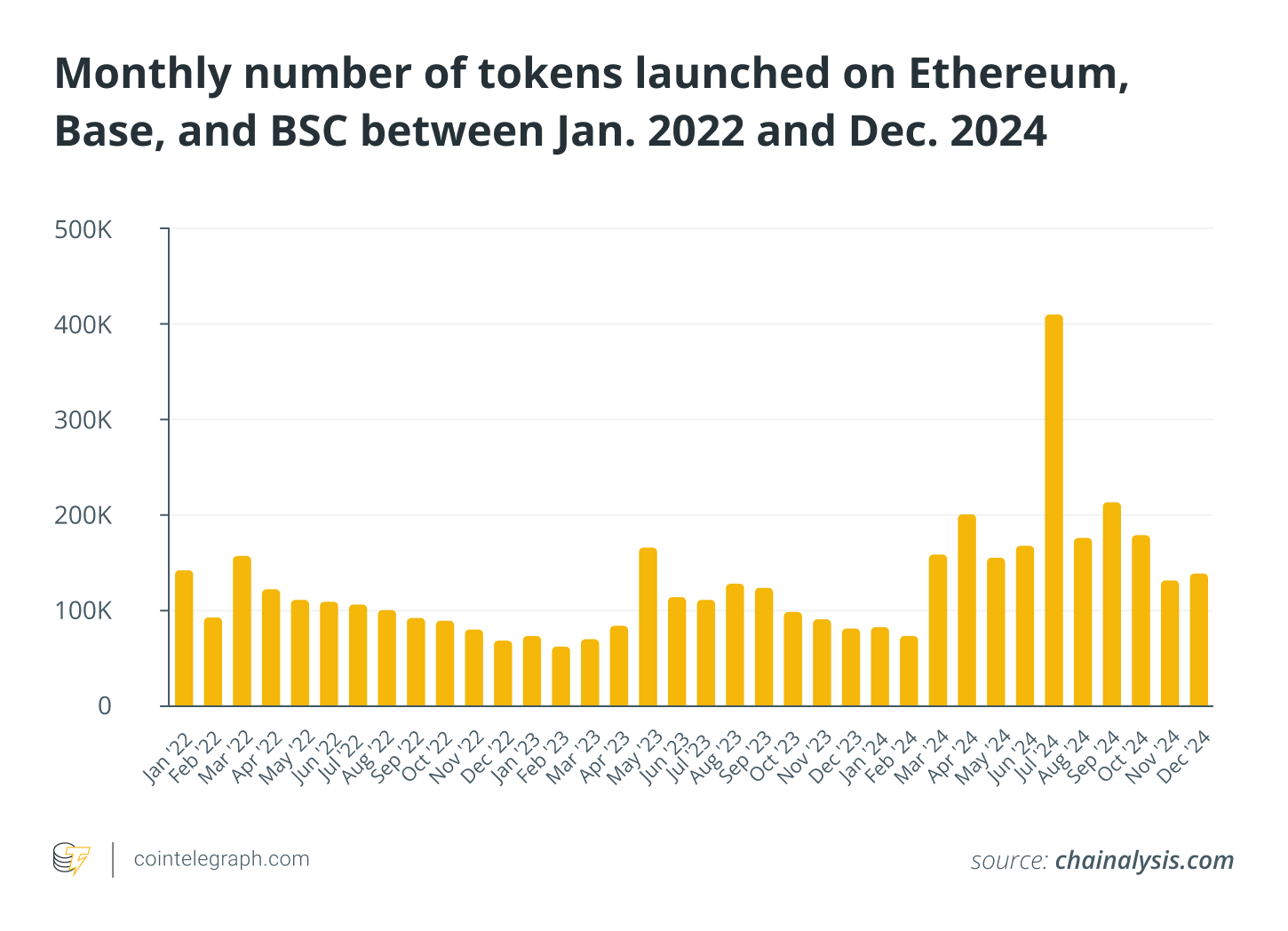
Did you know? In 2024, over 2 million tokens were launched. Of these, roughly 870,000 tokens, representing 42.35%, were available for trading on decentralized exchanges (DEXs).
How can you end up becoming an exit liquidity for others’ profit?
Unforeseen circumstances can sometimes turn your investments against you, making you an exit liquidity victim. Here are some common scenarios where this might happen:
Pump-and-dump schemes
Pump-and-dump schemes happen when a group of individuals artificially inflates the price of a cryptocurrency by aggressively creating a buzz around it. New investors are drawn in as the price surges, believing they are riding a profitable opportunity. However, the manipulators dump their holdings, causing a sharp crash in cryptocurrency, primarily memecoins. Those who bought late end up with significant losses and illiquid assets.
Project failures and scandals
A major security breach, financial mismanagement or controversy involving a crypto project can lead to a rapid decline in its token value. When panic selling begins, investors who exit early minimize their losses, while those who hold on too long become exit liquidity victims as the price crashes.
Regulatory crackdowns
Government actions against specific cryptocurrencies can suddenly shift market dynamics. If a cryptocurrency is declared illegal or subjected to strict regulations, its trading volume and liquidity can collapse, leaving investors struggling to sell.
Exchange delistings
When a cryptocurrency is removed from major exchanges, its liquidity can dry up quickly. Finding buyers for the token becomes increasingly difficult without access to a large trading platform. Novice investors may become an exit liquidity medium for those offloading their holdings ahead of the delisting.
Market manipulation
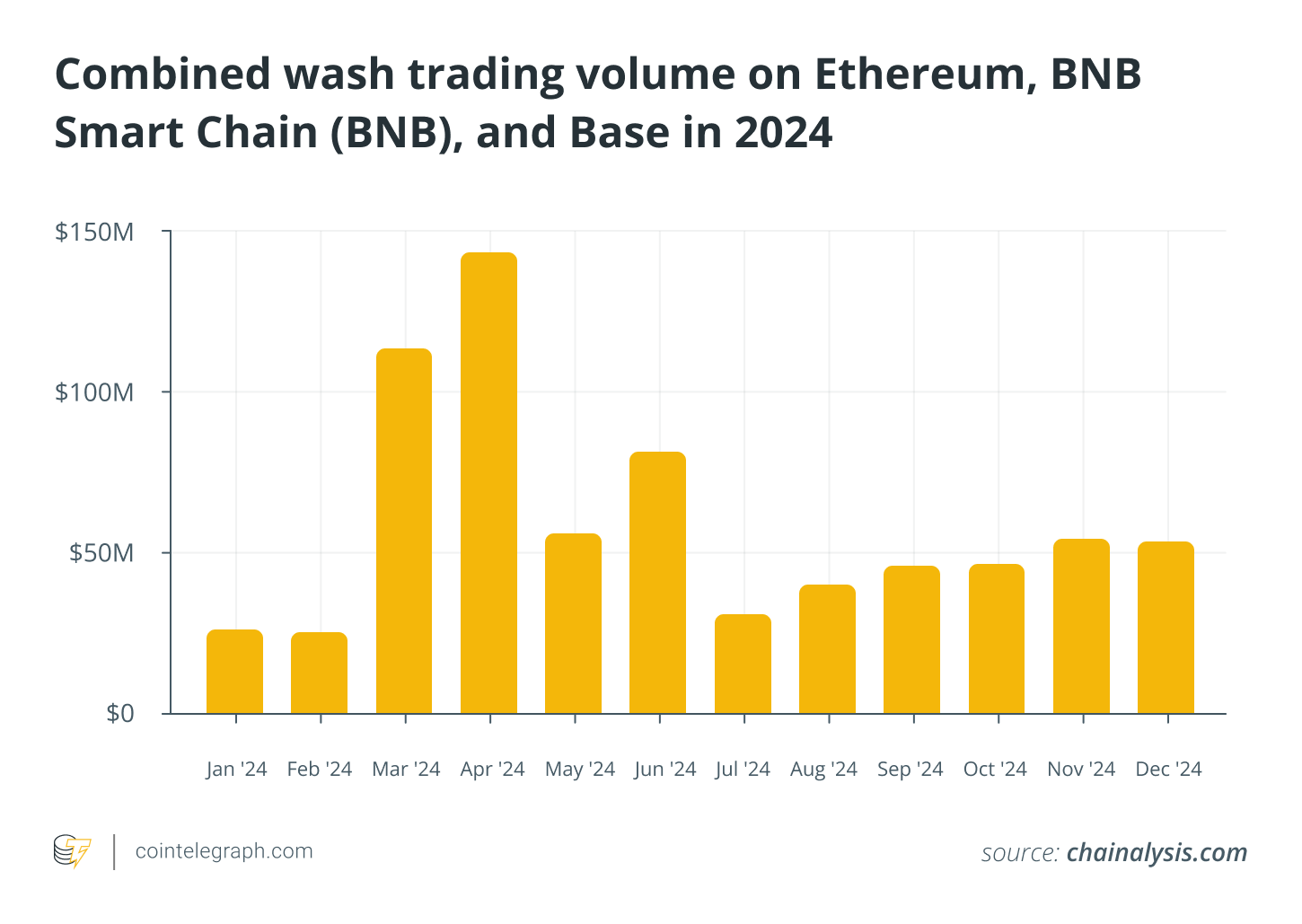
Certain deceptive trading practices, such as wash trading or spoofing, can mislead investors into believing there is a strong demand for cryptocurrency. Manipulators create an illusion of price growth, encouraging new investors to buy in. Once the price reaches their target, they sell their holdings, leaving others with depreciating assets.
ICOs and token sale frauds
Some initial coin offerings (ICOs) and token sales are designed to deceive investors. Project founders may sell large amounts of tokens under the promise of delivering a groundbreaking project but later abandon it or fail to fulfill commitments, leading to a steep decline in token value.
Did you know? As per Chainalysis, the number of tokens launched in 2024 was 2,063,519. Among these, the number of suspected pump-and-dump tokens was 74,037.
FOMO — The core reason for exit liquidity traps
FOMO, or fear of missing out, is a key factor behind crypto traders becoming exit liquidity victims. It is an emotional reaction where traders rush into perceived market opportunities, fearing they will miss potential gains. This leads to trades executed without thorough analysis, increasing the risk of losses.
-
Trend-chasing: FOMO-driven traders enter positions based on hype rather than fundamentals, making them vulnerable to market downturns.
-
Neglect of risk management: These traders frequently neglect risk management strategies like diversification or stop-loss orders. This leaves them exposed to sudden price drops.
-
Focus on short-term gains: FOMO-driven traders prioritize short-term gains over sustainable investment strategies, leading to frequent, costly trades that erode overall returns.
-
Impulsive decision-making: The traders’ heavy reliance on social media, news and peer influence further drives poor decision-making, as they react to market hype instead of conducting independent research.
Factors behind FOMO
Several factors trigger FOMO in crypto trading:
-
Market rallies: Sharp price surges create a sense of urgency. Traders rush to buy assets without analyzing fundamentals, fearing they will miss out on quick profits.
-
Social media hype: Social media influencers and online communities often create hype, leading traders into making risky, emotionally driven decisions.
-
Peer pressure: Peer pressure is another factor, as seeing friends or colleagues profit from trades can push individuals to follow suit.
-
Chasing trends: The tendency to chase trends pushes traders to neglect personal financial strategies. The fear of missed profits drives impulsive trades, which drives the trend.
-
Regret: Watching asset prices rise creates regret in traders if they don’t hold the cryptocurrency themselves, prompting traders to act without proper analysis.
-
News-induced anxiety: Overexposure to market news produces anxiety. Constant updates and financial reports create a sense of urgency, prompting traders to react hastily rather than sticking to a well-thought-out plan.
Did you know? According to Glosten et al.’s (1993) GJR-GARCH model, neither Baur and Dimpfl (2018) nor Cheikh et al. (2020) found the FOMO effect for Bitcoin or Ether during 2013–2018. But Wang et al. (2021) discovered a FOMO effect in the Bitcoin market between 2014 and 2019.
How to detect exit liquidity traps in crypto
Detecting exit liquidity traps requires diligent analysis on your part. Consider the project’s development activity, the team behind it and community engagement. Here are the red flags to spot potential exit liquidity traps:
Coins without solid fundamentals and exaggerated claims
Steer clear of projects that artificially inflate the price of a coin, luring in unsuspecting investors before insiders dump their holdings for profit. Known as pump-and-dump scams, these often involve exaggerated claims, assured returns and aggressive marketing. Examine if the project has a lopsided token distribution — a high concentration of tokens among a few wallets signals manipulation.
Bundled buys and developer activity
Bundled transactions can be used to manipulate token distributions, making a project seem more legitimate than it is. Developers may execute multiple transactions immediately after liquidity is added, securing tokens at the lowest price and later selling at a premium.
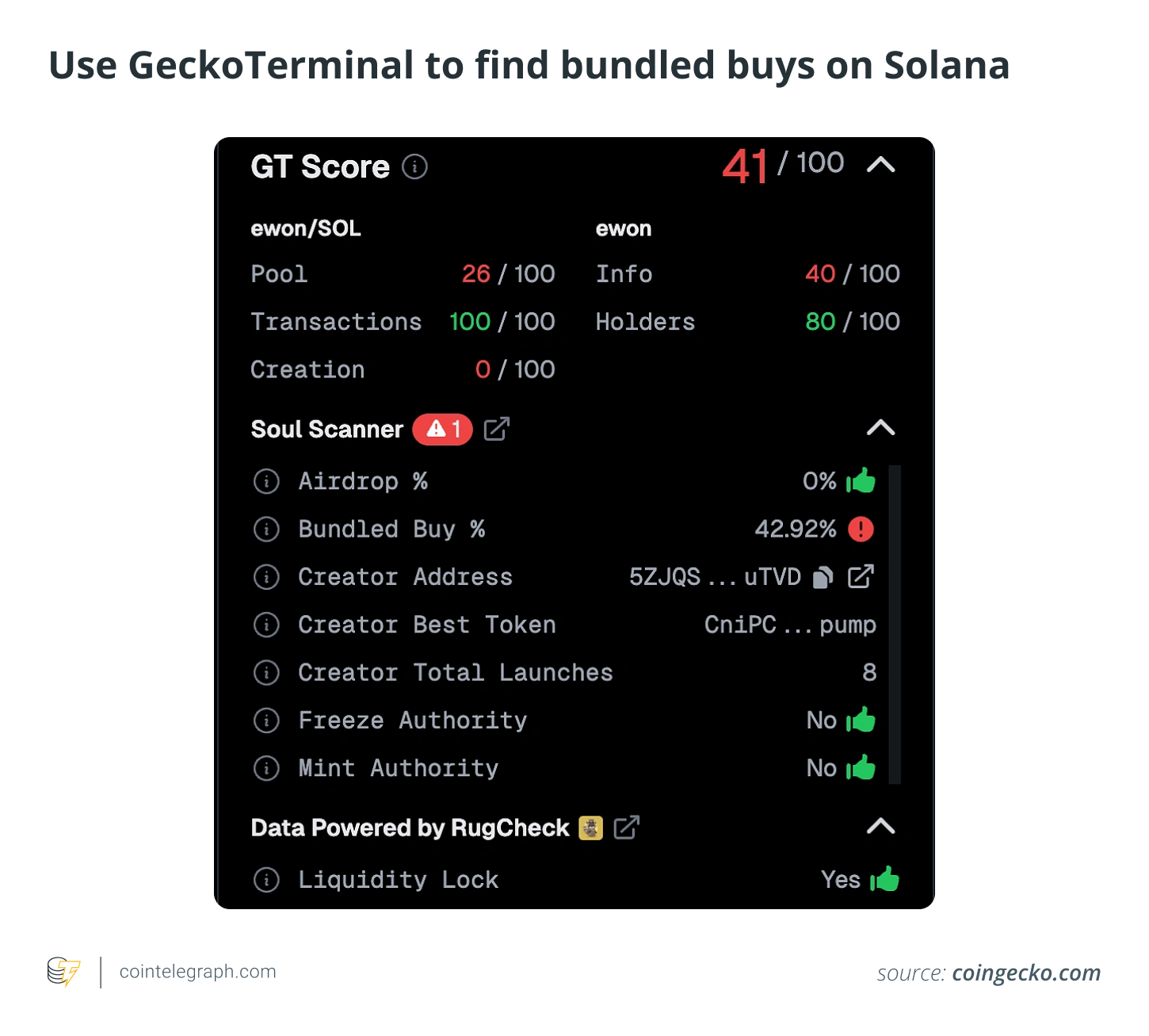
For example, to identify bundled buys on Solana, use GeckoTerminal. When you search for your desired token, the right sidebar displays its GT Score. The Soul Scanner section enables you to view the “Bundled Buy %,” which reveals the number of tokens acquired through bundled buys tactics. This metric provides insight into the bulk buying activity of a specific token.
Over-hyped coins
Aggressively promoted coins with weak fundamentals and a low number of use cases are likely to crash eventually. Such coins often experience short-term price surges driven by influencers. Developers who actively create the buzz around these coins, allocate tokens to themselves and dump their holdings after prices shoot up.
Launched in 2016, Bitconnect was marketed as a high-yield investment platform, promising substantial returns through a proprietary trading algorithm. Its multilevel marketing structure and unrealistic returns led to suspicions of it being a Ponzi scheme. In January 2018, Bitconnect abruptly shut down its lending and exchange services, causing the token’s price to plummet from an all-time high of nearly $525 to below $1, resulting in significant investor losses.
Invisible team
Cryptocurrency projects lacking identifiable team members present significant risks. The inability to verify developer identities prevents accountability. This anonymity enables developers to disappear with invested capital. The absence of transparency creates problems in evaluating a project’s legitimacy and progress. Moreover, the lack of visible leadership undermines trust, which is essential for any successful enterprise.
Regulatory issues
If a project faces regulatory issues regarding compliance or money laundering, consider it a red flag. Additionally, legal frameworks vary across jurisdictions, adding complexity and potential risks. Noncompliance could lead to hefty penalties or even the project’s shutdown.
How to avoid exit liquidity traps in crypto
If you are a crypto investor, you must understand how to avoid exit liquidity traps. Thankfully, there are strategies to help you avoid this situation and protect your investments. Here is a breakdown of such methods:
-
Invest in coins with high market capitalization: Coins with high market capitalization are typically more stable and liquid. These assets attract a large number of buyers and sellers, making it easier to enter and exit positions without major price fluctuations. Low-cap coins, on the other hand, can be highly volatile and often lack sufficient liquidity, increasing the risk of being stuck with unsellable assets. Always check a coin’s market cap and trading volume before investing.
-
Choose coins with active trading communities: A strong, engaged trading community is a key indicator of a coin’s liquidity. Coins with active investors and consistent trading activity tend to have stabler demand, reducing the risk of getting trapped in an illiquid market. Look for projects with active discussions on social media, consistent developer updates and healthy buy-sell activity on exchanges.
-
Avoid pump-and-dump scams: Be cautious of coins that gain sudden attention without any solid fundamentals. Conduct thorough research and avoid assets that appear too good to be true. You should consider vesting periods. Sudden developer sell-offs can crash prices and leave investors with worthless assets.
-
Use reputable exchanges: Trading on well-established exchanges like Binance and Coinbase ensures better liquidity and smoother transactions. Trustworthy platforms do their due diligence before listing projects so you can feel safer with the coins on offer. While regulatory hurdles — such as the removal of Tether’s USDt (USDT) in the European Union — or unforeseen events like the Terra ecosystem collapse in May 2022 can lead to delistings, reputable exchanges typically do not remove coins without significant reasons.
-
Focus on the coin’s long-term viability: If you feel a coin is overly promoted, especially in the memecoin space, take it as a warning sign. Instead of following social media trends, focus on a coin’s fundamentals and community strength. Your goal should be the long-term viability of the coin and not a short-term gain.
-
Stay informed about changing regulations: Staying informed about evolving cryptocurrency regulations is crucial for investors. Legal frameworks significantly impact market dynamics, asset valuation and investment strategies. Changes can introduce new compliance requirements, tax implications or even outright bans, affecting the stability of your portfolio.
Fundamental analysis of cryptocurrencies: A robust tool to deal with exit liquidity traps
Fundamental analysis is a crucial tool for investors looking to avoid exit liquidity traps. Unlike traditional assets such as stocks, cryptocurrencies lack standard valuation metrics like price-to-book ratios. But assessing a crypto asset’s actual value beyond its price movements can help identify solid investments and reduce liquidity risks.
When evaluating a cryptocurrency, one of the key questions is: Will businesses adopt it? While individual and institutional investors may drive demand by holding assets, long-term value is best determined by utility rather than scarcity alone. A cryptocurrency with real-world applications and industry adoption is more likely to sustain liquidity over time.
For instance, Ethereum introduced smart contract functionality, enabling decentralized applications (DApps). Despite its technological significance, issues like network congestion and high fees limited its public adoption. This highlights the importance of evaluating both innovation and practical usability when conducting fundamental analysis.
Other factors to consider include developer activity, transaction volume and network security. A strong development team, consistent upgrades and a growing user base signal a cryptocurrency’s potential for long-term viability. By focusing on these elements, investors can make informed decisions, reducing the chances of being trapped in illiquid assets.
Leveraging behavioral finance to avoid exit liquidity traps
“The investor’s chief problem — and even his worst enemy — is likely to be himself.” — Benjamin Graham
As Graham insightfully points out, investors often become their own worst enemy, making decisions driven by emotion rather than logic. To avoid exit liquidity traps, you need as much knowledge of behavioral finance as you do about crypto trading fundamentals. Understanding how human behavior influences financial decisions can help you recognize and mitigate irrational choices.
Humans are not always rational in our decision-making — emotions such as greed, fear and hope, along with cognitive biases, often drive trading behavior. Recognizing these psychological tendencies is crucial to making informed, objective investment decisions.
While honing hard skills like financial analysis and conducting due diligence on project teams is essential, it is equally important to develop behavioral skills. Practicing patience, managing FOMO and making balanced decisions can help you avoid impulsive trades and minimize risks in volatile markets.

How to bridge to Solana
Key takeaways Bridging assets to Solana allows you to diversify digital assets across chains and access Solana’s Web3 benefits, which include DApps, DeFi and NFTs. Decentralized bridging platforms like Portal provide an efficient way to bridge to Solana from multiple blockchains. You can connect your […]
Analysis
Key takeaways
-
Bridging assets to Solana allows you to diversify digital assets across chains and access Solana’s Web3 benefits, which include DApps, DeFi and NFTs.
-
Decentralized bridging platforms like Portal provide an efficient way to bridge to Solana from multiple blockchains. You can connect your wallets and transfer in minutes.
-
Centralized platforms like OKX and Binance offer an alternative method linked to your exchange account and wallet for those nervous about decentralized mechanisms.
-
The Solana bridging process involves connecting your source and destination wallets to a bridging platform, inputting the transaction details, and confirming the transfer.
Bridging assets to Solana allows you to diversify digital assets across chains and access Solana’s Web3 benefits, which include DApps, DeFi and NFTs.
Decentralized bridging platforms like Portal provide an efficient way to bridge to Solana from multiple blockchains. You can connect your wallets and transfer in minutes.
Centralized platforms like OKX and Binance offer an alternative method linked to your exchange account and wallet for those nervous about decentralized mechanisms.
The Solana bridging process involves connecting your source and destination wallets to a bridging platform, inputting the transaction details, and confirming the transfer.
The world of digital assets is filled with opportunity. Once you understand the basics of blockchains and Web3, it’s natural to start looking for new ways to diversify your portfolio, whether through trading new tokens, trying out different decentralized applications (DApps), or earning from decentralized finance (DeFi) infrastructure.
To get the most out of your digital assets, you’ll need to learn how to transfer assets between various blockchains, such as how to bridge to Solana from Ethereum. The only problem is that moving assets between blockchains can feel like a complex, daunting task, especially for those who are not tech-savvy.
Bridging assets can seem fraught with risks, such as losing funds due to transaction mistakes or security vulnerabilities. But the good news is that bridging to Solana doesn’t have to be a stressful experience.
This Solana token bridge guide offers a step-by-step process, including explanations and images. So, in just a few minutes, you’ll know how to bridge to Solana safely and securely.
What is a Solana bridge?
Crypto bridges are now a core part of the blockchain industry, enabling interoperability between multiple networks. As the name suggests, a bridge is a way to transfer assets and information from one blockchain to another.
Solana is one of the busiest blockchain networks, and it uses bridges to interact with other chains. This allows users and developers to build a flow of crypto tokens and data between Solana and other networks.
For example, people regularly transfer stablecoins between Ethereum and Solana using crosschain bridges, meaning a bridge can be used to transfer Tether’s USDt (USDT) from Ethereum to Solana and vice versa. The precise process required to bridge can vary depending on the assets, chains and bridge platform used.
Most commonly, the Solana bridging mechanism will lock the collateral assets to the source chain. Then, it will mint the equivalent value of the mirrored asset on the destination chain. This is known as a lock-and-mint system.
While the circulating supply of the original asset remains unaffected, the process effectively creates a wrapped version of the asset on the destination chain, which has its own supply metrics.
In the reverse process, called burning and minting, the system burns (destroys) the wrapped asset and mints (releases) the locked token, putting it back into circulation on the native blockchain.
Did you know? The process of transferring tokens between different blockchains, commonly known as “wrapping,” is facilitated by Wormhole, one of the bridging solutions for Solana. Wormhole securely enables cross-chain asset transfers, making tokens from one blockchain usable on another.
Preparing for a crosschain bridge to Solana
Before jumping into the Solana bridging process, there’s a bit of housekeeping to attend to.
Firstly, you’ll need to ensure you have the correct wallets for the process. Presumably, you already have a crypto wallet with existing funds that is compatible with the current chain your assets are sitting on, such as Ethereum or BNB Chain.
You’ll also need a Solana-compatible wallet, as this will be the destination for your newly bridged tokens. Phantom and Solflare are two such examples of Solana wallets, while hardware options like Ledger offer an alternative, security-focused option.
You’ll need to have enough funds to cover your transactions, so ensure you have a little extra in your wallet, as you’ll need this to cover gas and transaction fees along the way.
With your wallets and funds ready, it’s time to start bridging to Solana. First, you’ll learn how to use a decentralized Solana bridge.
Did you know? Hackers involved in the $625 million Ronin Bridge hack (linked to North Korea’s Lazarus Group) moved stolen Ether across blockchain bridges, swapping it into other cryptocurrencies and using mixers like Tornado Cash to obscure the funds’ origin.
Step-by-step guide to bridge to Solana
To bridge to Solana, follow these general steps, after which your assets will have been transferred from another blockchain (like Ethereum or BNB Smart Chain) to Solana. The specific steps can vary depending on the bridging service used, but here’s a common approach:
Step 1: Choose a bridge platform
First, select a trusted bridge that supports Solana, such as:
-
Wormhole (Ethereum to Solana, BNB Smart Chain to Solana)
-
Allbridge (Multichain support)
-
Portal (powered by Wormhole)
Step 2: Connect your wallet
To interact with the bridge, you will need a cryptocurrency wallet that supports Solana, such as:
-
Phantom
-
Sollet Wallet
-
Solflare
Ensure your wallet is set up and has the necessary tokens for the transaction.
Step 3: Select the asset to bridge
On the bridge platform, choose the token you want to transfer. Most bridges support popular assets like USDC (USDC), Ether (ETH) and Bitcoin (BTC), but you might need to check whether the token is supported on both the originating and destination blockchains.
Step 4: Specify the source chain and target chain
Select the blockchain you’re transferring from (for example, Ethereum or BNB Smart Chain) and put the destination as Solana.
Step 5: Initiate the transfer
Follow the platform’s instructions to initiate the transfer. This typically involves:
-
Approving the transaction in your wallet.
-
Paying any required network fees (for both the source and destination chains).
-
Confirming the transfer details.
Step 6: Wait for confirmation
Once you approve the transaction, the bridge will handle the transfer process. Depending on the bridge service, it may take anywhere from a few minutes to an hour for the transfer to be completed.
Step 7: Check your Solana wallet
After the transfer is confirmed, check your Solana wallet for the received assets. They should appear as Solana-compatible tokens in your wallet.
How to bridge to Solana using the Portal decentralized bridge platform
Portal is a multichain app enabling fast, secure token transfers between numerous networks. Powered by Wormhole, it allows users to easily move tokens and non-fungible tokens (NFTs) across blockchains, including transfers to and from Solana.
Here’s how to transfer tokens to Solana:
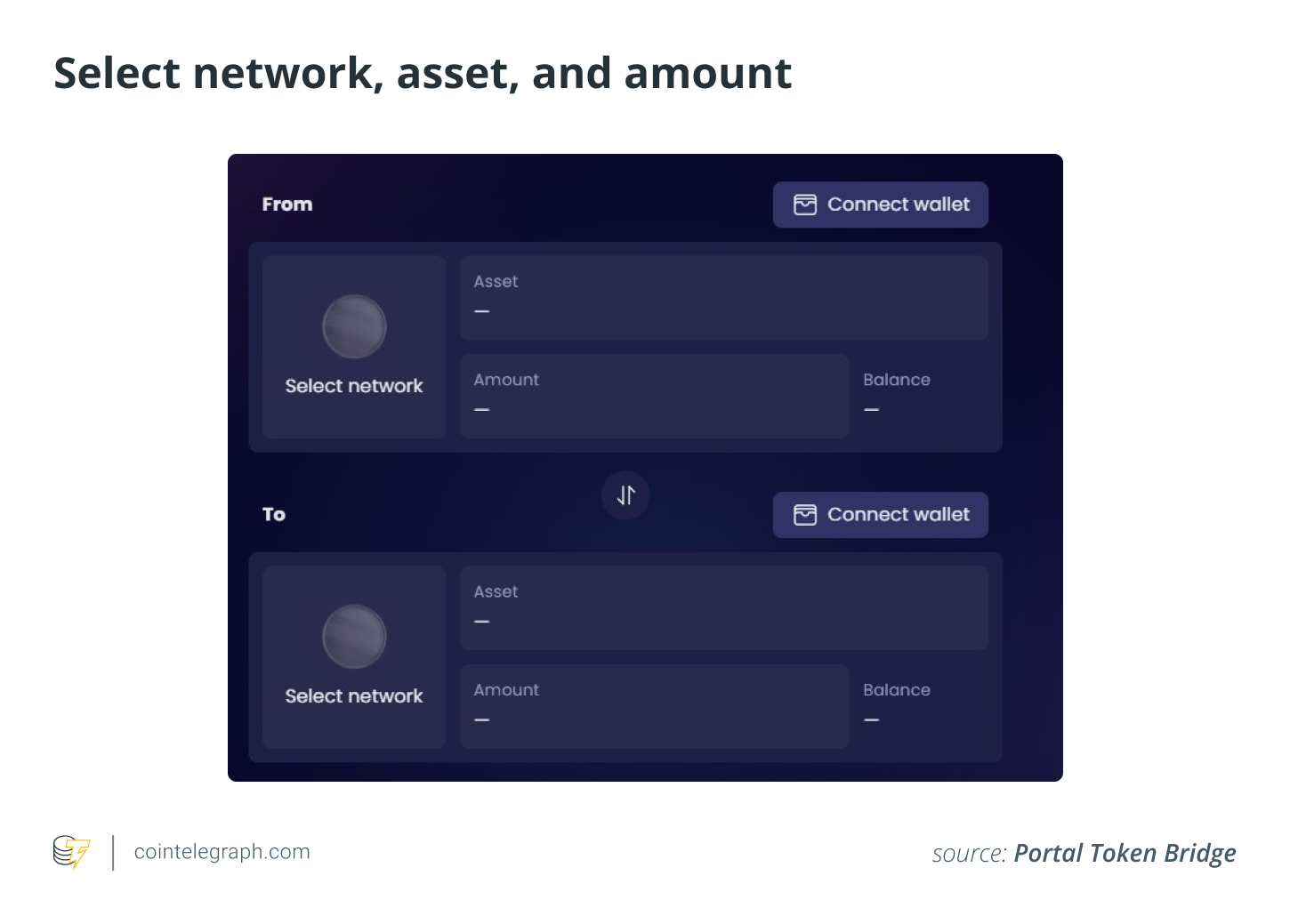
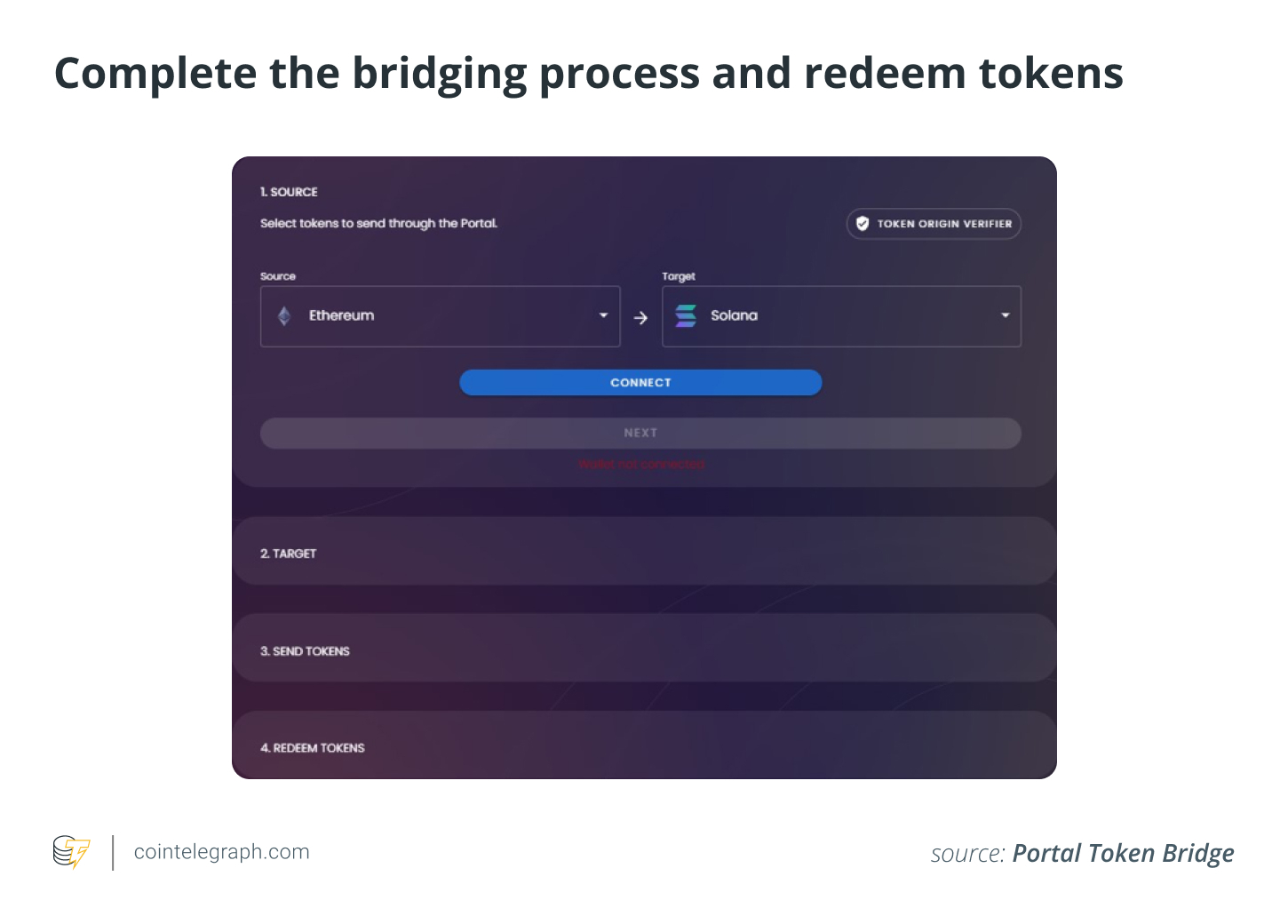
Step 1: Select the blockchains
Head to portalbridge.com, and select your source blockchain (the chain the assets are coming from) and the target blockchain (Solana).
Step 2: Connect the wallet
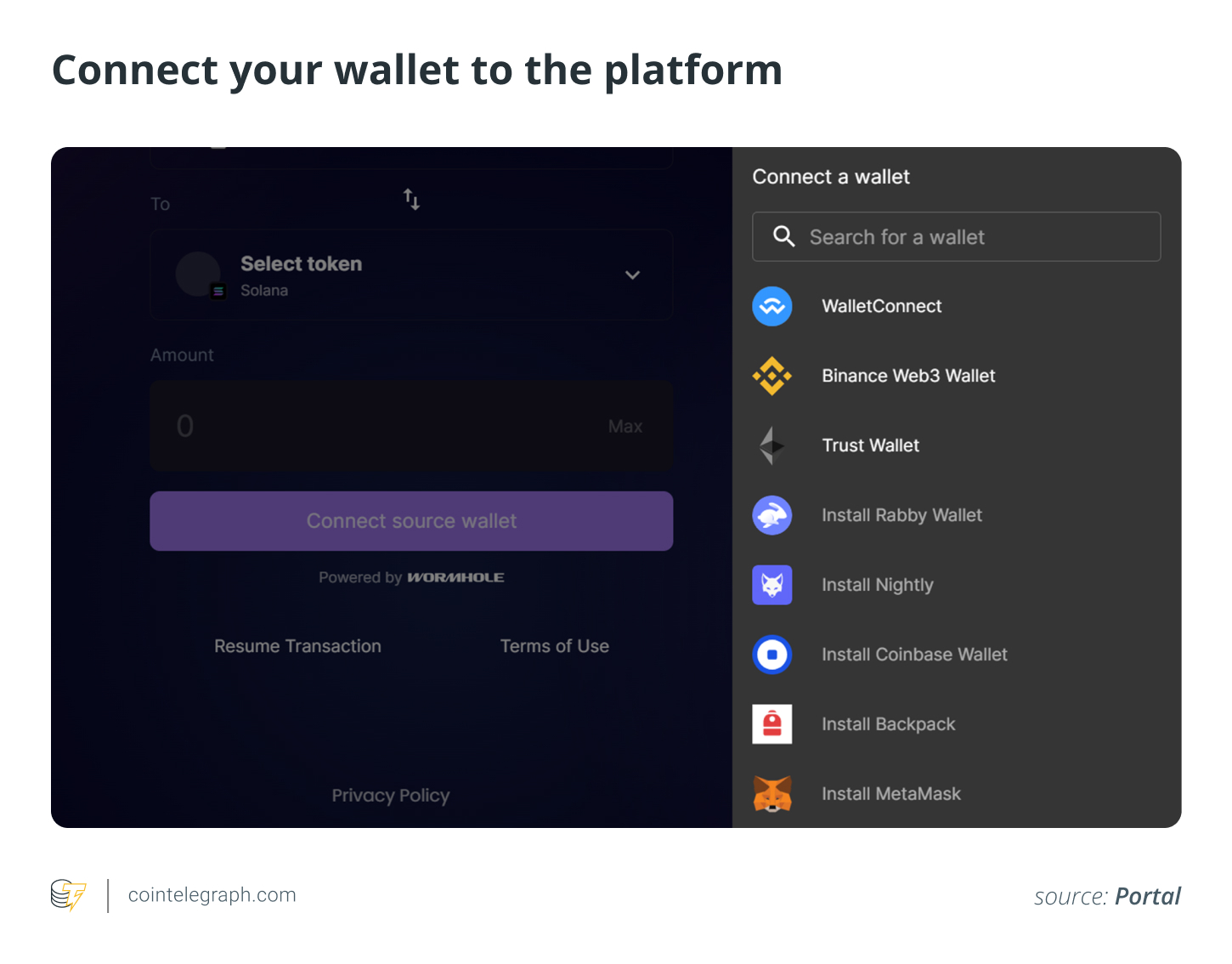
Next, connect your crypto wallets to the platform using the “Connect” button for both the “from” and “to” wallet. A prompt will appear asking you to select from an array of supported wallet providers and connect the wallet to the bridge.
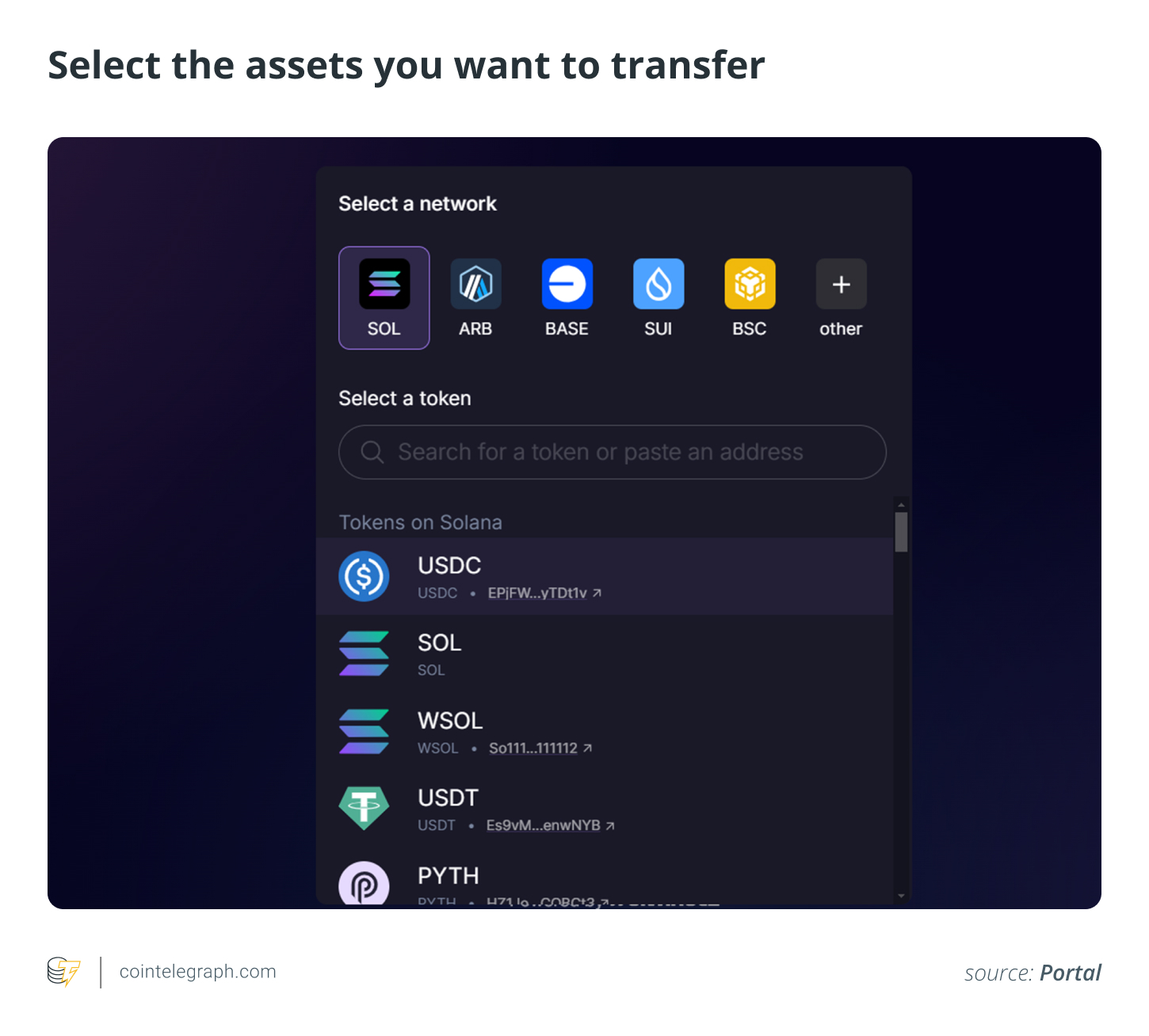
Step 3: Select an asset to transfer
After a wallet is connected to the bridge, select an asset from the “Select a Token” drop-down menu. Click any one from the list of supported assets or search for the asset you want to transfer.
Usually, the interface displays the balance for the selected asset, enabling you to identify the correct token. After that, you’ll need to enter the amount you wish to transfer.
Step 4: Connect your Solana wallet
Next, click the “Connect Destination Wallet” button. The interface displays an array of supported Solana wallets, and you can select from the options presented.
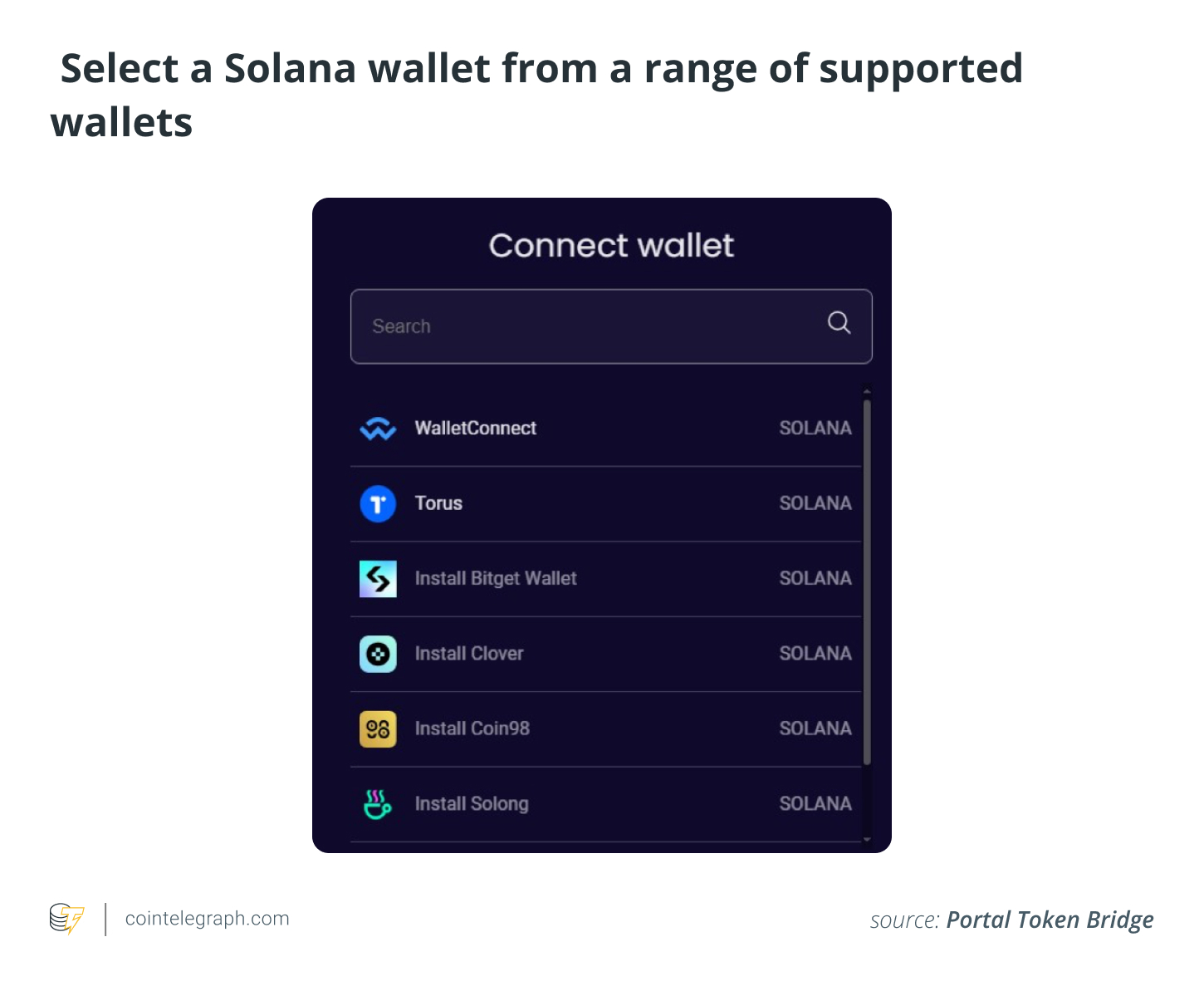
Click on the relevant option and follow the prompts in the wallet to connect to the bridge.
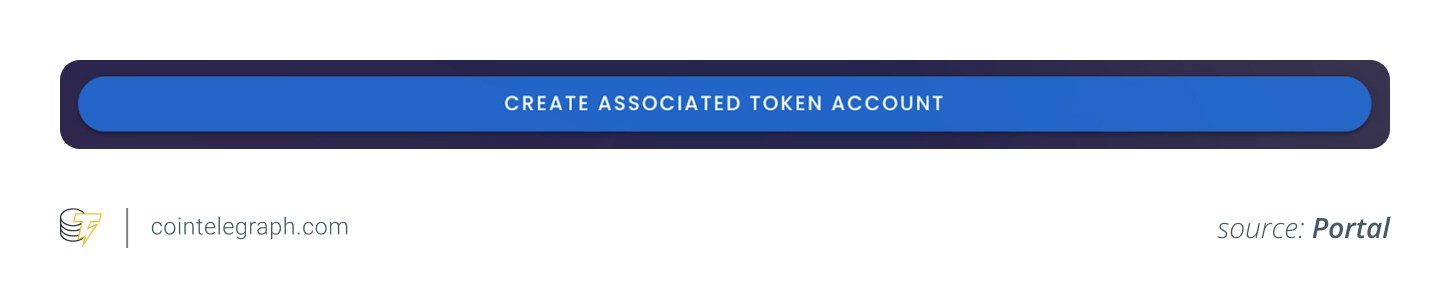
Step 5: Create associated token account
Once the origin and target wallets are linked, you need to create a token account in the Solana wallet by clicking the “Create Associated Token Account” button to receive the tokens. If you already have an associated token account, you can move to the next step.
Step 6: Bridge the funds
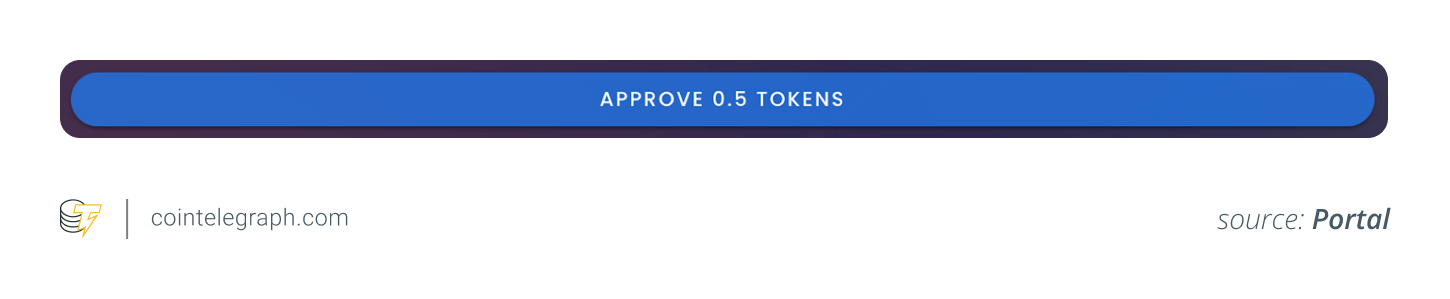
Now you’re ready to approve the token transfer through the bridge interface and confirm the transaction in the connected wallet. You can send assets to the bridge using the “Approve Tokens” button. Portal then processes the bridging of funds between chains.
Step 7: Claim the funds
When the bridging of funds is complete, you can use the “Redeem” button to claim the tokens from the bridge using your Solana wallet.
Did you know? Solana has a vibrant ecosystem with a wide range of DApps covering DeFi, NFTs, gaming and memecoins. Thanks to its high throughput and smart contract functions, it has become popular among developers and users, making it one of the most commonly bridged blockchains.
How to bridge to Solana using a centralized platform
If you’re uncomfortable using a decentralized bridge, several centralized exchange platforms have Web3 and bridging features built in. There are a number of reputable operators to choose from, including exchanges like OKX and Binance.
This example will show how to use OKX to bridge to Solana:
Step 1: Transfer the funds to centralized wallet
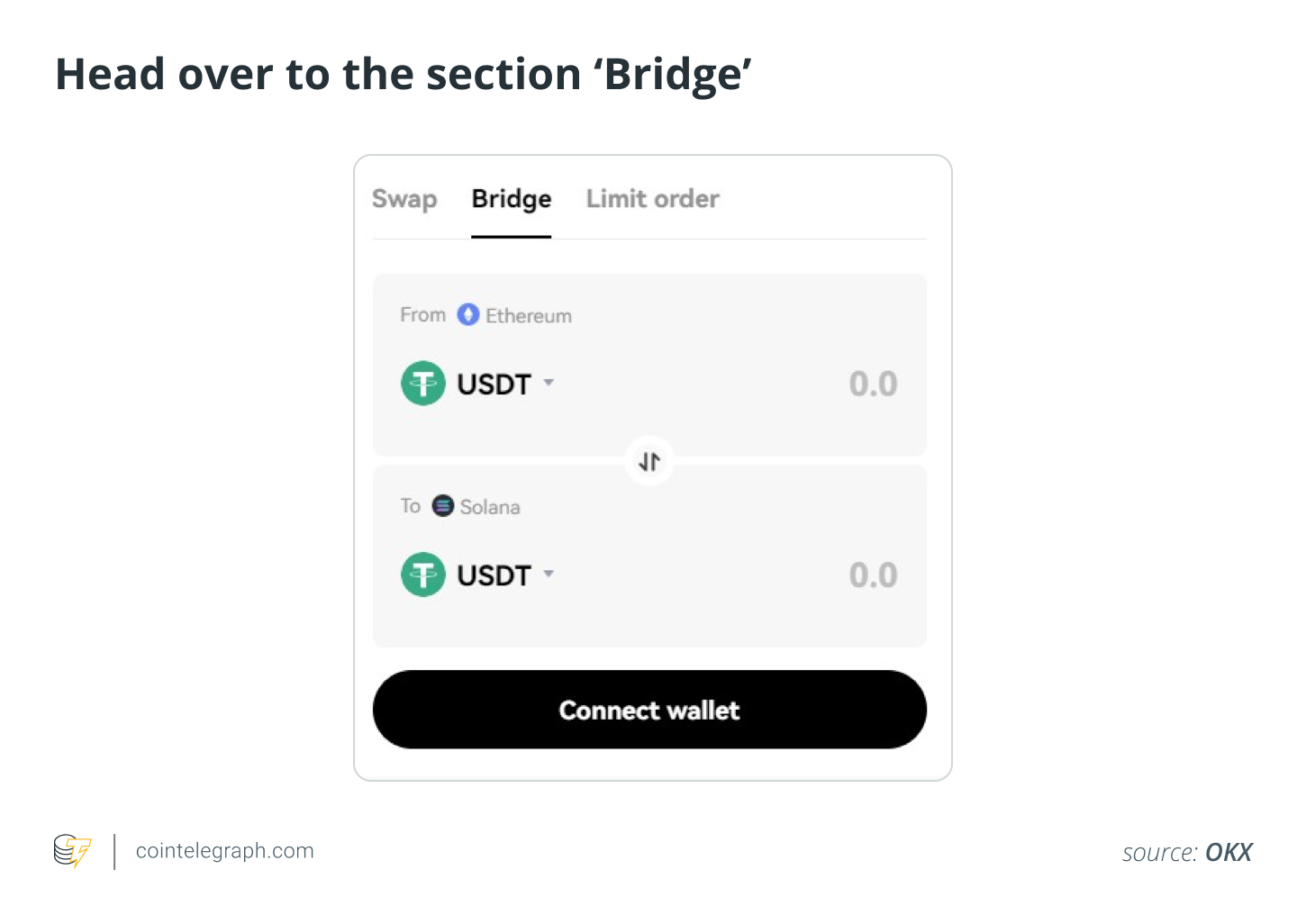
Start by setting up an OKX exchange account at okx.com. You’ll need to submit and verify your identity to abide by Know Your Customer (KYC) regulations along the way. Once set up, you can transfer the tokens you want to bridge to your OKX wallet. Then, head over to the section called “Bridge.”
Step 2: Connect wallet
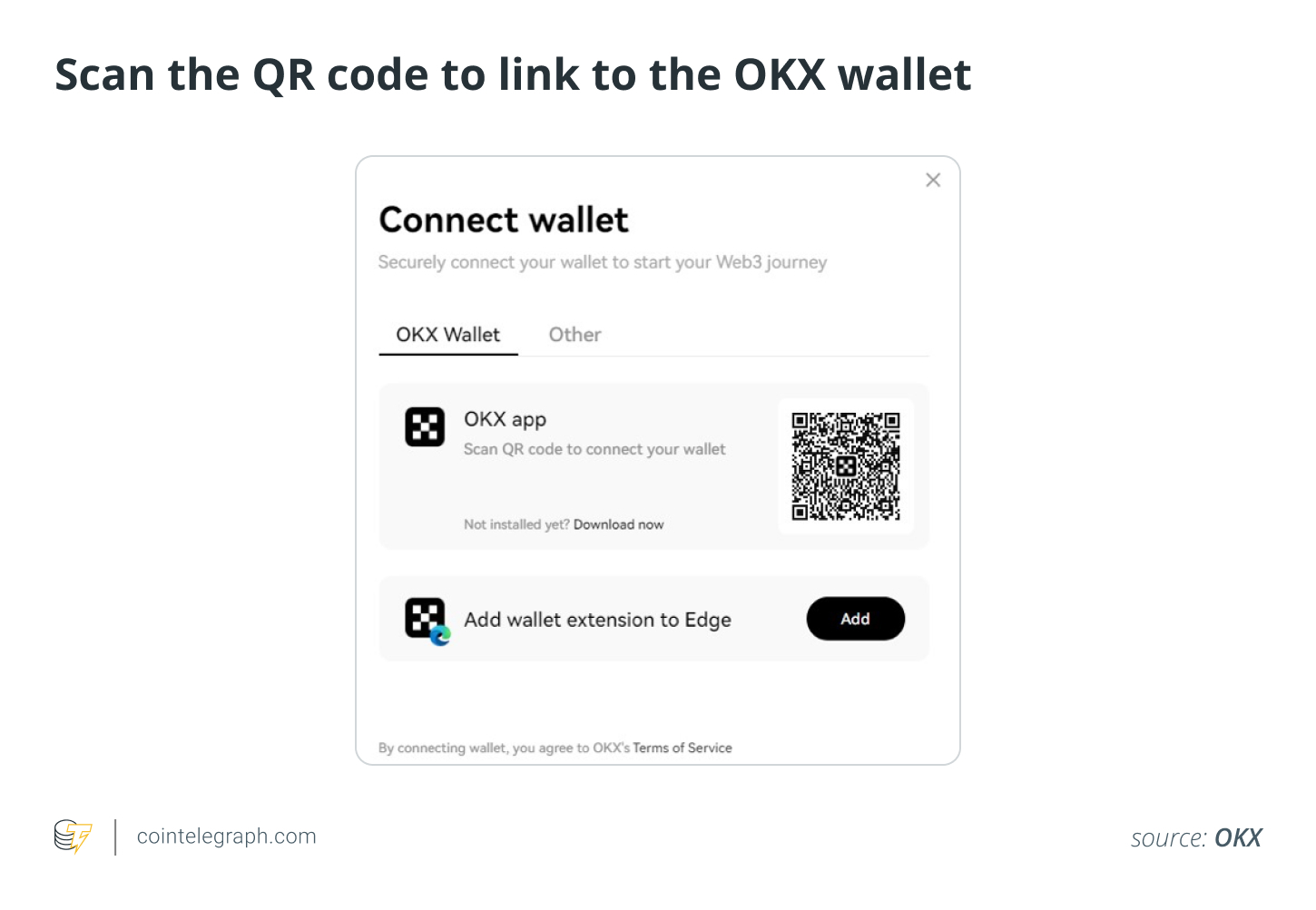
Click “Connect wallet” and scan the QR code to link to OKX Wallet. To add the wallet extension to your browser, select “OKX Wallet extension.” If you are using another wallet, such as MetaMask, select “Other.” You’ll need to enter your OKX Wallet password and select “Confirm” to link the wallet with OKX Swap.
Step 3: Bridge your assets
Now you can select the source blockchain and destination Solana wallet. You’ll also need to choose the source and destination tokens you wish to bridge. OKX Bridge will then show you the number of tokens you will receive. If satisfied, click “Swap across chains,” and confirm the transaction to complete the transfer.
Potential risks of using blockchain bridges
While bridging tokens between blockchains offers exciting opportunities — such as accessing different ecosystems, DApps, and DeFi protocols — it also comes with risks that users should understand before initiating a transfer. Below are the primary factors to keep in mind:
1. Smart contract vulnerabilities
-
Bridge exploits: Bridges have been a prime target for hackers, leading to high-profile exploits in the past (e.g., Wormhole and Ronin). Attackers often exploit bugs in bridge smart contracts or associated platforms, resulting in large-scale fund losses.
-
Audits and trust: Look for well-audited bridges with a proven track record. Even audited platforms can be compromised, but a strong security record and a reputable team are good indicators of safety.
2. Counterparty risk (centralized exchanges)
-
Dependency on custody: When using a CEX, you temporarily hand over control of your funds. If there are technical issues, hacks or policy changes, access to your tokens could be delayed or restricted.
-
KYC and privacy concerns: Many CEXs require identity verification. This may be a dealbreaker for users concerned about privacy or regulations.
3. Incorrect address or chain selection
-
Loss of funds due to mistakes: Sending assets to the wrong chain or an incompatible address can result in permanent loss. Double-check wallet addresses and network selections to avoid errors.
-
Associated token accounts: On Solana, you often need an associated token account to receive bridged tokens. Forgetting to create it can delay or confuse the process.
4. Network congestion and fees
-
Gas fees: Busy networks (like Ethereum) can have high gas fees during peak usage. This can make bridging unexpectedly expensive.
-
Transaction delays: Network congestion could cause longer confirmation times, meaning your assets may appear “in transit” for an extended period.
5. Liquidity constraints and slippage
-
Wrapped asset liquidity: Once you bridge tokens, you end up with a wrapped version of the token on the destination chain. If there’s insufficient liquidity for that wrapped token in DeFi pools, you may face slippage (unfavorable price changes) when trading.
-
Volatility: If the token is volatile, rapid price fluctuations can affect the value of your assets mid-transfer.
6. Operational and technical risks
-
Platform downtime or upgrades: Decentralized bridges occasionally undergo maintenance or upgrades. If the bridge goes down mid-transaction, you may need support to finalize the transfer.
-
Phishing attacks: Always ensure you’re using the correct URL and interacting with the legitimate bridge contract or CEX. Phishing sites can mimic authentic interfaces and steal funds.
7. Regulatory environment
-
Compliance issues: Some jurisdictions may restrict crosschain activity, especially via centralized exchanges that enforce specific user policies.
-
Evolving regulations: Crypto regulations vary by region and frequently change, potentially impacting bridging services and the availability of certain networks or tokens.
To mitigate the risks associated with bridging assets from one blockchain to another, you should take a cautious and well-informed approach. Start by researching and selecting reputable bridging platforms with strong security records and community trust. Before committing to a large transfer, test the process with a small amount to ensure smooth execution.
Keeping wallet software and bridging interfaces updated is crucial, as updates often include security patches that protect against vulnerabilities. For enhanced security, consider using a hardware wallet and enabling two-factor authentication (2FA) on centralized exchange accounts.
Always double-check wallet addresses and ensure you are selecting the correct blockchain network before submitting a transaction to prevent irreversible losses. Additionally, staying informed by following a bridge project’s official channels — such as X, Telegram and Discord — can help you stay aware of potential downtime, security patches or known vulnerabilities.

What to expect at Paul Atkins’ SEC confirmation hearing
Former US Securities and Exchange Commission (SEC) member Paul Atkins is scheduled to appear before lawmakers in the Senate Banking Committee on March 27 as part of the Trump administration’s efforts to get the president’s picks into high-level government positions. Since US President Donald Trump […]
Analysis
Former US Securities and Exchange Commission (SEC) member Paul Atkins is scheduled to appear before lawmakers in the Senate Banking Committee on March 27 as part of the Trump administration’s efforts to get the president’s picks into high-level government positions.
Since US President Donald Trump took office on Jan. 20, the SEC, under the leadership of acting chair Mark Uyeda, has dropped several investigations and enforcement actions against major crypto firms, many of which had been in court for months or years. Many analysts see the SEC’s recent actions as the administration acting on its campaign promises to the crypto industry, of which some figures donated directly to the then-presidential candidate or his inauguration fund after the Nov. 5 election.
The commission’s actions — which include declaring that memecoins aren’t securities — also stand in stark contrast to its position under former chair Gary Gensler, leading many to speculate that the SEC under Trump will lead to a booming US crypto industry essentially free of regulatory scrutiny.
Atkins, whom Trump picked in December 2024 and officially nominated after taking office, received support from industry players at Coinbase and Ripple, both of which had ongoing enforcement actions brought by the SEC. The cases have since been dropped.
Given the SEC’s seeming about-face on crypto enforcement and Trump’s potential conflicts of interest with the industry — with ties to the crypto firm World Liberty Financial and the launch of his own memecoin — some lawmakers are likely to question Atkins’ views on digital assets at the confirmation hearing.
If confirmed by the Senate, Atkins could return to a soon-to-be entirely Republican-controlled SEC, with Democratic Commissioner Caroline Crenshaw expected to leave by 2026.
It’s unclear if Atkins will have the votes to pass a confirmation hearing in the banking committee or a full floor vote in the Senate. Republicans hold a 53-seat majority in the chamber with only 51 votes required to confirm a nominee, and — with the exception of former Representative Matt Gaetz for US Attorney General — have not suggested that they intend to oppose any of Trump’s picks for crucial government positions.
Democratic opposition to Atkins’ nomination
Massachusetts Senator Elizabeth Warren, the top Democrat on the banking committee who has often equated crypto with drug trafficking and other illicit actions, said in a March 23 letter to Atkins that she had concerns about his potential role at the SEC after his consulting firm, Patomak Global Partners, was an adviser to defunct crypto exchange FTX. He was also an adviser to the advocacy group Chamber of Digital Commerce.
“Your deep involvement with FTX and other high-paying crypto clients raises questions about your approach to crypto regulation — and concerns about the extent of your knowledge of FTX’s illegal activities,” said Warren, adding:
“Your financial ties to the industries you will soon regulate raise serious concerns about your ability to avoid conflicts of interest as a regulator.”
Warren suggested that some members of the Senate would likely question Trump’s pick about the SEC recently dropping enforcement cases against crypto firms, reports that Trump’s family had held talks with Binance about acquiring a stake in the company as well as a possible pardon for former Binance CEO Changpeng Zhao, how Atkins intends to apply securities laws to digital assets if confirmed, and the commission’s recent opinion that memecoins were not securities.
She hinted that Atkins may have also communicated with Republican SEC commissioners Uyeda and Hester Peirce after being nominated.
Related: SEC is waiting for a chair before setting crypto agenda — Hester Peirce
Ahead of his hearing, Atkins has already met with Republican lawmakers on the committee, including Wyoming Senator Cynthia Lummis. Cointelegraph contacted Lummis’ office to comment on Atkins’ nomination but didn’t receive a response at the time of publication.
If his nomination moves through the Banking Committee and the Senate, Atkins would likely be confirmed to a term ending in June 2031, taking over as chair from Uyeda. In addition to the commission dropping investigations and enforcement actions, the SEC acting chair has proposed abandoning rules requiring crypto firms to register with the agency.
Magazine: Ripple says SEC lawsuit ‘over,’ Trump at DAS, and more: Hodler’s Digest, March 16 – 22

From ICO hype to AI utility: The evolution of crypto agents in Web3
The rise of AI-driven crypto agents is following a familiar trajectory that mirrors the initial boom, bust and resurgence of ICO-era projects. Just as early blockchain ventures thrived on hype before maturing into sustainable ecosystems, the current wave of AI agent projects is undergoing rapid […]
Analysis

The rise of AI-driven crypto agents is following a familiar trajectory that mirrors the initial boom, bust and resurgence of ICO-era projects. Just as early blockchain ventures thrived on hype before maturing into sustainable ecosystems, the current wave of AI agent projects is undergoing rapid market shifts.
A new report by HTX Ventures and HTX Research says that investors are growing cautious as competition in the sector intensifies, liquidity disperses and many projects struggle to define clear use cases. Still, as the sector moves beyond its speculative phase, AI-driven crypto agents are expected to evolve sustainable business models underpinned by genuine utility.
From meme hype to reality: The evolution of crypto agents
The initial wave of crypto agent projects in 2024 was driven by indiscriminate enthusiasm for AI projects. Following the impact of a $50,000 Bitcoin donation from Marc Andreessen in October 2024 and the success of token launchpads earlier in the year, many AI agent projects entered the space in Q1 of 2024 and rapidly diluted liquidity by Q1 of 2025. As with any emerging sector, early-stage hype did not always translate into long-term viability, and a cooling-off period in the crypto AI agent sector followed.
The market segment is now entering a more mature phase, and the focus is shifting from speculative excitement to revenue generation and product performance. The winners in this evolving landscape will be those that can generate stable revenue, cover the costs of running AI models and provide tangible value to users and investors alike.

AI agent applications emphasize real-world implementation and commercialization of this technology, particularly in areas like automated trading, asset management, market analysis and crosschain interaction. This approach aligns with multi-agent systems and DeFAI (decentralized finance + AI) initiatives like Hey Anon, GRIFFAIN and ChainGPT.
Recent research highlights the advantages of multi-agent systems (MAS) in portfolio management, particularly in cryptocurrency investments. Projects such as Griffain, NEUR, and BUZZ have already demonstrated how AI can help users interact with DeFi protocols and make informed decisions. Unlike single-agent AI models, multi-agent systems leverage collaboration among specialized agents to enhance market analysis and execution. These agents function in teams, such as data analysts, risk evaluators and trading execution units, each trained to handle specific tasks.
MAS frameworks also introduce inter-agent communication mechanisms, where agents within the same team refine predictions through collective learning, reducing errors in market trend analysis. The next phase of DeFAI will likely involve deeper integration of decentralized governance models, where multi-agent systems participate in protocol management, treasury optimization and onchain compliance enforcement.
DeepSeek-R1: A breakthrough in AI agent training
A breakthrough in AI agent technology arrived with DeepSeek-R1, an innovation that challenges traditional AI training methods. Unlike previous models, which relied on supervised fine-tuning (SFT) followed by reinforcement learning (RL), DeepSeek-R1 takes a different approach, optimizing entirely through reinforcement learning without an initial supervised phase. This shift has led to remarkable improvements in reasoning capabilities and adaptability, paving the way for more sophisticated AI-driven crypto agents.
To understand this paradigm shift, consider two different approaches to learning. In the Traditional SFT and RL model, a student first studies from a workbook, practicing problems with set answers (SFT), and then receives tutoring to refine their understanding (RL). In contrast, with the DeepSeek-R1 Model (Pure Reinforcement Learning), the student is thrown directly into an exam and learns through trial and error. This approach allows the student to improve dynamically based on feedback rather than relying on pre-defined answers.
Leveraging DeepSeek-R1’s pure RL model, AI agents learn through trial and error in real-world conditions, dynamically adjusting their strategies based on immediate feedback.
This method allows for greater adaptability, making it particularly useful for multi-agent AI systems in DeFi, where real-time market fluctuations require agents to make autonomous, data-driven decisions. For example, AI-powered agents can monitor liquidity pools, detect arbitrage opportunities and optimize asset allocations based on real-time market conditions. These agents adapt quickly to market fluctuations, ensuring more efficient capital deployment.
Launched in late November 2024, iDEGEN is the first crypto AI agent built on DeepSeek R1. This integration of DeepSeek’s R1 model emphasizes how crypto AI agents can inherit such enhanced reasoning capabilities, competing with other established AI models at a fraction of the cost.
This shift toward RL-powered, multi-agent AI in DeFi automation underscores why closed-source AI models (such as OpenAI’s GPT-based systems) are becoming an unsustainable expense. With workflows often requiring the processing of 10,000+ tokens per transaction, closed AI models impose significant computational costs, limiting scalability. In contrast, open-source RL models like DeepSeek-R1 allow for decentralized, cost-efficient AI development tailored for DeFi applications.
The future of AI agents in Web3
The key to longevity in this sector lies in continuous innovation, adaptability and cost efficiency. Open-source AI models like DeepSeek-R1 are lowering the barriers to entry, allowing blockchain-native startups to develop specialized AI solutions. Meanwhile, advancements in DeFAI and multi-agent systems will drive long-term integration between AI and decentralized finance.
The takeaway is clear: Projects must prove their value beyond hype. Those who develop sustainable economic models and leverage cutting-edge AI advancements will define the future of intelligent blockchain ecosystems. The ICO era of crypto agents is evolving, and the next wave of winners will be the ones that can turn innovation into long-term viability.
Disclaimer. Cointelegraph does not endorse any content or product on this page. While we aim at providing you with all important information that we could obtain in this sponsored article, readers should do their own research before taking any actions related to the company and carry full responsibility for their decisions, nor can this article be considered as investment advice.
This article is for general information purposes and is not intended to be and should not be taken as legal or investment advice. The views, thoughts, and opinions expressed here are the author’s alone and do not necessarily reflect or represent the views and opinions of Cointelegraph.
Cointelegraph does not endorse the content of this article nor any product mentioned herein. Readers should do their own research before taking any action related to any product or company mentioned and carry full responsibility for their decisions.

How to use ChatGPT to predict crypto market trends
Key takeaways To generate crypto market insights via ChatGPT, collect accurate historical and real-time data on prices, trading volumes and market capitalization. Organize data into clear formats, such as tables with consistent date formats and labeled columns, to help ChatGPT identify patterns and trends. Use […]
Analysis
Key takeaways
- To generate crypto market insights via ChatGPT, collect accurate historical and real-time data on prices, trading volumes and market capitalization.
- Organize data into clear formats, such as tables with consistent date formats and labeled columns, to help ChatGPT identify patterns and trends.
- Use precise and focused prompts to guide ChatGPT in generating actionable insights, enhancing the relevance and clarity of its responses.
- Cross-check ChatGPT’s outputs with up-to-date information from reputable sources before making trading decisions to account for potential inaccuracies.
Predicting crypto market trends can feel like navigating a storm — unpredictable and fast-changing. Prices can spike or crash unexpectedly due to investor sentiment, regulatory changes or sudden events such as exchange hacks. For traders, staying ahead means finding reliable ways to analyze these movements and make informed decisions.
This is where ChatGPT can help.
By analyzing historical data and recognizing patterns, ChatGPT offers insights that can support better decision-making. But for AI tools to deliver meaningful results, especially when using ChatGPT for crypto investments, it’s essential to follow the right process. Combining well-structured data, clear prompts and effective risk management can improve the accuracy and usefulness of its insights.
This article explores practical ways of how to use ChatGPT for crypto market analysis — from collecting and organizing data to crafting effective prompts that help the model generate actionable insights.
How to harness ChatGPT for crypto market analysis
While predicting crypto trends will always have its challenges, using data-driven insights with ChatGPT can make market behavior easier to understand. With the right strategy, ChatGPT becomes a powerful tool to identify patterns, highlight emerging trends, and support smarter trading decisions.
Using ChatGPT effectively for crypto analysis involves four key steps:
- Step 1: Gathering data for analysis
- Step 2: Formatting data for analysis via ChatGPT
- Step 3: Writing clear and effective prompts
- Step 4: Caution! Verify ChatGPT insights before drawing conclusions
Step 1: Gathering data for analysis
When it comes to predicting crypto trends, data is everything. Without reliable data, even the most advanced tools like ChatGPT can deliver unreliable insights. Crypto markets are notoriously volatile, and understanding the patterns behind price movements, whale activity and investor sentiment requires trustworthy information from the right sources.
The type of data required depends on the kind of analysis being performed. For example:
- Price analysis requires accurate records of past prices, volume and market cap trends.
- Whale activity analysis focuses on large investor movements and wallet behavior.
- Sentiment analysis relies on tracking social media discussions, influencer mentions and crowd sentiment shifts.

Did you know? A study found that higher X post engagement generally correlates negatively with cryptocurrency prices, indicating that increased social media activity may precede price declines.
Step 2: Formatting data for analysis via ChatGPT
To predict crypto trends with ChatGPT, data must be structured in a way that highlights patterns, trends and key events. Poorly formatted data can lead to incomplete or incorrect outputs, so investing time in proper organization is crucial.
Structuring data for analysis
When formatting price data, focus on key points that reflect market trends. Include the date open price, close price and volume in chronological order to capture market movement. This article uses the Bitcoin (BTC) price data below to illustrate the process.
Gaps in data are common, especially in volatile markets. Filling missing entries with estimated values, such as moving averages, can improve continuity and make analysis more accurate.
For technical indicators, like the relative strength index (RSI) or the moving average convergence divergence (MACD), aligning the data with consistent timestamps is key.
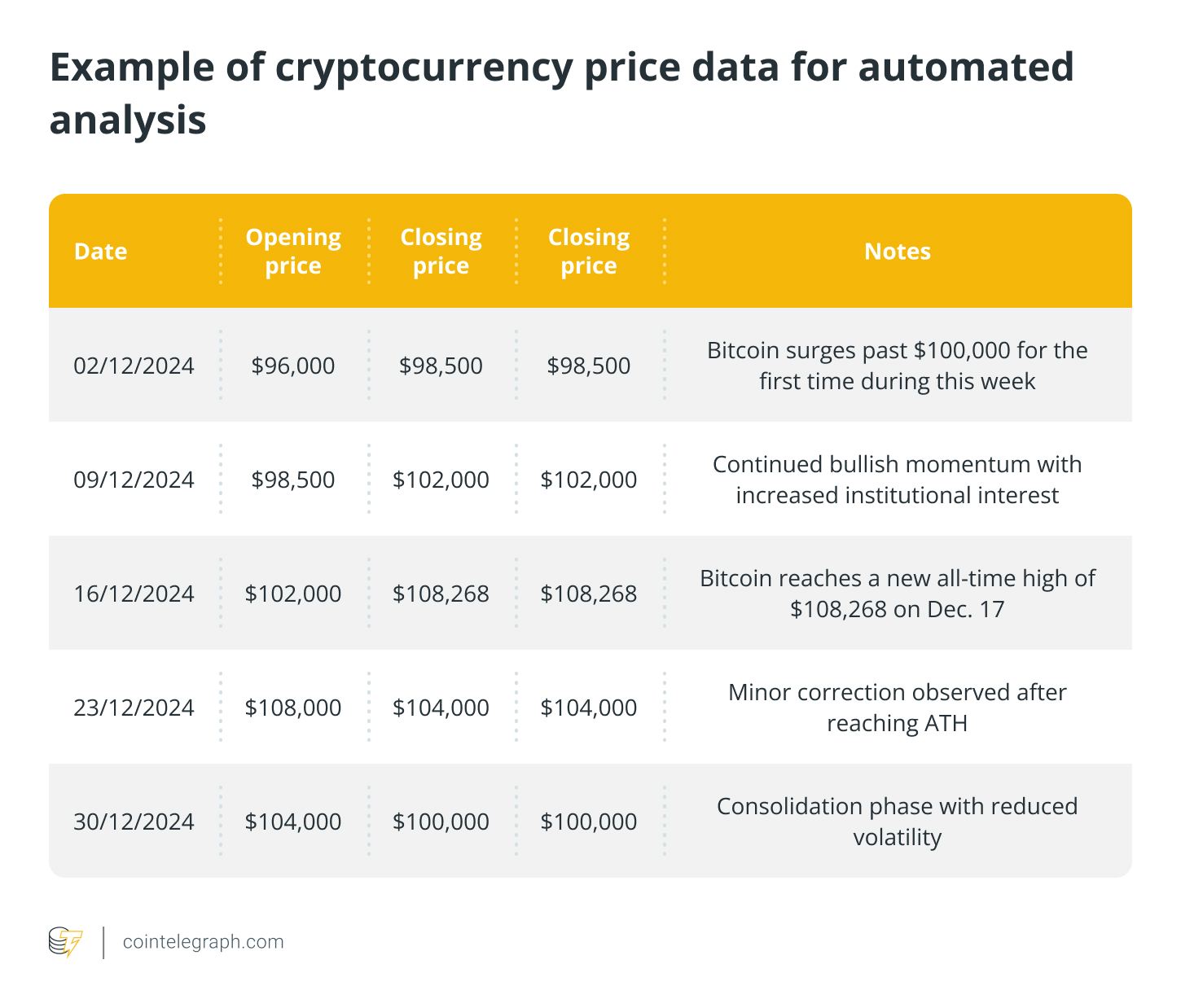
Sentiment data tends to be unstructured, which can make it challenging to analyze. To improve its clarity, combine sentiment scores with key dates and relevant events. For example:
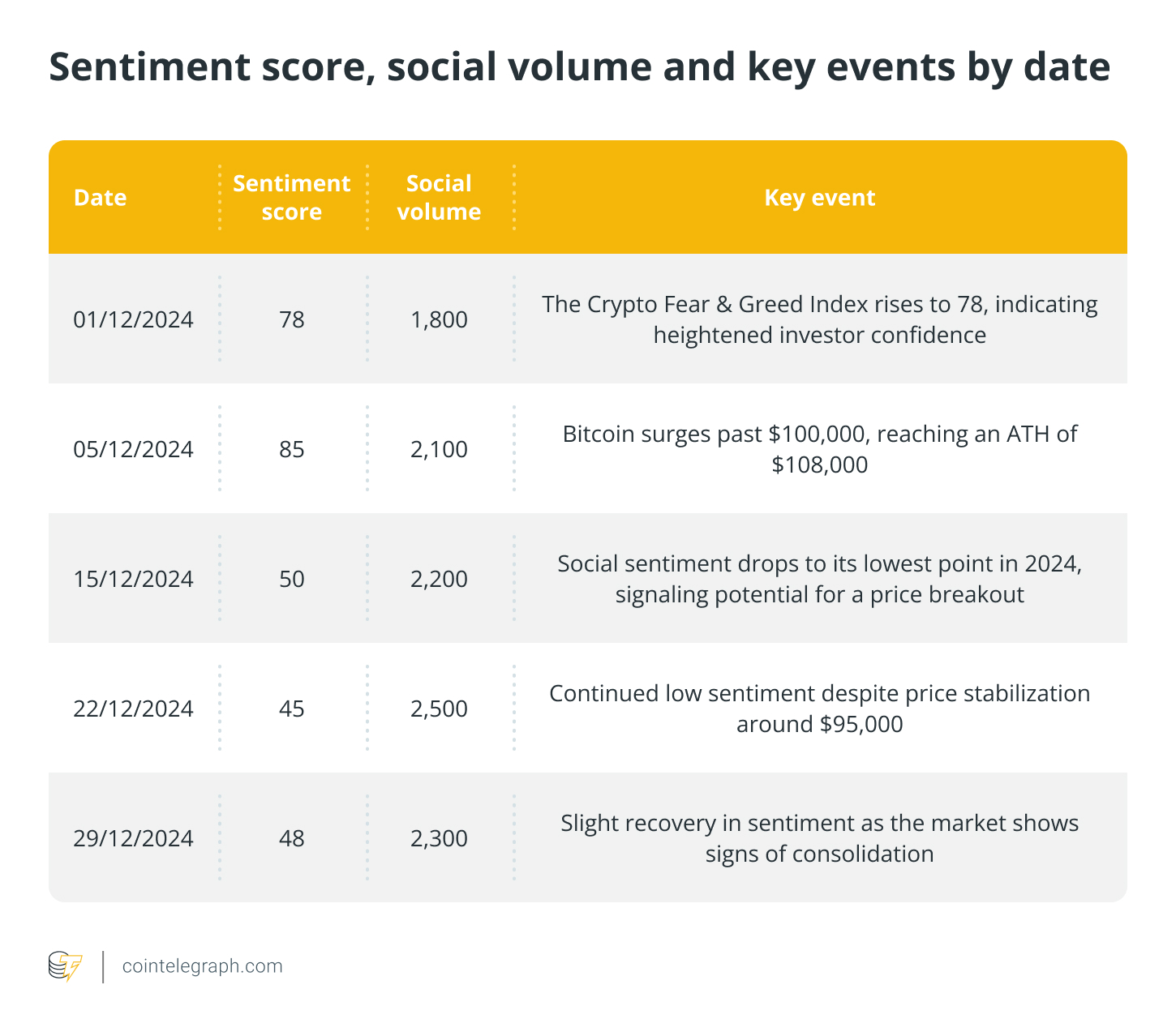
Data cleaning and preparation
To maximize the accuracy of ChatGPT insights, take these steps:
- Ensure date formats are consistent (e.g., YYYY-MM-DD) to prevent misalignment.
- Remove duplicates to avoid skewed data patterns.
- Fill missing values by interpolating trends or forward-filling where necessary.
- Label data clearly to provide the necessary context for ChatGPT’s interpretation.
Did you know? A study found that ChatGPT’s sentiment analysis of news headlines can effectively predict daily stock returns, outperforming traditional methods.
Creating well-structured prompts is key to unlocking meaningful insights from ChatGPT, especially for ChatGPT crypto analysis. Poorly written prompts can confuse the model, resulting in incomplete or irrelevant responses. Clear prompts guide ChatGPT in focusing on the right data points and generating actionable insights.
Step 3: Writing clear and effective prompts
Effective prompts are built around three core principles: clarity, purpose and focus. The illustrations and prompts used in this article were experimented with using ChatGPT-4o.
Also, please note that ChatGPT outputs only show trimmed versions for illustration purposes. The original outputs are too long to display in full, but they provide detailed insights into each RSI dip, including exact price movements, duration and trader takeaways.
- Clarity: Use precise language that defines exactly what is needed. Avoid vague requests like:
“Is Bitcoin bullish?”
Instead, provide clear instructions with relevant details: “Analyze Bitcoin’s RSI and MACD data between December 2024 and January 2025. Identify points where both indicators aligned with bullish breakouts.”
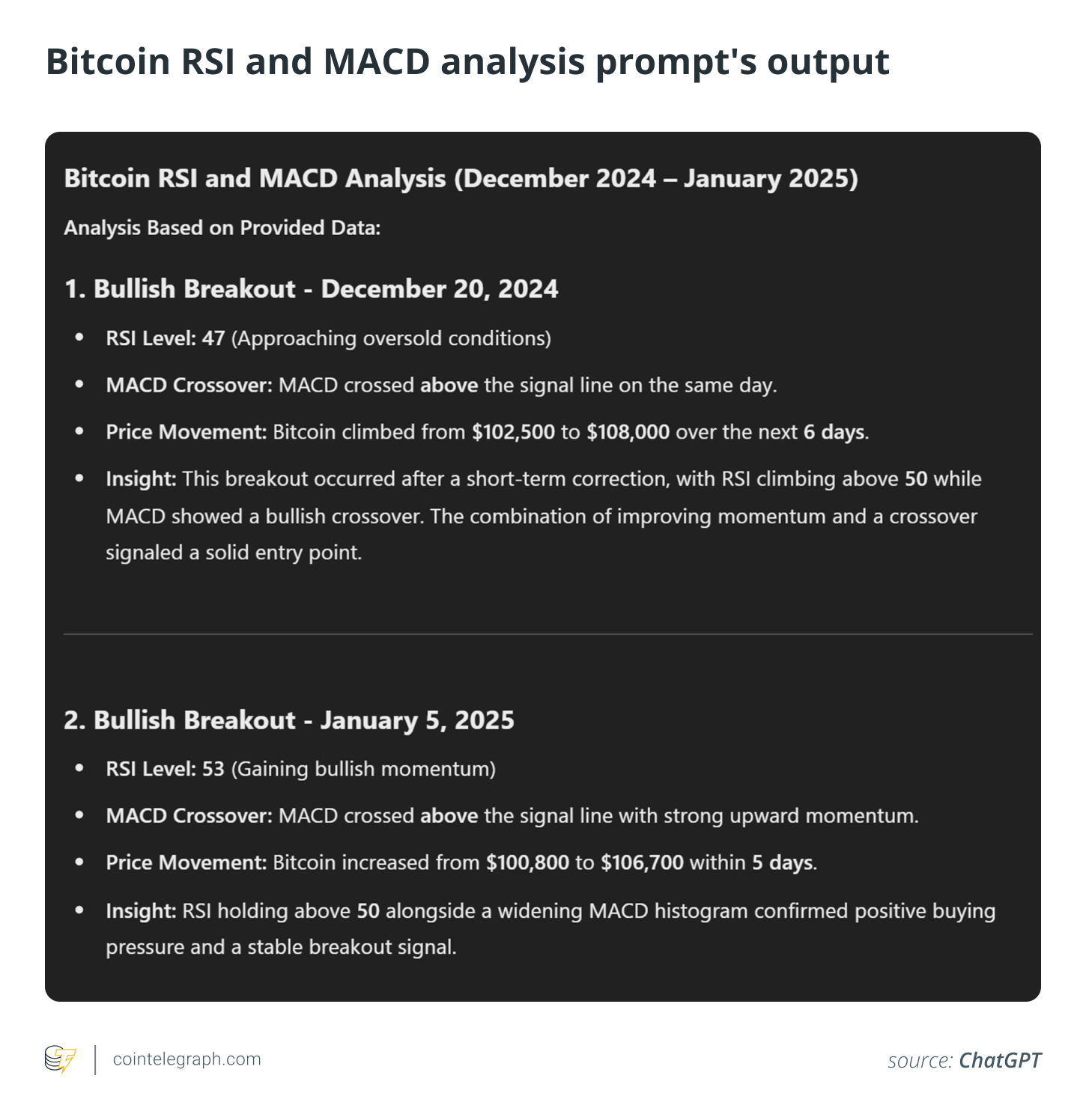
- Purpose: Be specific about the outcome you expect. For example:
“Summarize how Bitcoin’s social sentiment changed in December 2024 and highlight its impact on price movement.”
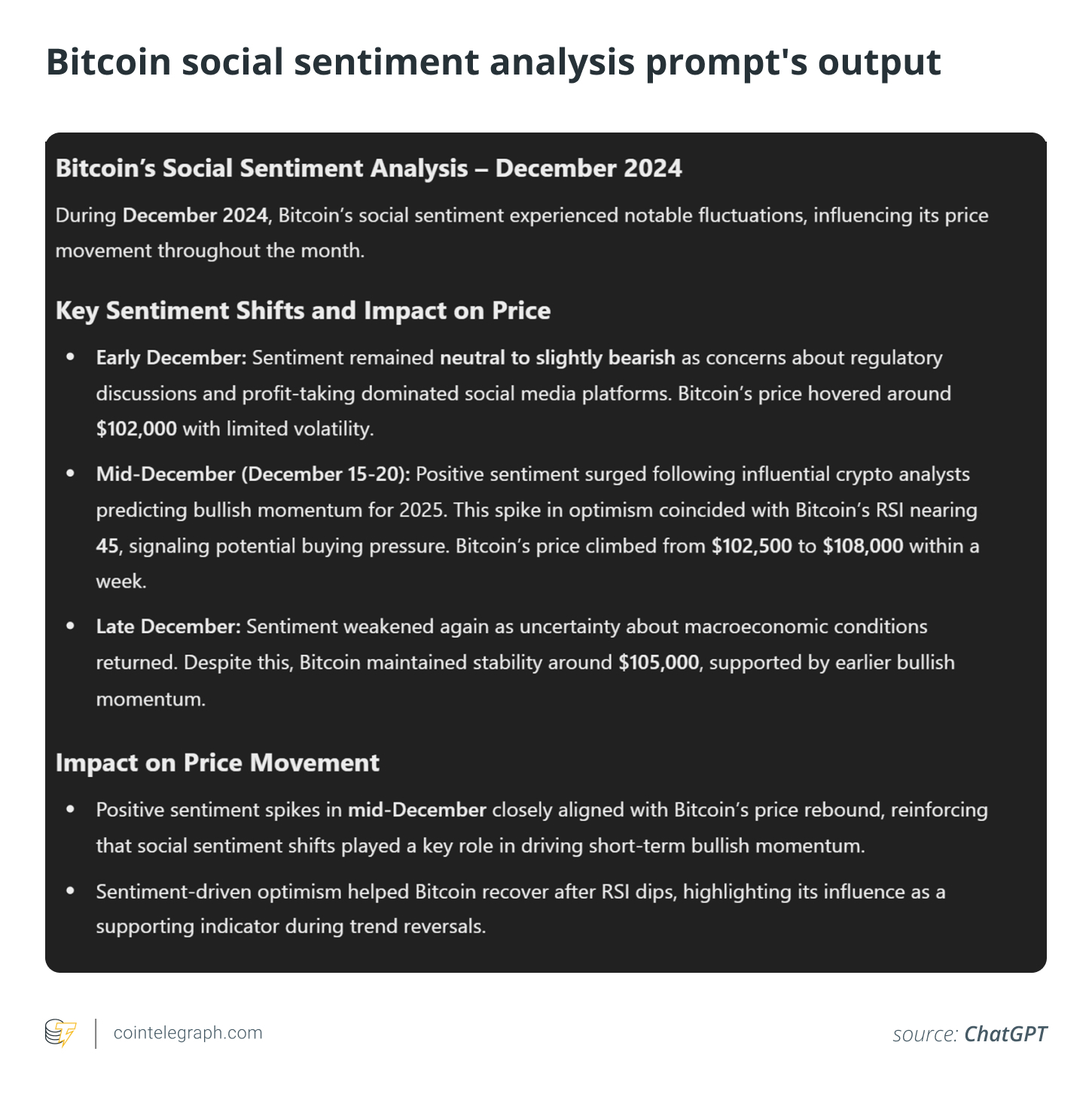
- Focus: Include relevant conditions, such as timeframes, data sources or key indicators, to ensure the analysis is targeted and relevant. For instance:
“Identify instances where Bitcoin’s RSI dipped below 50 between December 2024 and January 2025. Describe how long each dip lasted and explain the resulting price movement.”
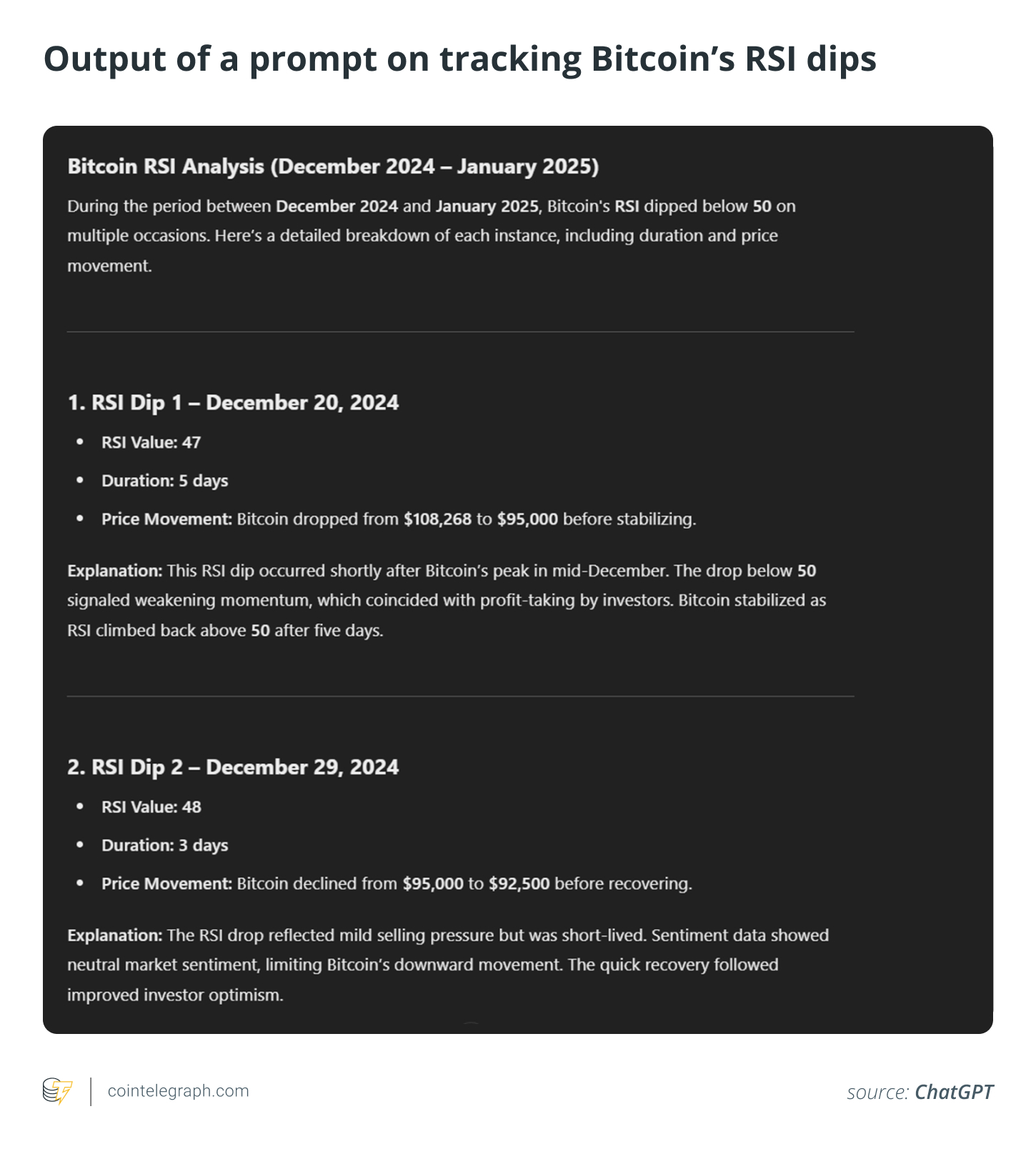
Prompt examples for crypto market trend analysis
Here are examples of effective prompts tailored for different types of crypto insights:
- Technical analysis prompt: “Analyze Bitcoin’s RSI dips below 30 from 2024 onward. Identify how long it typically took for the price to recover.”
- Sentiment analysis prompt: “Summarize Bitcoin sentiment trends on Reddit and Twitter throughout 2024. Identify patterns linked to price surges.”
- Strategy development prompt: “Create a trading strategy for Bitcoin using RSI, MACD, and whale accumulation data. Identify optimal entry and exit points.”
How to improve prompt quality
If ChatGPT’s response lacks detail or produces irrelevant insights, improving the prompt structure can enhance the outcome. Instead of rephrasing the same request, focus on adjusting the prompt’s depth, scope or context. Try these approaches for better results:
- Add more data references: Refer to RSI, MACD or other indicators to improve precision.
- Define the timeframe more clearly: Limiting the analysis period often provides sharper insights.
- Request comparative analysis: Asking ChatGPT to compare conditions across different timelines or trends can reveal more meaningful insights.
When tested on GPT-4o, a refined prompt produced significantly better results. The basic prompt, “Analyze Bitcoin RSI data,” returned vague and incomplete insights.
In contrast, an enhanced prompt — “Analyze Bitcoin’s RSI dips below 50 between December 2024 and January 2025. For each dip, identify the exact dates, duration, and the corresponding price movement. Explain whether the dips signaled trend reversals, corrections, or further declines. Additionally, provide insights in simple language, focusing on how traders can interpret these RSI movements for better decision-making in market entries and exits. Prepare a structured table summarizing each dip, including columns for date, RSI value, duration, price movement, and key insights for traders” — generated clear, actionable insights in contrast to previous output, as seen above.
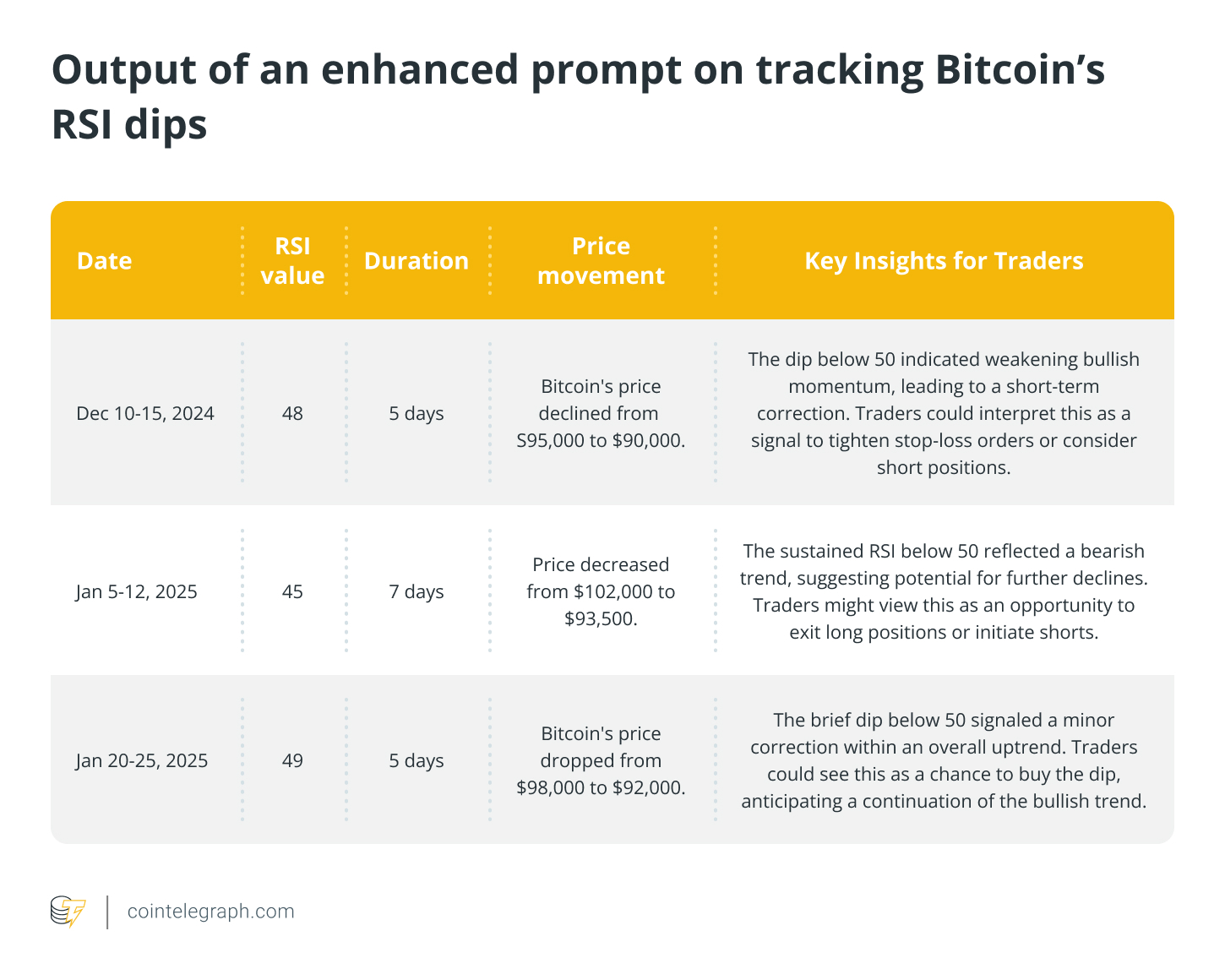
The below table summarizes key differences in the outputs of Prompt 1 and Prompt 2:
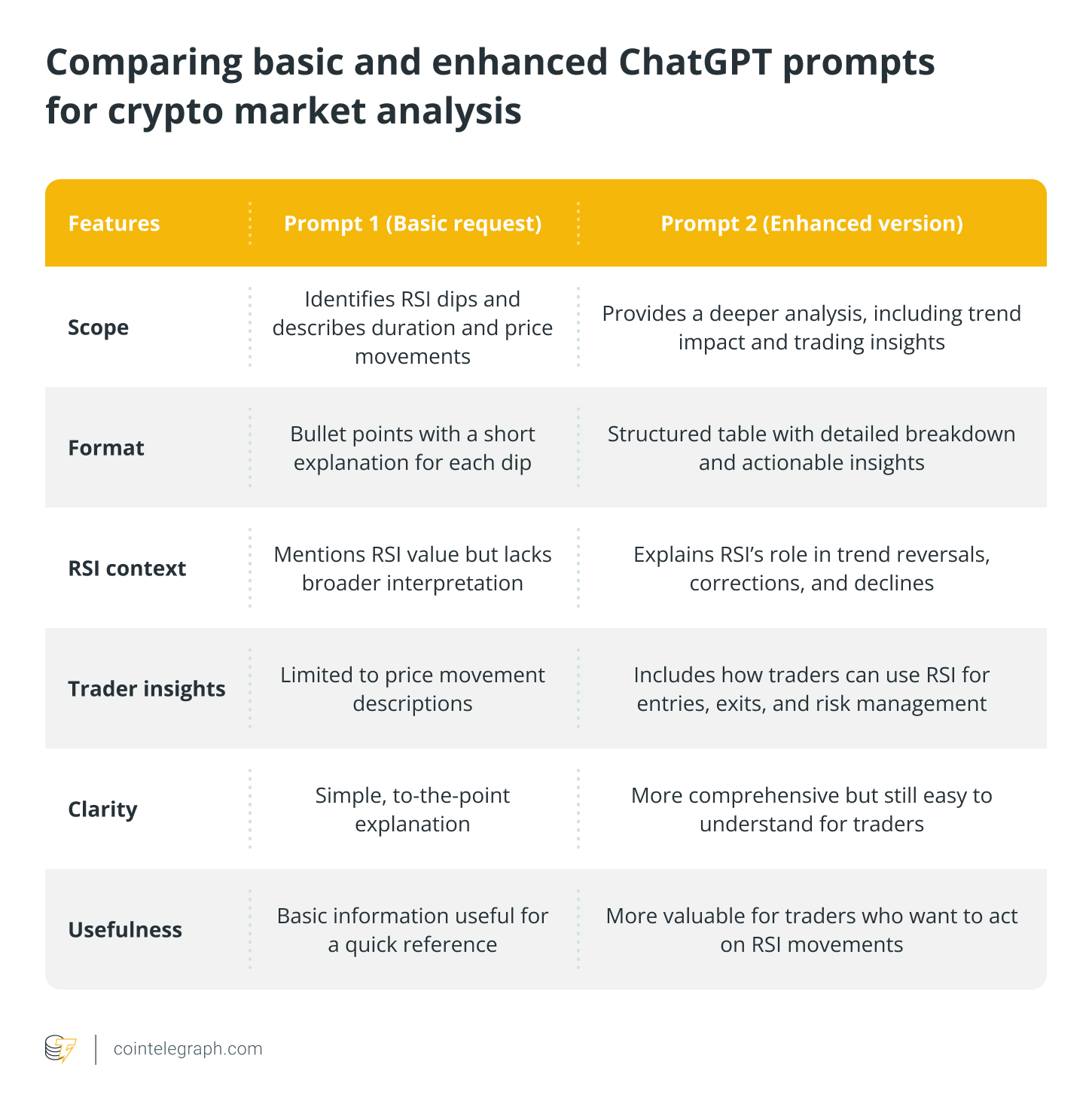
As observed, taking the time to write clear, targeted prompts significantly improves ChatGPT’s ability to provide meaningful and actionable insights for crypto market analysis.
However, results may vary as ChatGPT may not yield the same outputs all the time due to differences in prompt wording, data interpretation and inherent variability in AI-generated responses. Also, traders should cross-check insights with real-time data and multiple sources for informed decision-making.
Step 4: Caution! Verify ChatGPT insights before drawing conclusions
Insights generated by ChatGPT can provide useful guidance, but verifying those insights is crucial before making investment decisions. Crypto markets are volatile, and relying solely on AI crypto market predictions without cross-referencing data may lead to poor outcomes.
Verifying ChatGPT insights
To confirm the accuracy and relevance of ChatGPT’s insights:
- Cross-check with trusted data sources: If ChatGPT highlights a bullish signal based on RSI trends, compare this finding with live data from platforms like TradingView, CoinGecko or Glassnode to confirm the signal’s validity.
- Review key market conditions: Market behavior often depends on broader economic events, news or geopolitical factors. If ChatGPT identifies a pattern, check if major events align with the prediction.
- Test insights on a demo account: Before applying any suggested strategy, test it in a risk-free environment using demo trading platforms to assess its effectiveness.
Applying verified insights
Once insights are verified, applying them effectively is essential:
- Set clear entry and exit points: If crypto trading with ChatGPT suggests a bullish breakout pattern, establish specific price points to minimize risk and secure profits.
- Use stop-loss orders: Protect investments by setting stop-loss points that limit potential losses if the trend reverses unexpectedly.
- Diversify approach: Even when ChatGPT identifies promising trends, combining insights from multiple data sources helps reduce reliance on a single prediction.
Did you know? A survey by Mercer Investments in 2024 revealed that 54% of investment managers have already integrated AI into their investment processes, while over 90% are either currently using or planning to adopt AI tools.
Limitations of using ChatGPT for crypto market predictions
While ChatGPT can be a valuable tool for analyzing market trends, it has several limitations:
- Lack of real-time data: ChatGPT does not have live access to market prices, trading volumes or real-time sentiment. External data sources are needed for up-to-date analysis.
- No predictive accuracy guarantee: ChatGPT analyzes historical patterns and sentiment but cannot predict future price movements with certainty. Market conditions can change rapidly due to unforeseen factors.
- Data quality dependence: The accuracy of insights depends on the quality of the input data. If outdated or biased information is provided, the analysis may be misleading.
- Limited understanding of market manipulation: ChatGPT cannot detect wash trading, pump-and-dump schemes or other forms of market manipulation that can influence crypto prices.
- No personal financial advice: ChatGPT does not provide personalized investment recommendations. Traders should combine AI-generated insights with technical analysis, fundamental research and risk management strategies.
As the saying goes, “Past performance is not indicative of future results.” AI tools like ChatGPT can support decision-making, but they should never replace critical thinking. Thus, always cross-check AI-driven insights with reliable market research before making any trading decisions.
The future of ChatGPT in predicting crypto market trends
As AI technology continues to evolve, using ChatGPT for crypto forecasting is expected to become more refined and integrated with real-time data platforms. Future developments could include:
- Enhanced data integration: While ChatGPT cannot access live market data directly, integrating it with financial data providers like Finnhub or Polygon.io via APIs may allow real-time data retrieval.
- Improved prediction models: AI models are rapidly improving their ability to identify complex patterns, potentially enhancing prediction accuracy.
- Automated trading strategies: Future updates may enable traders to automate strategies based on ChatGPT insights, with alerts for optimal entry and exit points.
While ChatGPT is already a valuable tool, its capabilities will likely expand further as AI continues to develop, providing crypto traders with even more effective analysis and strategic insights
This article does not contain investment advice or recommendations. Every investment and trading move involves risk, and readers should conduct their own research when making a decision.

What are address poisoning attacks in crypto and how to avoid them?
Address poisoning attacks are malicious tactics used by attackers who can reroute traffic, interrupt services, or obtain unauthorized access to sensitive data by inserting bogus data or changing routing tables. The integrity of data and network security are seriously threatened by these assaults, which take […]
Analysis
Address poisoning attacks are malicious tactics used by attackers who can reroute traffic, interrupt services, or obtain unauthorized access to sensitive data by inserting bogus data or changing routing tables. The integrity of data and network security are seriously threatened by these assaults, which take advantage of flaws in network protocols.
This article will explain what address poisoning attacks are, their types and consequences, and how to protect oneself against such attacks.
Address poisoning attacks in crypto, explained
In the world of cryptocurrencies, hostile actions where attackers influence or deceive consumers by tampering with cryptocurrency addresses are referred to as address poisoning attacks.
On a blockchain network, these addresses, which are made up of distinct alphanumeric strings, serve as the source or destination of transactions. These attacks use a variety of methods to undermine the integrity and security of cryptographic wallets and transactions.
Address poisoning attacks in the crypto space are mostly used to either illegally acquire digital assets or impair the smooth operation of blockchain networks. These attacks may encompass:
Theft
Attackers may trick users into transmitting their funds to malicious addresses using strategies such as phishing, transaction interception or address manipulation.
Disruption
Address poisoning can be used to disrupt the normal operations of blockchain networks by introducing congestion, delays or interruptions in transactions and smart contracts, reducing the effectiveness of the network.
Deception
Attackers frequently attempt to mislead cryptocurrency users by posing as well-known figures. This undermines community trust in the network and might result in erroneous transactions or confusion among users.
To protect digital assets and the general integrity of blockchain technology, address poisoning attacks highlight the significance of strict security procedures and constant attention within the cryptocurrency ecosystem.
Related: How to mitigate the security risks associated with crypto payments
Types of address poisoning attacks
Address poisoning attacks in crypto include phishing, transaction interception, address reuse exploitation, Sybil attacks, fake QR codes, address spoofing and smart contract vulnerabilities, each posing unique risks to users’ assets and network integrity.
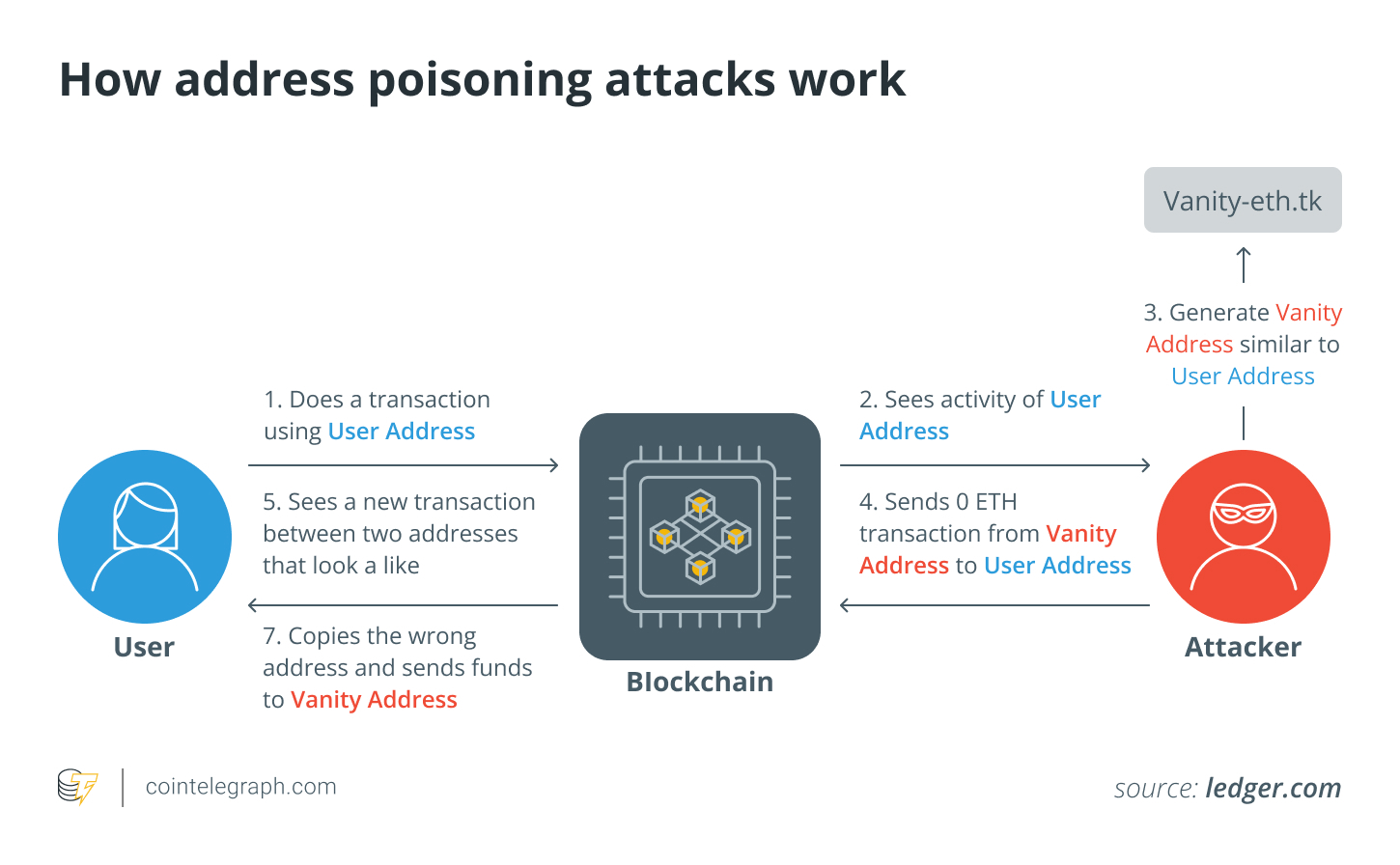
Phishing attacks
In the cryptocurrency realm, phishing attacks are a prevalent type of address poisoning, which involves criminal actors building phony websites, emails or communications that closely resemble reputable companies like cryptocurrency exchanges or wallet providers.
These fraudulent platforms try to trick unsuspecting users into disclosing their login information, private keys or mnemonic phrases (recovery/seed phrases). Once gained, attackers can carry out unlawful transactions and get unauthorized access to victims’ Bitcoin (BTC) assets, for example.
For instance, hackers might build a fake exchange website that looks exactly like the real thing and ask consumers to log in. Once they do so, the attackers can gain access to customer funds on the actual exchange, which would result in substantial financial losses.
Transaction interception
Another method of address poisoning is transaction interception, in which attackers intercept valid cryptocurrency transactions and change the destination address. Funds destined for the genuine receiver are diverted by changing the recipient address to one under the attacker’s control. This kind of attack frequently involves malware compromising a user’s device or network or both.
Address reuse exploitation
Attackers monitor the blockchain for instances of address repetition before using such occurrences to their advantage. Reusing addresses can be risky for security because it might reveal the address’s transaction history and vulnerabilities. These weaknesses are used by malicious actors to access user wallets and steal funds.
For instance, if a user consistently gets funds from the same Ethereum address, an attacker might notice this pattern and take advantage of a flaw in the user’s wallet software to access the user’s funds without authorization.
Sybil attacks
To exert disproportionate control over a cryptocurrency network’s functioning, Sybil attacks entail the creation of several false identities or nodes. With this control, attackers are able to modify data, trick users, and maybe jeopardize the security of the network.
Attackers may use a large number of fraudulent nodes in the context of proof-of-stake (PoS) blockchain networks to significantly affect the consensus mechanism, giving them the ability to modify transactions and potentially double-spend cryptocurrencies.
Fake QR codes or payment addresses
Address poisoning can also happen when fake payment addresses or QR codes are distributed. Attackers often deliver these bogus codes in physical form to unwary users in an effort to trick them into sending cryptocurrency to a location they did not plan.
For example, a hacker might disseminate QR codes for cryptocurrency wallets that look real but actually include minor changes to the encoded address. Users who scan these codes unintentionally send money to the attacker’s address rather than that of the intended receiver, which causes financial losses.
Address spoofing
Attackers who use address spoofing create cryptocurrency addresses that closely resemble real ones. The idea is to trick users into transferring money to the attacker’s address rather than the one belonging to the intended recipient. The visual resemblance between the fake address and the real one is used in this method of address poisoning.
An attacker might, for instance, create a Bitcoin address that closely mimics the donation address of a reputable charity. Unaware donors may unintentionally transfer money to the attacker’s address while sending donations to the organization, diverting the funds from their intended use.
Smart contract vulnerabilities
Attackers take advantage of flaws or vulnerabilities in decentralized applications (DApps) or smart contracts on blockchain systems to carry out address poisoning. Attackers can reroute money or cause the contract to behave inadvertently by fiddling with how transactions are carried out. Users may suffer money losses as a result, and decentralized finance (DeFi) services may experience disruptions.
Consequences of address poisoning attacks
Address poisoning attacks can have devastating effects on both individual users and the stability of blockchain networks. Because attackers may steal crypto holdings or alter transactions to reroute money to their own wallets, these assaults frequently cause large financial losses for their victims.
Beyond monetary losses, these attacks may also result in a decline in confidence among cryptocurrency users. Users’ trust in the security and dependability of blockchain networks and related services may be damaged if they fall for fraudulent schemes or have their valuables stolen.
Additionally, some address poisoning assaults, such as Sybil attacks or the abuse of smart contract flaws, can prevent blockchain networks from operating normally, leading to delays, congestion or unforeseen consequences that have an effect on the entire ecosystem. These effects highlight the need for strong security controls and user awareness in the crypto ecosystem to reduce the risks of address poisoning attacks.
Related: How to put words into a Bitcoin address? Here’s how vanity addresses work
How to avoid address poisoning attacks
To protect users’ digital assets and keep blockchain networks secure, it is crucial to avoid address poisoning assaults in the cryptocurrency world. The following ways may help prevent being a target of such attacks:
Use fresh addresses
By creating a fresh crypto wallet address for each transaction, the chance of attackers connecting an address to a person’s identity or past transactions can be decreased. For instance, address poisoning attacks can be reduced by using hierarchical deterministic (HD) wallets, which create new addresses for each transaction and lessen the predictability of addresses.
Utilizing an HD wallet increases a user’s protection against address poisoning attacks because the wallet’s automatic address rotation makes it more difficult for hackers to redirect funds.
Utilize hardware wallets
When compared to software wallets, hardware wallets are a more secure alternative. They minimize exposure by keeping private keys offline.
Exercise caution when disclosing public addresses
People should exercise caution when disclosing their crypto addresses in the public sphere, especially on social media sites, and should opt for using pseudonyms.
Choose reputable wallets
It is important to use well-known wallet providers that are known for their security features and regular software updates to protect oneself from address poisoning and other attacks.
Regular updates
To stay protected against address poisoning attacks, it is essential to update the wallet software consistently with the newest security fixes.
Implement whitelisting
Use whitelisting to limit transactions to reputable sources. Some wallets or services allow users to whitelist particular addresses that can send funds to their wallets.
Consider multisig wallets
Wallets that require multiple private keys to approve a transaction are known as multisignature (multisig) wallets. These wallets can provide an additional degree of protection by requiring multiple signatures to approve a transaction.
Utilize blockchain analysis tools
To spot potentially harmful conduct, people can track and examine incoming transactions using blockchain analysis tools. Sending seemingly trivial, small quantities of crypto (dust) to numerous addresses is a common practice known as dusting. Analysts can spot potential poisoning efforts by examining these dust trade patterns.
Unspent transaction outputs (UTXOs) with tiny amounts of cryptocurrency are frequently the consequence of dust transactions. Analysts can locate possibly poisoned addresses by locating UTXOs connected to dust transactions.
Report suspected attacks
Individuals should respond right away in the event of a suspected address poisoning attack by getting in touch with the company that provides their crypto wallet through the official support channels and detailing the occurrence.
Additionally, they can report the occurrence to the relevant law enforcement or regulatory authorities for further investigation and potential legal action if the attack involved considerable financial harm or malevolent intent. To reduce possible risks and safeguard both individual and group interests in the cryptocurrency ecosystem, timely reporting is essential.