South Korea lifts 9-year corporate crypto ban: What the policy change means
South Korea reopens crypto to corporations with strict caps and asset limits. This is part of a broader strategy that includes stablecoin legislation and potential spot crypto ETFs.
Analysis
How South Korea is using AI to detect crypto market manipulation
South Korea’s regulators are deploying AI systems to monitor crypto trading, flag manipulation and strengthen digital asset enforcement.
Analysis
How a Bitcoin promotion error triggered a regulatory reckoning in South Korea
A mistaken Bitcoin payout revealed how exchange ledgers work and why South Korea is rethinking internal controls for crypto platforms.
Analysis
Bitcoin mining 2025: Post-halving profitability, hashrate and energy trends
As Bitcoin mining faces new challenges post-halving, uncover how miners adapt to new realities and secure their places in the Bitcoin ecosystem.
Analysis
As Bitcoin mining faces new challenges post-halving, uncover how miners adapt to new realities and secure their places in the Bitcoin ecosystem.

How to spot a fake crypto investment platform: 10 red flags
Scam crypto investment platforms are everywhere, and spotting them isn’t as complicated as you may think.
Analysis
Scam crypto investment platforms are everywhere, and spotting them isn’t as complicated as you may think.

SEC delays Solana ETF as decisions for Polkadot, XRP loom
Over 80% of investors are betting on the approval of a Solana and Litecoin ETF in 2025, despite the latest delay from the SEC.
Litecoin
Over 80% of investors are betting on the approval of a Solana and Litecoin ETF in 2025, despite the latest delay from the SEC.
What are the next steps for the US stablecoin bill?
A bill to regulate stablecoins failed to pass a crucial vote in the US Senate on May 8 in part due to Democratic lawmakers’ concerns over Donald Trump’s ties to crypto.
Analysis
A bill to regulate stablecoins failed to pass a crucial vote in the US Senate on May 8 in part due to Democratic lawmakers’ concerns over Donald Trump’s ties to crypto.

How to use tsUSDe on TON for yield-generating dollar savings
Earn yield with tsUSDe on TON by staking on platforms like STON.fi for liquidity or DeDust for speed, and start earning trading fees and rewards.
Analysis
Earn yield with tsUSDe on TON by staking on platforms like STON.fi for liquidity or DeDust for speed, and start earning trading fees and rewards.

Can you stake Bitcoin (BTC)? Here’s what you need to know
Earn yield on Bitcoin using centralized lending platforms, through Wrapped Bitcoin (WBTC) on Ethereum, or Bitcoin layer-2 platforms.
Analysis
Earn yield on Bitcoin using centralized lending platforms, through Wrapped Bitcoin (WBTC) on Ethereum, or Bitcoin layer-2 platforms.

Browser-based crypto mining in 2025: Still viable or virtually dead?
Browser-based crypto mining is making a quiet return in 2025, offering a low-barrier way to earn crypto, but its profitability and impact remain limited.
Analysis
Browser-based crypto mining is making a quiet return in 2025, offering a low-barrier way to earn crypto, but its profitability and impact remain limited.

How to set up and use AI-powered crypto trading bots
Key takeaways AI-powered crypto trading bots use machine learning to make smarter, faster trading decisions — without emotions. Setting up a bot involves choosing a platform, connecting your exchange, configuring strategies and running backtests. Bots can run 24/7, react to data instantly and are ideal […]
Analysis
Key takeaways
-
AI-powered crypto trading bots use machine learning to make smarter, faster trading decisions — without emotions.
-
Setting up a bot involves choosing a platform, connecting your exchange, configuring strategies and running backtests.
-
Bots can run 24/7, react to data instantly and are ideal for passive income seekers and active traders.
-
While powerful, they’re not “set-it-and-forget-it” tools. You’ll need to monitor performance and tweak strategies over time.
-
Understanding your goals (long-term investing, day trading, etc.) helps you choose the right bot and strategy.
AI-powered crypto trading bots use machine learning to make smarter, faster trading decisions — without emotions.
Setting up a bot involves choosing a platform, connecting your exchange, configuring strategies and running backtests.
Bots can run 24/7, react to data instantly and are ideal for passive income seekers and active traders.
While powerful, they’re not “set-it-and-forget-it” tools. You’ll need to monitor performance and tweak strategies over time.
Understanding your goals (long-term investing, day trading, etc.) helps you choose the right bot and strategy.
Crypto markets move fast and rarely sleep. That’s why AI-powered crypto trading bots are no longer a novelty. These bots use machine learning to analyze data, identify patterns and execute trades in real time, often faster and with more discipline than human traders.
From beginners looking to automate simple strategies to professionals deploying predictive models, AI bots offer a scalable way to participate in volatile markets.
This guide explains how to build the best AI trading bots for crypto, how AI trading bots work, how to set them up correctly and what to avoid for long-term performance, not just short-term automation.
What are AI-powered crypto trading bots?
AI-powered crypto trading bots are programs that automatically buy and sell crypto assets based on machine learning algorithms, rather than fixed rules. These bots ingest large volumes of historical and real-time data — price action, order book depth, volatility, even social sentiment — and use that information to detect opportunities.
Unlike traditional bots that act only when predefined conditions are met, AI bots can adjust dynamically. For example, a bot trained on past market behavior might delay execution during uncertain conditions or increase position sizing during high-confidence periods. This adaptability makes them particularly useful in high-frequency, volatile environments where speed and objectivity matter.
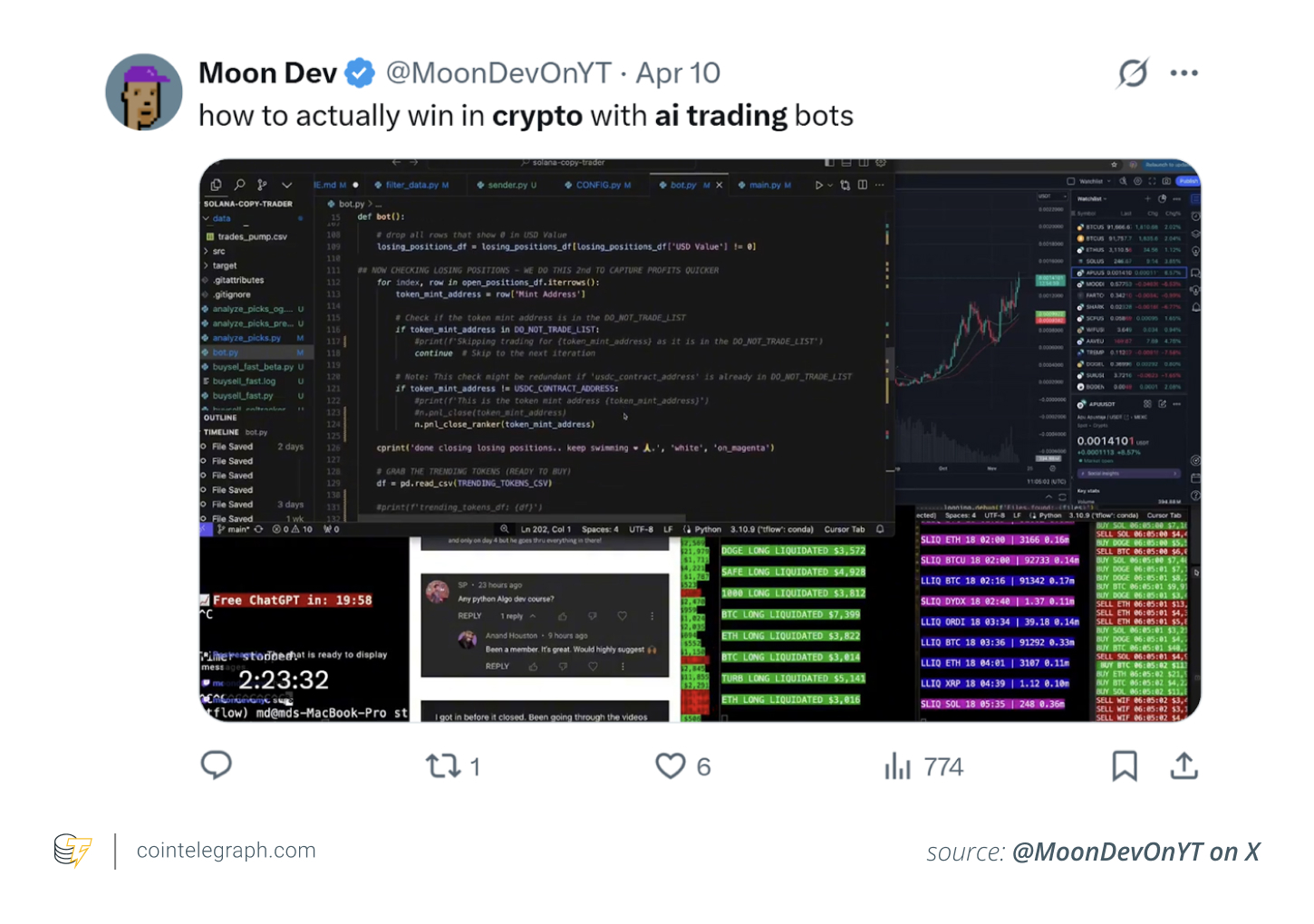
Advanced platforms like Freqtrade and Trality allow users to import custom-trained models, while others like Stoic by Cindicator use in-house quant research to automate portfolio balancing. The core advantage lies in their ability to reduce emotional trading and operate around the clock without fatigue.
How to set up an AI crypto trading bot
Getting started with an AI-powered crypto trading bot is easier than ever, especially with today’s user-friendly platforms.
But behind the ease of clicking “Start” lies a setup process that determines whether the bot performs reliably or becomes a source of costly errors. Proper setup ensures alignment with market conditions, trading goals and risk tolerance.
Below are a few key points to bear in mind while setting up crypto trading bots:
-
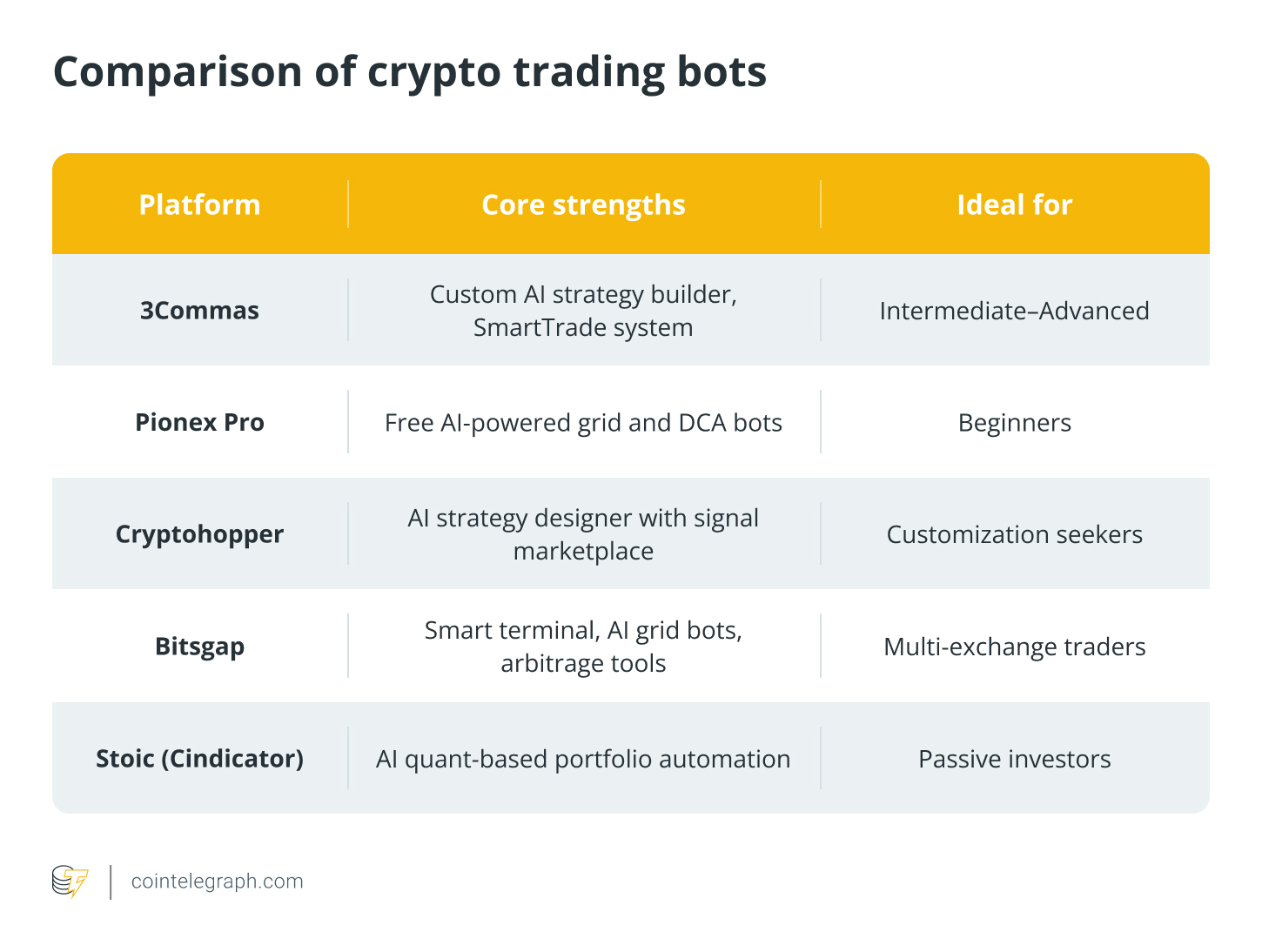
Choose a platform that supports AI functionality. Tools like Freqtrade, Trality and Jesse AI allow importing machine learning models. Others like 3Commas, Pionex and Cryptohopper focus on user-friendly automation and visual strategy builders.
-
Connect the bot to an exchange using API keys. Security settings should always disable withdrawal permissions, enable 2FA and restrict access via IP whitelisting where possible.
-
Configure the strategy. This includes defining trade pairs, order sizes, stop-loss and take-profit rules, cooldowns and maximum concurrent positions. Some platforms support prebuilt logic, while others allow full scripting with Python.
-
Backtest the strategy using historical data. Platforms like 3Commas, Cryptohopper and Freqtrade support robust backtesting to measure risk-adjusted performance across different market phases.
-
Deploy in live conditions with minimal capital. Initial live testing should include real-time monitoring of execution logs, fill prices, slippage and fees. Alerts should be set for failed orders or drawdowns. Most bots support integrations with Telegram, Slack or email for notifications.
Choosing the right AI bot
Selecting the right AI-powered crypto trading bot is a foundational step toward building a sustainable, automated trading strategy.
The decision should align with the desired strategy complexity, technical skill level, risk appetite and required exchange support. Bots differ not only in interface and pricing but also in how deeply they incorporate machine learning and adaptive logic.
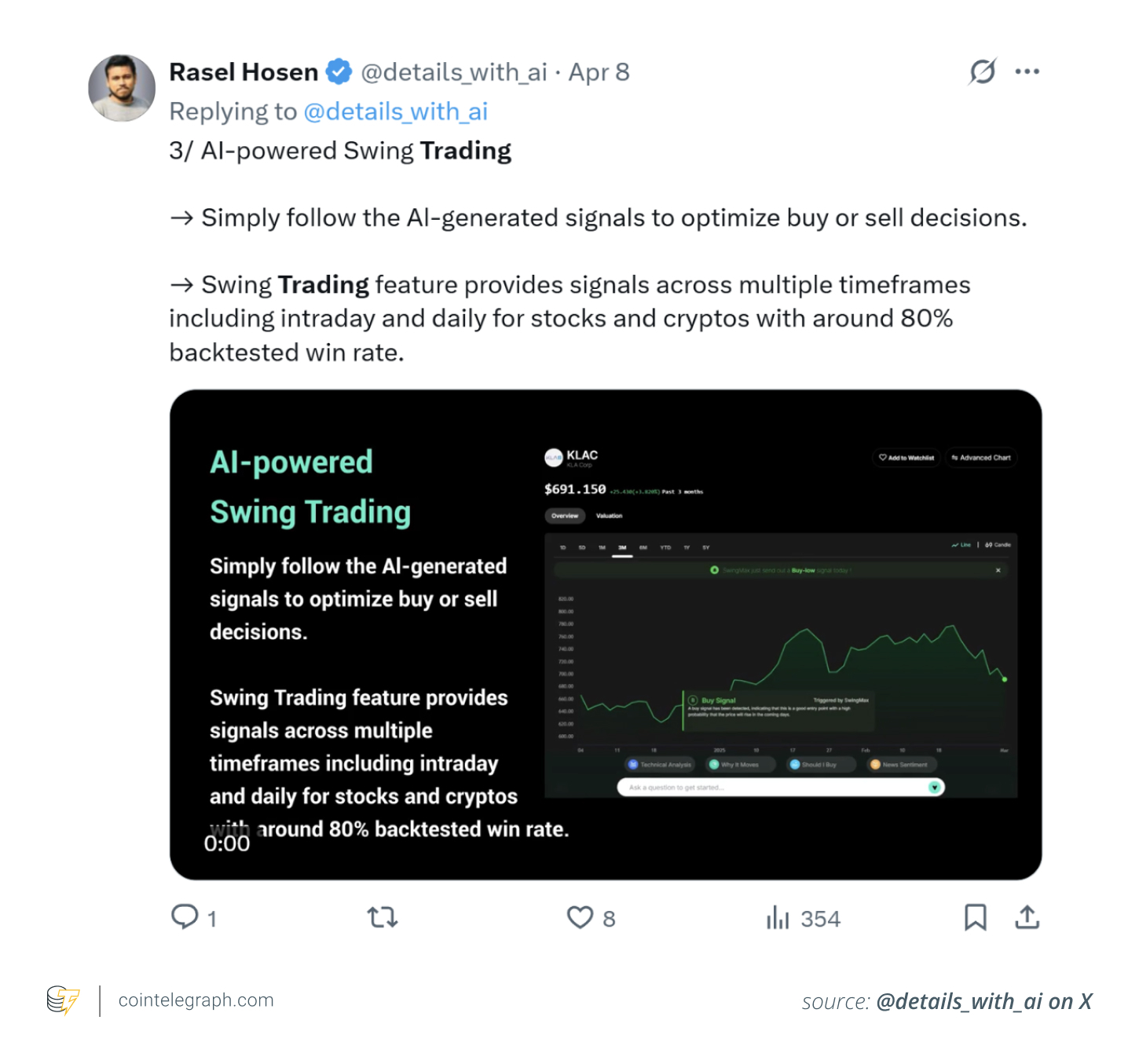
Some bots, like Pionex and Stoic by Cindicator, prioritize simplicity and automation with minimal configuration, targeting users who prefer passive execution or prebuilt strategies.
Others, such as Freqtrade, Trality and Jesse AI, offer full control, deep customization and support for importing externally trained AI models — catering to users with programming experience or quantitative backgrounds.
-
Strategy fit: Pionex and Bitsgap could be ideal for grid and dollar-cost-averaging (DCA) strategies. For trend-based or breakout strategies, 3Commas supports custom logic with popular indicators. Freqtrade and Jesse AI are best for those building predictive models with Python.
-
Level of AI support: Some bots like Stoic by Cindicator use built-in quant models. Others like Trality and Freqtrade allow importing externally trained machine learning models for advanced control.
-
User experience: No-code users can explore platforms like Cryptohopper and Kryll. Intermediate users often prefer 3Commas. Developers will benefit from Trality’s Python IDE or Freqtrade’s scripting interface.
-
Exchange compatibility: Most bots support Binance, Kraken, KuCoin, Coinbase and Bybit. Platforms such as 3Commas and Bitsgap offer multi-exchange support and are especially popular among copy-trading users, allowing them to mirror professional strategies across multiple accounts in real time.
-
Backtesting capabilities: Trality, Cryptohopper and 3Commas include visual backtesting. Jesse AI and Freqtrade offer deeper simulations with latency and slippage modeling.
-
Security features: Look for bots with encrypted API key storage, IP whitelisting and two-factor authentication. These are standard on 3Commas and Trality.
-
Pricing models: Pionex is free to use. Platforms like 3Commas and Trality run on subscriptions. Freqtrade and Jesse AI are open-source but require technical setup.
Common mistakes while using AI bots and how to avoid them
Despite the availability of powerful AI tools, some mistakes still lead to poor outcomes. These errors typically arise from misconfiguration, over-optimization or lack of oversight.
-
Overfitting backtests: Many bots look great on paper but fail when they go live. Use walk-forward testing and avoid strategies that only succeed in past conditions.
-
Relying on marketplace bots: Marketplace strategies from platforms like Kryll or Cryptohopper often lack adaptability. Always test and tweak before deployment.
-
Weak risk controls: Skipping stop-losses or using oversized positions can wipe out capital. Bots like Freqtrade and Trality let users define precise risk limits. Make sure to use them.
-
Ignoring trading costs: Backtests often ignore slippage and fees. Jesse AI and Freqtrade offer built-in tools to simulate these costs more accurately.
-
Lack of monitoring: Bots need regular checks. Platforms like 3Commas and Trality support real-time alerts for failed trades or sudden drawdowns.
-
Overleveraging: Using high leverage on exchanges like Bybit or Binance Futures (crypto derivative exchange) can lead to liquidation. Apply strict limits from the start.
-
Wrong market fit: DCA works well in declining markets; breakout bots don’t. Platforms like Stoic and Kryll offer filters or pause triggers to prevent misfires.
Avoiding these common errors requires thoughtful setup, continuous validation and disciplined risk controls. AI bots can enhance performance but require human oversight, strategic clarity, and technical awareness to deliver consistent results.
The future of crypto AI trading
AI crypto trading is entering a new phase where real-time learning replaces static strategy templates. Instead of relying on predefined signals, emerging trading systems use reinforcement learning and online model retraining to adapt continuously to shifting market dynamics.
Platforms such as Freqtrade, combined with cloud-native tools like Google Vertex AI or AWS SageMaker, enable this shift by supporting pipelines that monitor live order books, price volatility and macroeconomic indicators to automatically refine decision-making thresholds during active trading.
A major evolution is the integration of large language models (LLMs) into trading workflows. Unlike traditional bots limited to charts and price data, LLM-enhanced agents interpret unstructured information — central bank statements, tokenomics updates, SEC filings or even Discord announcements — and convert it into actionable insights.
Early implementations are emerging in institutional quant desks and experimental tools like Delphi AI and Kaito, which allow bots to pause or adjust positions based on narrative sentiment, regulatory shifts or reputational risk events in real time.
AI is also expanding its footprint onchain, with smart contract-based agents executing trades, managing liquidity and optimizing DeFi yield in a fully decentralized manner.
Projects like Fetch.ai are developing AI agents that operate autonomously across protocols without human intervention. These agents interact directly with AMMs, lending pools and governance protocols, ushering in an era where the lines between algorithmic trading, protocol participation and AI reasoning are entirely blurred within the blockchain itself.
This article does not contain investment advice or recommendations. Every investment and trading move involves risk, and readers should conduct their own research when making a decision.

Forget PEPE—This New Memecoin Has a 20,000% Growth Target by Q4!
The post Forget PEPE—This New Memecoin Has a 20,000% Growth Target by Q4! appeared first on Coinpedia Fintech News A new memecoin has emerged, capturing attention with ambitious growth predictions by year’s end. Forecasts suggest an eye-popping 20,000% surge, drawing interest from across the crypto […]
Sponsored
The post Forget PEPE—This New Memecoin Has a 20,000% Growth Target by Q4! appeared first on Coinpedia Fintech News
A new memecoin has emerged, capturing attention with ambitious growth predictions by year’s end. Forecasts suggest an eye-popping 20,000% surge, drawing interest from across the crypto sphere. Could this be the next breakout sensation, eclipsing previous favorites? This article explores the buzz around this intriguing newcomer and what might be driving its anticipated rise.
Price Prediction for XYZVerse ($XYZ): Is a 30x Jump Possible?
XYZVerse has entered the meme coin market at a time when community-driven tokens continue to dominate speculative trading. The rise of meme coins like PEPE, Dogwifhat, and Bonk proves that strong branding, viral marketing, and community engagement can drive massive gains.
The broader market sentiment also plays a key role in XYZVerse’s potential. As the altcoin season is about to start, lower-cap meme coins are seeing increased investor interest. Given that XYZVerse is still in presale, it could benefit from this wave if it secures strategic exchange listings and maintains community hype post-launch.
Key Strengths of XYZVerse in the Current Market:
- Strong branding with sports and influencer partnerships, broadening its appeal
- Deflationary mechanics (17.13% token burn) to reduce supply pressure
- Liquidity allocation (15%) to support stability after launch
- Community incentives (10%) fostering engagement and holding
Price Prediction for $XYZ
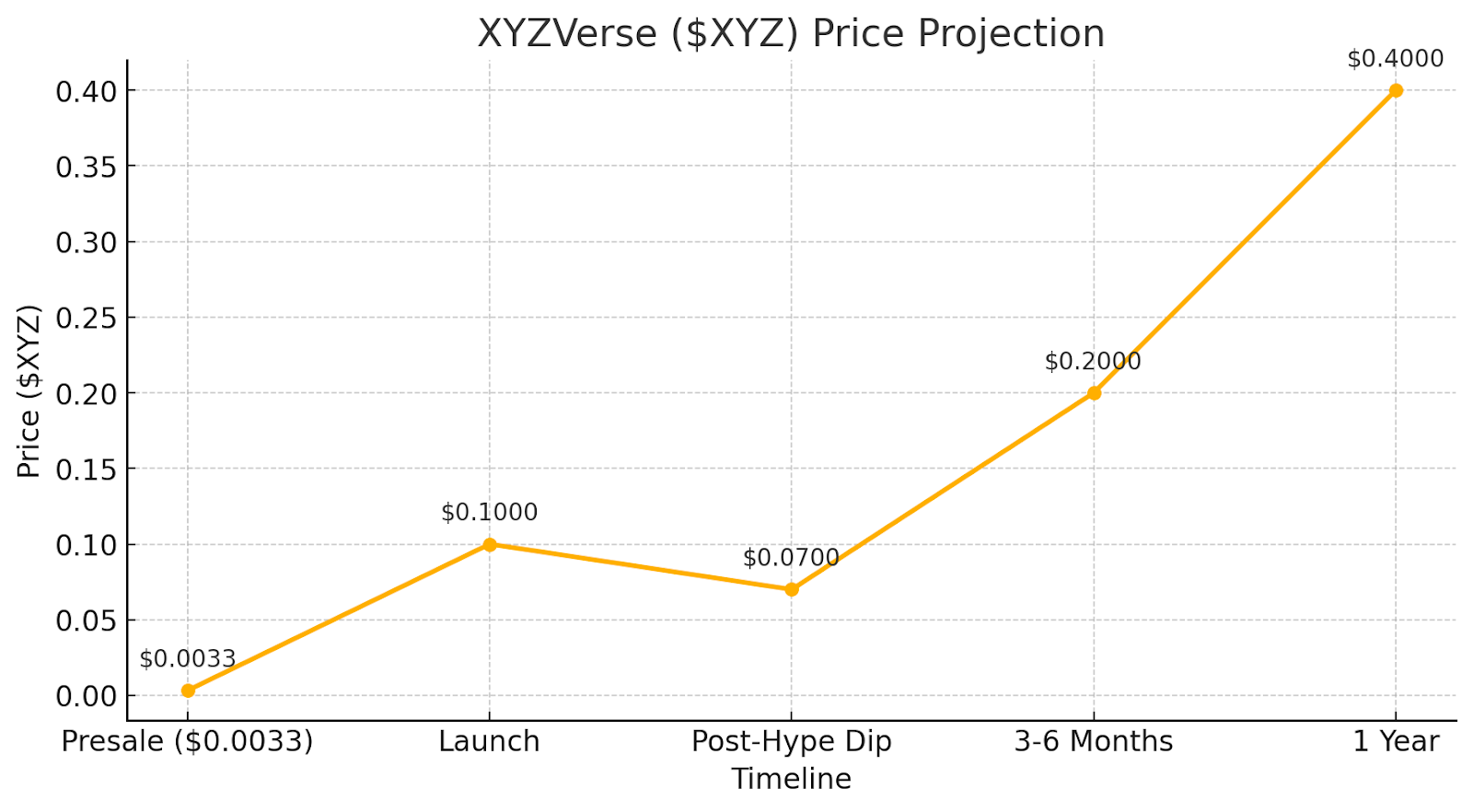
- Current Presale Price: $0.003333
- Projected Post-Presale Target: $0.10 (as per project’s estimates)
- Potential ATH (First 1-2 Weeks Post-Launch): $0.15 – $0.25 (if demand surges and listings drive FOMO)
- Long-Term Potential (6-12 Months): $0.20 – $0.40 (if the project secures major partnerships and listings)
Buy $XYZ Early to Increase Its Profit Potential
Realistic Expectations: Will XYZ Hit $0.10?
A 30x jump from presale to $0.10 is possible but depends on:
- Strong Exchange Listings – If XYZVerse lands on major CEX platforms like KuCoin, OKX, or Binance, its price could skyrocket on launch day.
- Sustained Community Growth – Meme coins need viral momentum. If XYZVerse delivers on its sports influencer partnerships, it could drive massive social media engagement.
- Market Conditions – If Bitcoin and altcoins remain bullish, speculation-driven assets like XYZVerse tend to benefit.
Is a 3000% Surge Possible for $XYZ?
XYZVerse has the ingredients for a strong launch, but its long-term success depends on execution. If the team delivers strong marketing, high-profile listings, and real community engagement, the $0.10+ target, which is around 3000% from the current price, could be achievable.
Invest in $XYZ Before It Surges
PEPE: A Deflationary Memecoin Inspired by Pepe the Frog
PEPE is a deflationary memecoin launched on the Ethereum blockchain, drawing inspiration from the Pepe the Frog internet meme created by Matt Furie. The cryptocurrency seeks to capitalize on the popularity of meme-based coins like Shiba Inu and Dogecoin. PEPE appeals to the crypto community with a no-tax policy and by being transparent about its lack of utility, embracing its identity purely as a memecoin.
In late April to May 2023, PEPE experienced a significant surge, with its market capitalization reaching a peak of $1.6 billion, resulting in substantial gains for early holders. This surge contributed to a period some refer to as a “memecoin season,” leading to the rapid rise and fall of other meme-based cryptocurrencies. The PEPE roadmap includes listings on major exchanges and a “meme takeover” as part of its three-phase plan. The coin’s recent activity and community support highlight its influence in the current market cycle, reflecting ongoing interest in meme-based digital assets.
Conclusion
Though coins like PEPE have impressive gains, XYZVerse’s unique sports ecosystem and 20,000% growth target make it a standout memecoin with significant potential by Q4.
You can find more information about XYZVerse (XYZ) here:
https://xyzverse.io/, https://t.me/xyzverse, https://x.com/xyz_verse

What are XRP futures and how to invest in them?
If you’re following developments in the cryptocurrency market, you’ve likely noticed that Coinbase Derivatives has introduced XRP futures contracts to its US derivatives exchange. This move is part of a broader trend where regulated platforms are expanding access to futures trading, giving investors new ways […]
Analysis
If you’re following developments in the cryptocurrency market, you’ve likely noticed that Coinbase Derivatives has introduced XRP futures contracts to its US derivatives exchange. This move is part of a broader trend where regulated platforms are expanding access to futures trading, giving investors new ways to engage with digital assets like XRP (XRP).
But what exactly are XRP futures? And how do you get involved as an investor or trader?
Let’s take a closer look.
What are XRP futures?
XRP futures are standardized financial contracts that allow you to agree to buy or sell XRP at a predetermined price on a specific future date. Rather than trading the actual token, you’re trading a contract that tracks the price of XRP.
These contracts are overseen by the US Commodity Futures Trading Commission (CFTC), meaning they operate within a regulated framework. That adds a level of oversight and structure that appeals to many investors, particularly those wary of the risks tied to unregulated platforms.
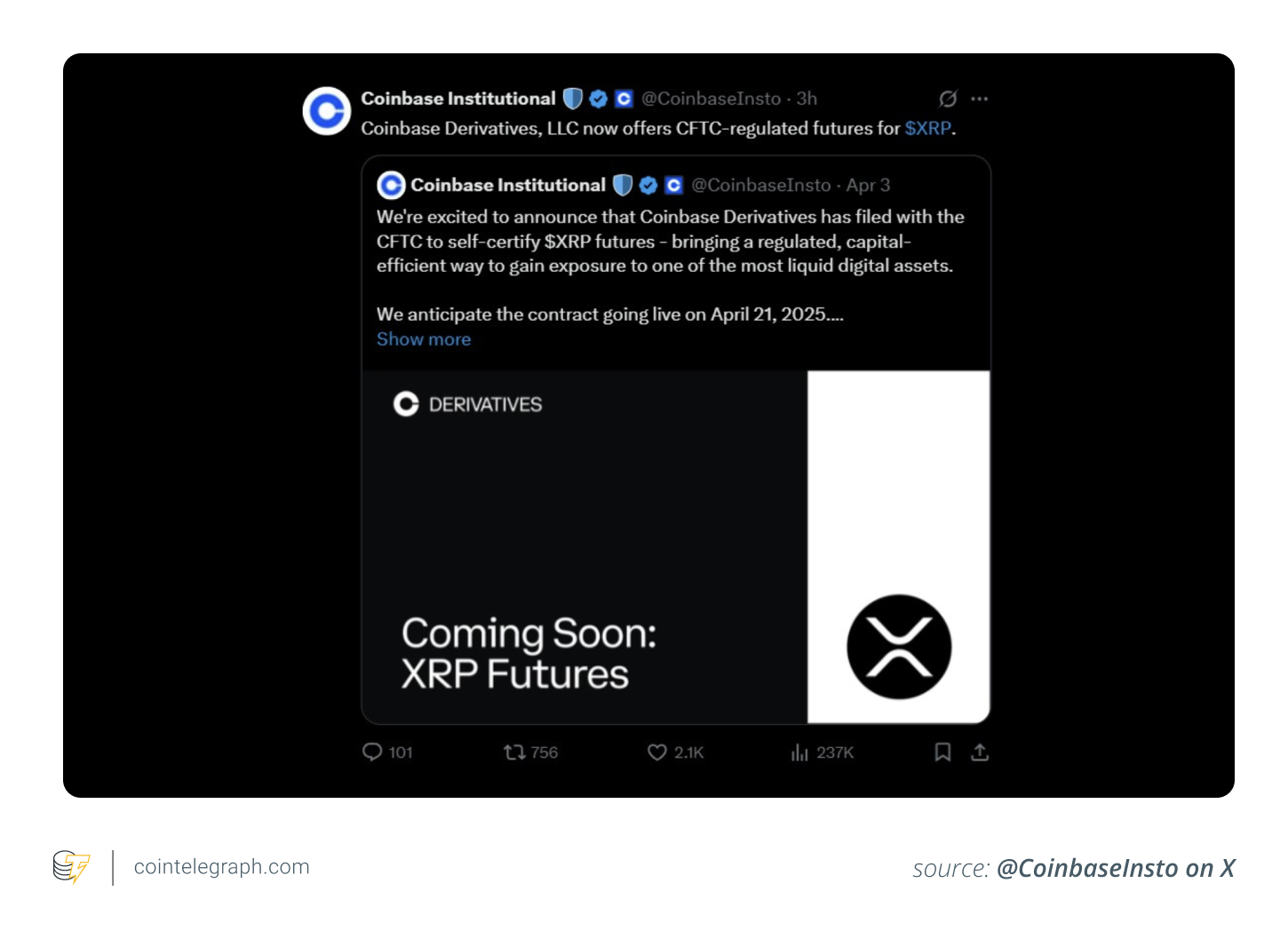
On April 3, 2025, Coinbase Derivatives announced it had filed with the CFTC to self-certify XRP futures contracts, and the contracts were launched on April 21, 2025.
Types of XRP futures contracts offered by Coinbase
Coinbase’s offering includes:
-
Nano XRP futures represent 500 XRP per contract, cash-settled in US dollars. These are designed for retail traders and smaller institutions, offering lower capital requirements while still providing exposure to XRP price movements.
-
Standard XRP futures cover 10,000 XRP per contract, are also settled in USD, and are aimed at larger institutions and active traders.
This variety lets you choose a position size that matches your risk tolerance and investment strategy.
But what do terms like “cash-settled” actually mean?
Both Nano and Standard XRP futures are contracts that let you trade based on the price of XRP — but you don’t actually own or receive XRP. You’re trading contracts that track XRP’s price.
And, when the contract closes, the difference between your entry and exit price is calculated (profit or loss) and settled in USD — this is what cash settlement means.
Did you know? Other products offered by the Coinbase Derivatives exchange include more than 20 futures contracts on assets such as Bitcoin (BTC), Ether (ETH), Dogecoin (DOGE), Solana (SOL), Chainlink (LINK) and Stellar (XLM).
Why choose XRP futures contracts over buying XRP?
You might be wondering why someone would choose futures over simply buying XRP on the spot market.
Here are a few reasons:
-
Leverage: Futures often allow you to control a large position with a relatively small amount of capital. While this can amplify gains, it also increases potential losses.
-
Hedging: If you already hold XRP and expect short-term volatility, futures can be used to protect your portfolio.
-
Speculation: Futures allow you to take both long (bullish) and short (bearish) positions, so you can potentially benefit from market moves in either direction.
-
No wallet or storage needs: Buying XRP requires a secure wallet and managing private keys, which carries risks like hacking or loss. Futures contracts are financial instruments traded on exchanges, eliminating the need for direct XRP custody.
-
Liquidity and accessibility: Futures markets often have high liquidity, making it easier to enter and exit positions. Some exchanges offer XRP futures with lower barriers than buying XRP on certain crypto platforms, especially in regions with regulatory restrictions.
-
Cash settlement: Many XRP futures are cash-settled, meaning you settle profits or losses in fiat or stablecoins without handling XRP itself, simplifying the process for traders avoiding crypto custody.
When to choose futures contracts:
-
You want to trade XRP price movements with leverage or flexibility to go long or short.
-
You prefer not to deal with crypto wallets or custody.
-
You’re hedging an existing XRP position or portfolio.
-
You’re comfortable with the risks and complexities of derivatives.
When to buy XRP:
-
You believe in XRP’s long-term value and want to hold it as an investment.
-
You plan to use XRP for transactions or in its ecosystem (e.g., Ripple’s payment network).
-
You want to avoid the risks of leverage and futures margin calls.
Ultimately, futures suit active traders or those seeking leveraged exposure, while buying XRP could be ideal for long-term holders or users of the asset. You must always assess your risk tolerance and goals before deciding whether to invest in XRP or XRP futures.
Did you know? The MarketVector™ Coinbase XRP Benchmark Rate provides a robust USD price reference exclusively for XRP traded on the Coinbase Exchange. It includes no other assets and no other exchanges — just XRP, just Coinbase.
Where to invest in XRP futures
If you’re looking to invest in XRP futures, there are several platforms (other than Coinbase) offering access depending on your location and trading needs.
-
Kraken Futures: Kraken provides XRP futures with leverage. In Australia, access is limited to wholesale clients through Beaufort Fiduciaries Pty Ltd (AFSL no. 545124). In the United Kingdom, only clients classified as Professional Clients under Financial Conduct Authority rules can trade through Crypto Facilities Limited (FRN: 757895).
-
Binance: Binance offers XRP/USDT perpetual futures contracts, allowing users to trade XRP without an expiry date. These contracts support leverage, giving traders flexibility in managing exposure. However, as of May 28, 2024, Binance no longer supports XRP as a margin asset under its “Multi-Assets Mode,” though XRP futures remain available in other trading modes.
-
OKX: OKX also provides XRP/USDT perpetual swaps, which let traders speculate on XRP price movements continuously. While OKX delisted XRP expiry futures contracts in December 2024, perpetual swaps are still supported. Traders can apply leverage and adjust positions based on their risk strategy.
-
Bitget: It is a globally accessible platform that offers XRP futures with options to take long or short positions. It features a user-friendly interface, making it suitable for both new and experienced traders, though availability depends on regional regulations.
-
KuCoin Futures: KuCoin supports XRP perpetual contracts (XRP/USDT) with leverage. The platform is known for low trading fees and offers various features for different trading strategies. It’s accessible in many countries, with some regional restrictions.
-
MEXC: It provides XRP futures in both USDt-margined and coin-margined formats. MEXC supports high leverage and offers educational tools, catering to traders of all levels. The platform is available in most regions, though users should check for local compliance.
-
Delta Exchange: It lists XRP perpetual futures with leverage up to 100x. It’s known for low fees and advanced risk management tools. The platform is available to traders in several countries, depending on local laws.
-
Bitfinex: Lastly, Bitfinex offers XRP futures as part of its broader derivatives portfolio. Its platform caters to advanced users with customizable strategies. Access is region-dependent, and traders must ensure eligibility based on their location.
Did you know? Coinbase crypto derivatives are not available to retail clients based in the United Kingdom or Spain due to local regulatory restrictions.
How to invest in XRP futures
If you’re interested in trading XRP futures, here are general steps to get started:
-
Choose a platform: Select a regulated exchange offering XRP futures, such as Coinbase’s US Derivatives Exchange. Create an account and complete identity verification, which typically involves submitting a valid ID and proof of address.
-
Understand the product: Research how XRP futures contracts work, including contract sizes (e.g., Coinbase offers standard contracts of 10,000 XRP or nano contracts of 500 XRP), margin requirements, leverage options and fees. Futures are complex, so review the exchange’s documentation and understand risks, such as liquidation.
-
Fund your account: Deposit USD or another accepted currency to use as collateral (margin) for trading. Check the platform’s minimum deposit and margin requirements. For example, Coinbase settles futures in USD, and you can fund via bank transfer or debit card.
-
Place your trade: Use the platform’s trading interface (e.g., Coinbase Advanced) to select XRP futures contracts (symbol: XRL for standard XRP contracts on Coinbase). Decide whether to go long (buy) or short (sell), set your position size, and apply any leverage if available. Confirm the trade after reviewing details.
-
Practice risk management: Futures carry high risks due to leverage and volatility. Set stop-loss orders, limit position sizes based on your risk tolerance, and avoid risking more than you can afford to lose. For instance, some exchanges pause trading if the underlying asset’s price moves over 10% in an hour to mitigate volatility risks.
-
Monitor the market: Track XRP’s price, market sentiment, funding rates and external factors like regulatory news or macroeconomic trends. Use tools like candlestick charts or technical indicators on the platform to inform your strategy. Stay updated to adjust positions and avoid unexpected losses.
Oregon targets Coinbase over XRP, cites securities violations
Oregon’s Attorney General has sued Coinbase, claiming the exchange offered unregistered securities, including XRP. The lawsuit argues that a wide range of digital assets traded on the platform qualify as investment contracts under state law.
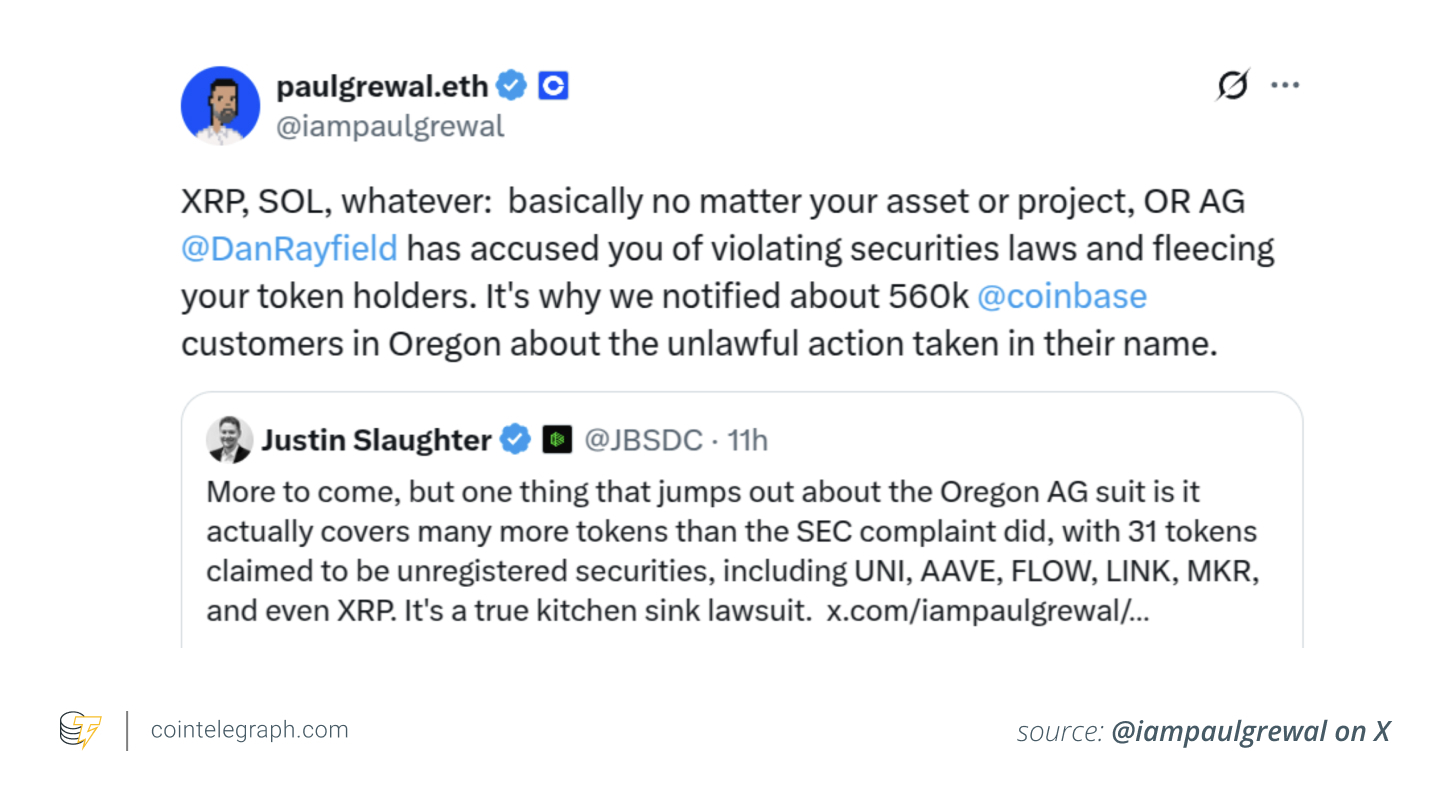
State officials say the case is part of a broader effort to step in where federal enforcement has pulled back. Legal experts note that while the outcome won’t set a national precedent, it could influence how regulators and courts approach similar cases.
The timing is notable — just weeks after the SEC dropped its case against Ripple and days after Coinbase listed XRP futures on its US derivatives exchange.
Did you know? On March 25, 2025, Ripple Labs settled its long-standing legal dispute with the SEC. As part of the agreement, Ripple consented to pay a reduced fine of $50 million — down from the original $125 million — without admitting any wrongdoing.
How risky are crypto futures?
Futures trading offers opportunities, but it comes with significant risks — especially if you’re new to derivatives. Here’s what you should keep in mind:
-
Leverage risk: While leverage can increase your returns, it also amplifies losses. A small price move in the wrong direction can quickly deplete your account.
-
Volatility: XRP is known for its sharp price swings. Futures contracts can exaggerate the impact of volatility on your position.
-
Funding rates: Perpetual futures contracts charge periodic funding fees, which can eat into profits if held long-term.
-
Liquidation: If the market moves against you and your margin falls below the required level, your position may be automatically closed — often at a loss.
-
Complexity: Futures are more complicated than spot trading. Understanding contract terms, funding rates and expiry dates is crucial to managing your trades effectively.
-
Market liquidity: While XRP is a liquid asset, futures trading depends on active participation. Thin order books can lead to slippage and unexpected price movements.
-
Emotional pressure: The fast-paced nature of futures trading can lead to impulsive decisions. Discipline and a clear strategy are essential.
If you’re new to this type of trading, consider starting with a demo account or using nano contracts to reduce your exposure while you learn. Trade smart — your safety’s on you!
This article does not contain investment advice or recommendations. Every investment and trading move involves risk, and readers should conduct their own research when making a decision.